Political controversy over remarks on Netaji Subhas Chandra Bose
Source:thehindu ↗
Why It Matters
Netaji Subhas Chandra Bose and the Azad Hind Fauj are central to India's freedom struggle, making them highly relevant for the History syllabus. Controversies around historical figures often prompt questions on their contributions and associated organizations.
Summary
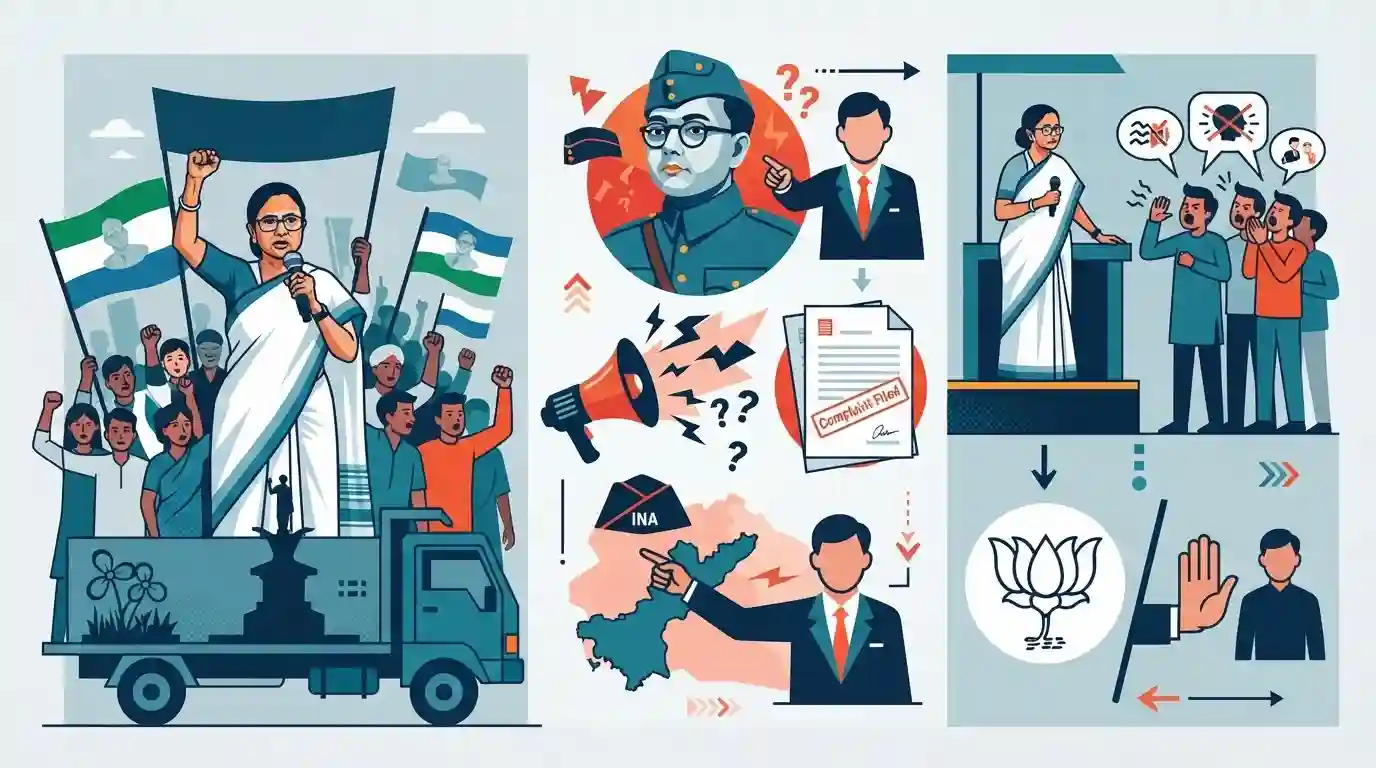
West Bengal Chief Minister Mamata Banerjee held a protest in Kolkata's Shyambazar against BJP Rajya Sabha MP Nagendra Roy, who controversially labeled Netaji Subhas Chandra Bose a "war criminal" and questioned the role of the Azad Hind Fauj. The incident sparked political tensions, with the TMC demanding accountability and a police complaint being filed in Siliguri. During the protest, Banerjee also faced derogatory slogans from some locals, marking the second such disruption of her events recently. The state BJP leadership has distanced itself from the MP's remarks, citing them as personal opinions.
Key Points
- West Bengal CM Mamata Banerjee led a protest in Kolkata after BJP Rajya Sabha MP Nagendra Roy termed Netaji Subhas Chandra Bose a "war criminal".
- Roy also questioned Netaji's leadership and the historical role of the Azad Hind Fauj in the Indian freedom struggle.
- During the protest at Shyambazar, Banerjee faced retaliatory "chor, chor" (thief) slogans from sections of the crowd, echoing a similar incident in Halisahar days earlier.
- A formal police complaint was filed by the organisation 'Netaji Bahini' in Siliguri over the derogatory remarks.
- The West Bengal BJP leadership has distanced itself from Roy's statements, stating they are his personal views.
Important Terms
Azad Hind Fauj (Indian National Army)

An armed force established in 1942 by Mohan Singh and later revived by Subhas Chandra Bose to secure India's independence from the British Raj alongside Axis powers during WWII.
UPSC context
GS-I (Modern Indian History). Crucial for questions on the Indian National Movement, Netaji's leadership, and the INA trials.
Netaji Bahini
A local socio-political organization based in Siliguri, West Bengal, dedicated to upholding the legacy of Netaji Subhas Chandra Bose. It recently filed police complaints regarding derogatory remarks against him.
UPSC context
GS-II (Polity). Relates to civic activism, protection of historical legacies, and the intersection of free speech and defamation.
Trinamool Congress (TMC)
A prominent political party founded by Mamata Banerjee. It is currently the ruling party in West Bengal and acts as a significant opposition force in national politics.
UPSC context
GS-II (Indian Polity). Important for topics on regional political parties, federalism, and state-level electoral dynamics.
Bharatiya Janata Party (BJP)
One of India's major national political parties, currently leading the ruling National Democratic Alliance (NDA) government at the Centre. It generally advocates conservative and nationalist policies.
UPSC context
GS-II (Indian Polity). Relevant for understanding India's party system, electoral democracy, and the role of national versus regional parties.
Prelims Trap
Subhas Chandra Bose was the original founder of the Indian National Army (INA).
The INA was originally conceived and founded by Capt. Mohan Singh in 1942. Bose took over its leadership and revived it in 1943.
Static Concepts Connected
What was the timeline of Subhas Chandra Bose's key activities from 1939 to 1943?
- Forward Bloc (1939): Formed as a left-wing faction within the Congress after Bose resigned from the presidency following the Tripuri crisis.
- Great Escape (1941): Escaped house arrest following his 1940 detention over the Holwell Monument protests in Calcutta.
- Azad Hind Radio (1942): Launched in Berlin to broadcast anti-imperialist propaganda in multiple languages, later shifting to Southeast Asia.
- Provisional Govt (1943): Proclaimed 'Arzi Hukumat-e-Azad Hind' in Singapore, operating as a fully recognized government-in-exile.
What were the key attributes of the Azad Hind Fauj's Provisional Government?
- Institutional setup: Operated as a government-in-exile with its own civil code, currency, and anthem ("Subh Sukh Chain").
- Territorial control: Held nominal authority over the Japanese-occupied Andaman and Nicobar Islands, renaming them 'Shaheed' and 'Swaraj'.
- Women's combat unit: Featured the Rani of Jhansi Regiment, a pioneering all-female combat infantry unit commanded by Capt. Lakshmi Swaminathan.
Cross-Topic Patterns
INA Trials (1945) & Mass Upsurge
The current "war criminal" rhetoric mirrors British framing of INA soldiers, whose 1945 Red Fort trials sparked nationwide strikes, united rival political factions, and fueled the 1946 RIN Mutiny.
MPs' Freedom of Speech limits
Controversial statements by MPs highlight the friction between Article 105 parliamentary privileges (if spoken in Parliament) and standard defamation or hate-speech laws applying to public statements outside the House.

Controversies over INA's legacy make the timeline of Netaji's escape, the Forward Bloc, and INA's Provisional Govt prime for 2026 Prelims.
Linked PYQs · 5
Linked PYQs · 5
- 2017WBCS_PRELIMSGS1
Who was the founder of the 'Azad Hind Fauz'?
- 2018WBCS_PRELIMSGS1
Party founded by Subhash Bose was
- 2019WBCS_PRELIMSGS1
Who set up the Indian Independence League?
- 2020WBCS_PRELIMSGS1
Who founded the Forward Bloc?
- 2017WBCS_PRELIMSGS1
Who was the founder of the 'Forward Bloc'?
