West Bengal Chief Minister Criticizes Election Commission SIR Process
Source:The Hindu ↗
Why It Matters
The article is highly relevant for GS Paper 2 (Polity and Governance) as it touches upon the functional independence and impartiality of the Election Commission of India. It brings to light the administrative complexities and political controversies surrounding electoral roll revisions, voter verification processes, and the fundamental right to vote, which are frequent themes in UPSC Mains and Prelims.
Summary
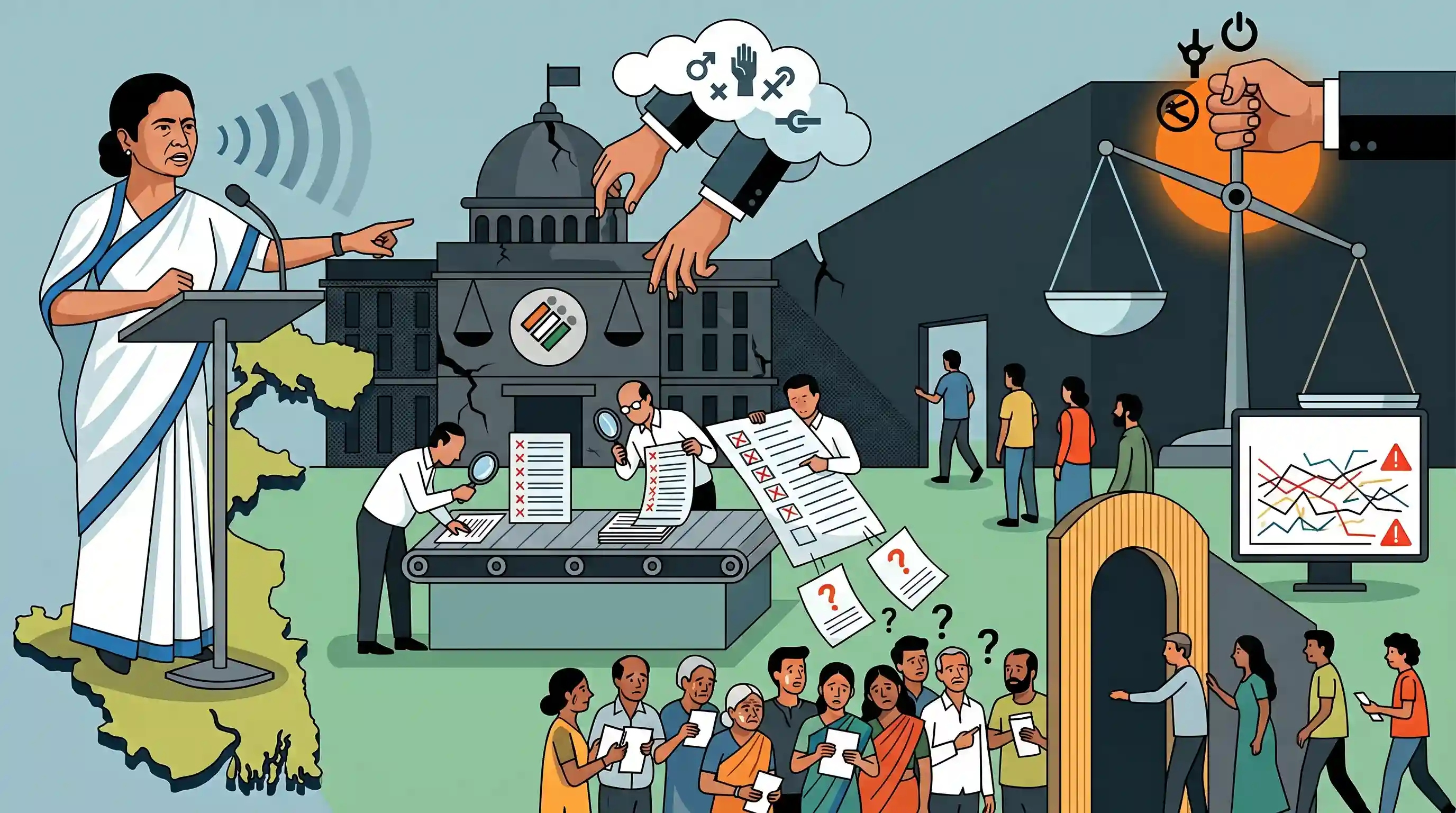
West Bengal Chief Minister Mamata Banerjee has sharply criticized the Election Commission of India (ECI), accusing it of acting as a proxy for the BJP during the ongoing Special Intensive Revision (SIR) of electoral rolls. Speaking on National Voters' Day, she alleged that the poll body is harassing legitimate voters by issuing excessive hearing notices, comparing the scrutiny to a 'backdoor NRC'. Banerjee claimed this process has caused severe distress, particularly among vulnerable populations, and demanded transparency in voter deletions, citing Supreme Court directives regarding 'logical discrepancy' lists. The allegations spotlight ongoing debates regarding the independence of constitutional bodies and the safeguarding of voting rights.
Key Points
- West Bengal Chief Minister Mamata Banerjee accused the Election Commission of India (ECI) of acting in a partisan manner on behalf of the BJP during the Special Intensive Revision (SIR) of electoral rolls.
- Banerjee alleged that voters, including the elderly and physically challenged, are being subjected to excessive harassment through hearing notices to prove their credentials, comparing the process to a backdoor National Register of Citizens (NRC).
- She highlighted that the Supreme Court had previously directed the ECI to display the names of those placed on 'logical discrepancies' lists, emphasizing the need for transparency in voter deletions.
- The remarks, made on National Voters' Day, underscore rising political friction over electoral mechanisms, potential voter disenfranchisement, and the perceived erosion of the Election Commission's independence.
Important Terms
Election Commission of India (ECI)

A permanent constitutional body under Article 324 responsible for administering Union and State election processes to ensure free and fair democratic participation in India.
UPSC context
GS II (Constitutional Bodies); critical for understanding institutional independence and electoral integrity in a parliamentary democracy.
Special Intensive Revision (SIR)
A comprehensive, time-bound house-to-house verification drive by the ECI to update voter lists by removing duplicates and ineligible entries while adding new eligible voters.
UPSC context
GS II (Elections); tests knowledge of the administrative procedures used to maintain electoral rolls and prevent disenfranchisement.
Logical Discrepancy List
A category used during electoral roll revision to flag voters with data mismatches (e.g., age-gap inconsistencies or parental name errors) for further verification or deletion.
UPSC context
GS II (Governance/Elections); relevant for discussing procedural transparency and judicial scrutiny of administrative actions by the ECI.
National Register of Citizens (NRC)
A database of all legal Indian citizens mandated by the 2003 amendment of the Citizenship Act, 1955, primarily used to identify and deport illegal immigrants.
UPSC context
GS II (Citizenship/Polity); key for understanding legal citizenship, federalism, and the socio-political challenges of migration in border states.
Representation of the People Act, 1950
A foundational legislation that provides the legal framework for the allocation of seats, delimitation of constituencies, and the preparation/revision of electoral rolls.
UPSC context
GS II (Statutory Bodies/Elections); essential for understanding the administrative and legal basis of the Indian electoral system.
National Voters' Day
Celebrated annually on January 25 since 2011 to mark the ECI's foundation day (1950) and promote electoral awareness and registration among citizens.
UPSC context
Prelims/GS II; emphasizes institutional efforts toward inclusive participation and the promotion of democratic rights.
Prelims Trap
"The preparation and revision of electoral rolls are governed by the Representation of the People Act, 1951."
Electoral roll preparation, including the Special Intensive Revision (SIR), is strictly governed by the RPA 1950. The RPA 1951 deals with the actual conduct of elections and candidate qualifications.
Static Concepts Connected
How are the Chief Election Commissioner and other ECs appointed under the 2023 Act?
- Selection Committee: Appointed by the President on the recommendation of a committee comprising the PM, a Union Cabinet Minister, and the Leader of Opposition (or largest opposition party) in Lok Sabha.
- Search Committee: Headed by the Law Minister, it prepares a panel of five persons for the Selection Committee's consideration.
- Removal process: The CEC is removed in the same manner as a Supreme Court judge. Other ECs can only be removed on the recommendation of the CEC.
What is the legal difference between RPA 1950 and RPA 1951?
- RPA 1950: Deals with the allocation of seats, delimitation of constituencies, qualifications of voters, and preparation of electoral rolls.
- RPA 1951: Governs the actual conduct of elections, qualifications/disqualifications for MPs and MLAs, corrupt practices, and electoral offenses.
Cross-Topic Patterns
Voter rolls vs. Citizenship verification
Political framing often blurs electoral roll sanitization (RPA 1950) with citizenship verification (Citizenship Act 1955), making procedural voter deletions a proxy battleground for broader citizenship debates.
ECI autonomy and the Basic Structure
Debates over the new CEC Appointment Act 2023 tie directly into constitutional law, questioning if executive dominance in poll body appointments violates 'free and fair elections', a basic structure feature.

Expect a multi-statement prelims question testing RPA 1950 vs 1951 distinctions alongside ECI's powers for special electoral revisions.
Linked PYQs · 5
Linked PYQs · 5
- 2022MainsGS2
Discuss the role of the Election Commission of India in the light of the evolution of the Model Code of Conduct.
- 2017MainsGS2
To enhance the quality of democracy in India the Election Commission of India has proposed electoral reforms in 2016. What are the suggested reforms and how far are they significant to make democracy successful?
- 2017PrelimsGS1
For election to the Lok Sabha, a nomination paper can be filed by
- 2017PrelimsGS1
Right to vote and to be elected in India is a
- 2022MainsGS2
Discuss the procedures to decide the disputes arising out of the election of a Member of the Parliament or State Legislature under The Representation of the People Act, 1951. What are the grounds on which the election of any returned candidate may be declared void ? What remedy is available to the aggrieved party against the decision ? Refer to the case laws.
