Supreme Court Review of Election Commission Symbol Freeze Powers
Source:Indian Express ↗
কেন এটি গুরুত্বপূর্ণ
This case directly relates to the powers of the Election Commission of India in resolving political party disputes and symbol freezes, serving as a vital topic for understanding constitutional bodies, federal politics, and judicial oversight in India's democracy.
সারসংক্ষেপ
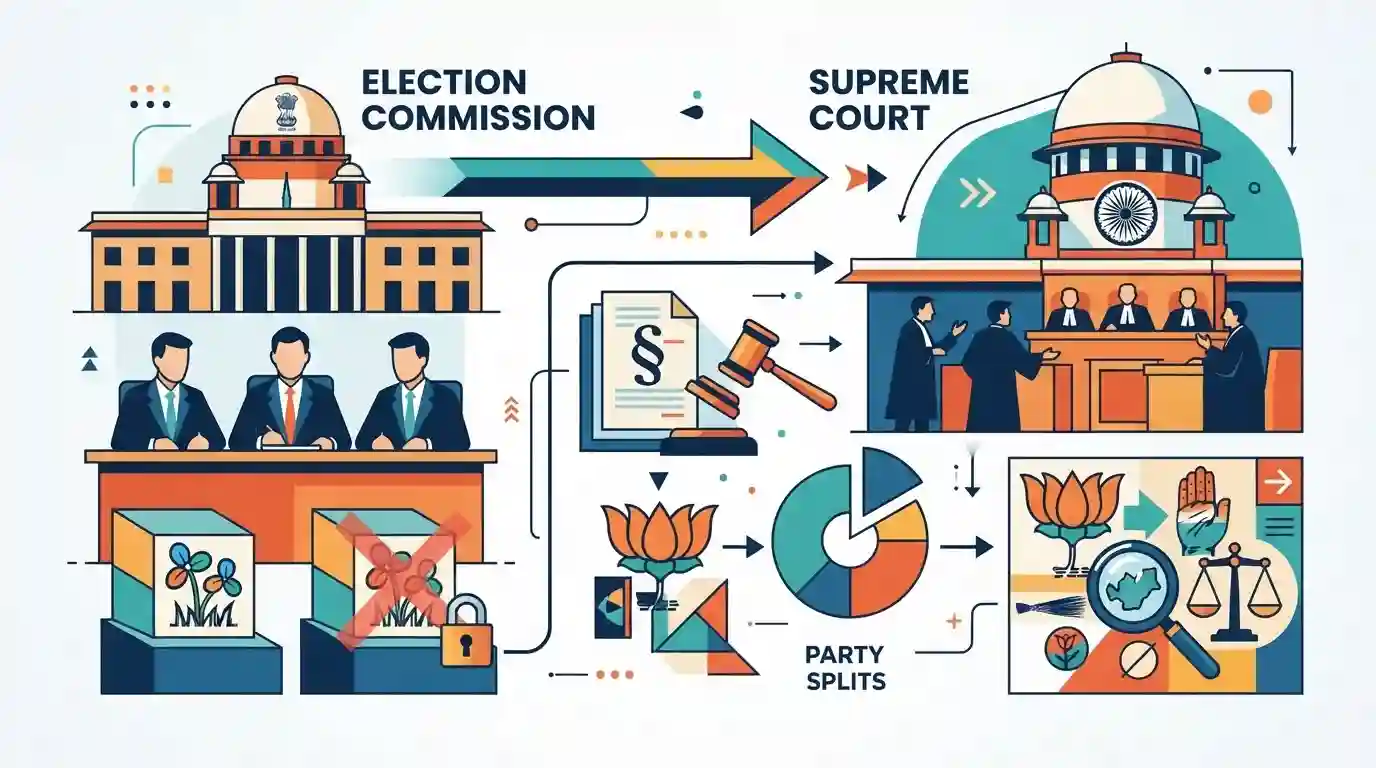
Trinamool Congress (TMC) chief Mamata Banerjee has approached the Supreme Court to challenge the Election Commission's decision to freeze the party's name and symbol. The dispute underscores the complex statutory framework governing political party splits, symbol allocation, and the parameters of judicial review over the Election Commission's quasi-judicial decisions.
মূল বিষয়
- Mamata Banerjee and the Trinamool Congress (TMC) challenged the Election Commission's decision to freeze the party's name and symbol in the Supreme Court.
- The legal dispute brings to the forefront the constitutional and statutory powers of the Election Commission under the Election Symbols (Reservation and Allotment) Order, 1968, regarding party splits and symbol allocation.
- The case highlights issues surrounding political party governance, internal democracy, and the judicial review of quasi-judicial decisions made by constitutional bodies like the ECI.
গুরুত্বপূর্ণ শব্দ
Election Symbols (Reservation and Allotment) Order, 1968

A statutory order promulgated by the ECI under Article 324 and the Conduct of Elections Rules, governing the reservation, choice, and allotment of election symbols and adjudication of intra-party disputes.
UPSC context
GS Paper II (Constitutional Bodies & Polity). Tests understanding of ECI's powers, statutory framework for symbol disputes, and party splits.
Election Commission of India (ECI)
An autonomous constitutional authority responsible for administering election processes in India under Article 324, including recognizing political parties and allocating election symbols.
UPSC context
GS Paper II (Constitutional Bodies). Core topic regarding the independence, powers, functions, and quasi-judicial roles of constitutional bodies.
Supreme Court
The apex judicial body of India with the power of judicial review under Articles 32 and 136, empowered to examine administrative and quasi-judicial decisions made by authorities like the ECI.
UPSC context
GS Paper II (Judiciary). Tests the scope of judicial review over quasi-judicial decisions of constitutional authorities and federal disputes.
Trinamool Congress (TMC)
A recognized national political party in India, whose leadership and organizational structure are subject to ECI regulations and dispute resolution mechanisms during splits.
UPSC context
GS Paper II (Polity). Relevant for understanding party politics, regional parties, recognition criteria, and intra-party democracy issues.
সংযুক্ত স্থির ধারণা
What are the constitutional and statutory provisions governing the Election Commission of India and symbol allocation?
- Constitutional Basis: Derived from Article 324 of the Constitution, vesting superintendence, direction, and control of elections in the ECI.
- Symbols Order 1968: Promulgated under Article 322/324 read with Conduct of Election Rules, empowering ECI to recognize parties and allot symbols.
- Quasi-Judicial Role: ECI acts as a quasi-judicial body while deciding rival factions' claims, subject to judicial review under Article 132/136/226.
আন্তঃবিষয় প্যাটার্ন
ECI Symbol Disputes & Judicial Review
The ECI's quasi-judicial role in symbol disputes connects constitutional body powers with administrative law principles of natural justice and judicial review.

ECI symbol disputes under the 1968 Order + Article 32 judicial review bounds will likely be tested in a statement-based prelims question.
সংযুক্ত PYQ · 2
সংযুক্ত PYQ · 2
- 2017PrelimsGS1
Consider the following statements: 1. The Election Commission of India is a five-member body. 2. Union Ministry of Home Affairs decides the election schedule for the conduct of both general elections and bye-elections. 3. Election Commission resolves the disputes relating to splits/mergers of recognised political parties. Which of the statements given above is/are correct?
- 2022MainsGS2
Discuss the role of the Election Commission of India in the light of the evolution of the Model Code of Conduct.
