Voter roll deletions in West Bengal after revision
Source:The Hindu ↗
Why It Matters
The controversy highlights critical issues surrounding the institutional neutrality of the Election Commission of India (ECI) and the integrity of the electoral process. Allegations of mass voter deletion and the subsequent judicial adjudication of 60 lakh electors underscore the challenges in maintaining accurate electoral rolls. For UPSC aspirants, this illustrates the practical friction points in electoral governance, the application of the Representation of the People Act, and the crucial role of the judiciary in safeguarding the constitutional right to vote (Article 326).
Summary
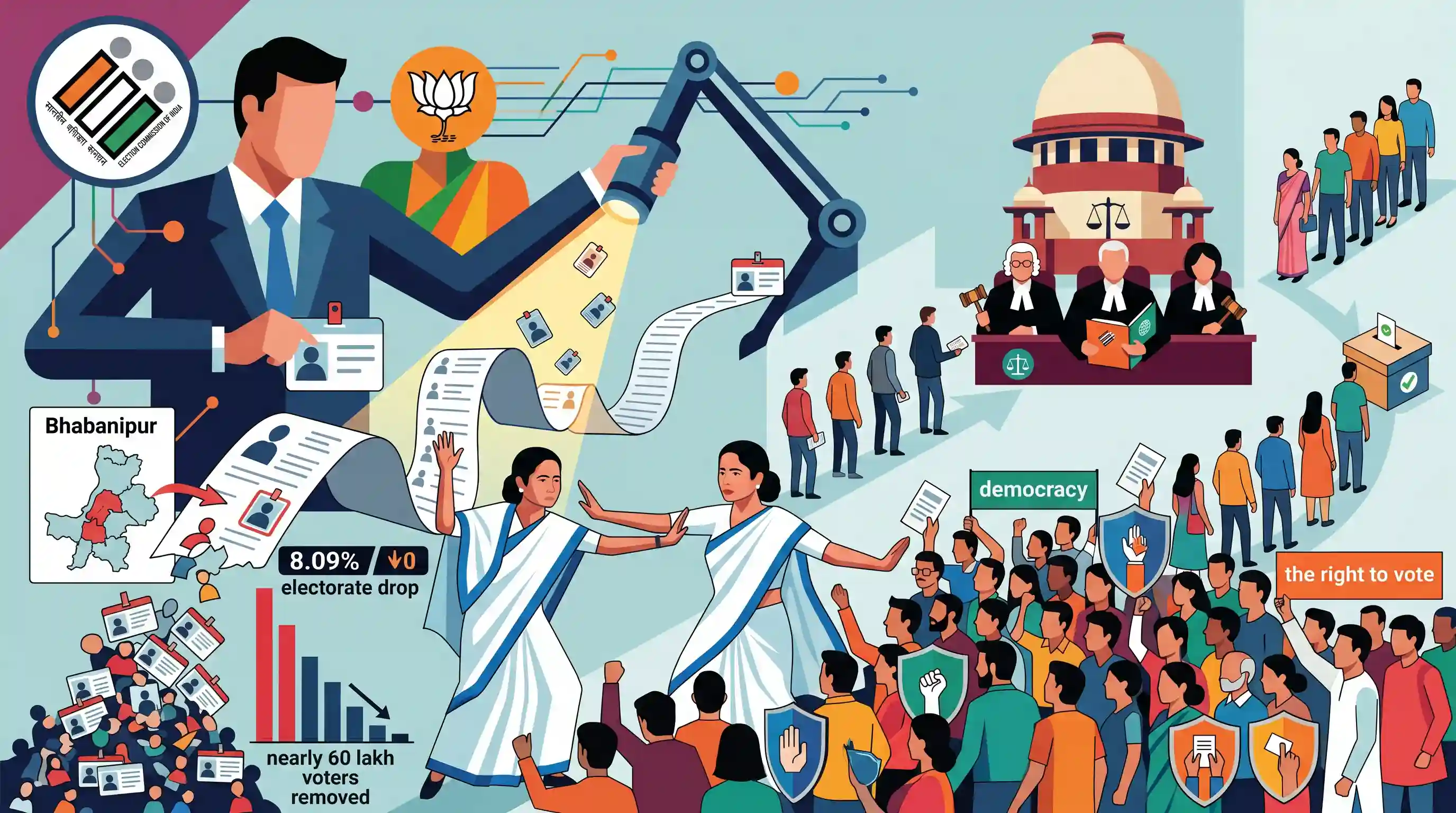
West Bengal Chief Minister Mamata Banerjee has raised serious allegations against the Election Commission of India (ECI), accusing it of acting in a nexus with the BJP to systematically delete genuine voters from the state's electoral rolls. Following the ECI's Special Intensive Revision (SIR), West Bengal's total electorate dropped by 8.09%, which includes nearly 60 lakh voters currently facing adjudication by judicial officials under a Supreme Court directive. Banerjee, pointing to targeted deletions in her own constituency of Bhabanipur, announced a protest against the ECI's actions, which she claims threaten the voting rights of over a crore citizens and compromise the fairness of the upcoming Assembly elections.
Key Points
- West Bengal Chief Minister Mamata Banerjee accused the Election Commission of India (ECI) of colluding with the BJP to deliberately delete valid voters, particularly in TMC strongholds like her constituency of Bhabanipur.
- The draft electoral roll published by the EC shows an 8.09% drop in West Bengal's electorate following the Special Intensive Revision (SIR).
- The revised list includes approximately 60 lakh electors whose status is currently under adjudication by judicial officials, appointed as per a recent Supreme Court order.
- Banerjee announced plans to hold a protest (dharna) against the mass deletion of voters, warning that about 1.2 crore people in the state risk losing their voting franchise.
Important Terms
Election Commission of India (ECI)

An autonomous constitutional body established under Article 324, responsible for the superintendence, direction, and control of elections to Parliament, State Legislatures, and the offices of President and Vice-President.
UPSC context
GS Paper II: Constitutional Bodies. Crucial for understanding institutional independence and the conduct of free and fair elections.
Representation of the People Act (RPA)
The twin legislations (1950 and 1951) that govern India's electoral system; the 1950 Act handles electoral rolls and seat allocation, while the 1951 Act governs the actual conduct of elections.
UPSC context
GS Paper II: Statutory Bodies and Electoral Reforms. Key to questions on voter eligibility, disqualification, and election management.
Special Intensive Revision (SIR)
A comprehensive, door-to-door verification and updating of electoral rolls by the ECI, distinct from regular summary revisions, aimed at ensuring the 'purity' of voter lists by removing ineligible entries.
UPSC context
GS Paper II: Governance/Elections. A specific administrative process used to address large-scale voter discrepancies and migration-related roll errors.
Right to Vote
In India, a right derived from Article 326 (Universal Adult Suffrage) and operationalized via the RPA, generally interpreted by the Supreme Court as a constitutional or statutory right rather than a fundamental one.
UPSC context
GS Paper II: Constitutional Law. Frequently tested regarding its legal status (Statutory vs. Constitutional) and its link to democratic principles.
Supreme Court
The highest judicial authority in India with the power of judicial review to ensure that electoral processes and legislative actions regarding elections remain consistent with the Constitution's basic structure.
UPSC context
GS Paper II: Judiciary. Relevant for its role in adjudicating election disputes and protecting the constitutional validity of the electoral process.
Electoral Roll
A comprehensive list of all eligible citizens in a particular constituency who are entitled to vote, prepared and updated under the superintendence of the Election Commission.
UPSC context
GS Paper II: Electoral Process. Fundamental to the inclusion and representation aspects of Indian democracy.
Prelims Trap
"Courts are completely barred from reviewing electoral rolls under Article 329 of the Constitution."
Article 329 only bars interference once the election notification is issued. Pre-election tasks like electoral roll preparation are subject to judicial review.
Static Concepts Connected
What does the Representation of the People Act, 1950 primarily govern?
- Seat Allocation: Provides the framework for allocating seats in the Lok Sabha and State Legislative Assemblies.
- Electoral Rolls: Lays down procedures for the preparation, periodic revision, and correction of electoral rolls.
- Voter Qualifications: Defines the eligibility criteria for registering as a voter in a constituency.
What is the exact legal status of the Right to Vote in India?
- Constitutional Basis: The Supreme Court and UPSC recognize it as a Constitutional Right guaranteed under Article 326 (Universal Adult Suffrage).
- Statutory Framework: While the right stems from the Constitution, the actual mechanism and conditions are governed by statutory law (RPA 1950/1951).
Cross-Topic Patterns
ECI autonomy and 2023 Appointment Act
Allegations of ECI bias gain traction following the 2023 CEC Appointment Act, which removed the Chief Justice from the selection panel, sparking continuous debate on institutional neutrality.
Border states and citizenship debates
Voter list revisions in West Bengal heavily overlap with CAA-NRC anxieties, where electoral rolls are politicized and often incorrectly viewed as proxy citizenship registers.

Expect a 2026 prelims statement testing the exact boundary between ECI's Article 324 powers and Article 329's bar on judicial review.
Linked PYQs · 4
Linked PYQs · 4
- 2022MainsGS2
Discuss the role of the Election Commission of India in the light of the evolution of the Model Code of Conduct.
- 2018MainsGS2
In the light of recent controversy regarding the use of Electronic Voting Machines (EVM), what are the challenges before the Election Commission of India to ensure the trustworthiness of elections in India?
- 2017PrelimsGS1
Consider the following statements: 1. The Election Commission of India is a five-member body. 2. Union Ministry of Home Affairs decides the election schedule for the conduct of both general elections and bye-elections. 3. Election Commission resolves the disputes relating to splits/mergers of recognised political parties. Which of the statements given above is/are correct?
- 2017PrelimsGS1
Right to vote and to be elected in India is a
