Climate Change Impacts on Plantation Agriculture in Western Ghats
Source:The Hindu ↗
Why It Matters
The article bridges Geography (Western Ghats ecology), Disaster Management (landslides), and Economy (plantation crops, farming crises). It provides a regional case study of how climate change tangibly impacts commercial agriculture, making it highly relevant for GS-1 (Geography) and GS-3 (Agriculture & Environment) answers.
Summary
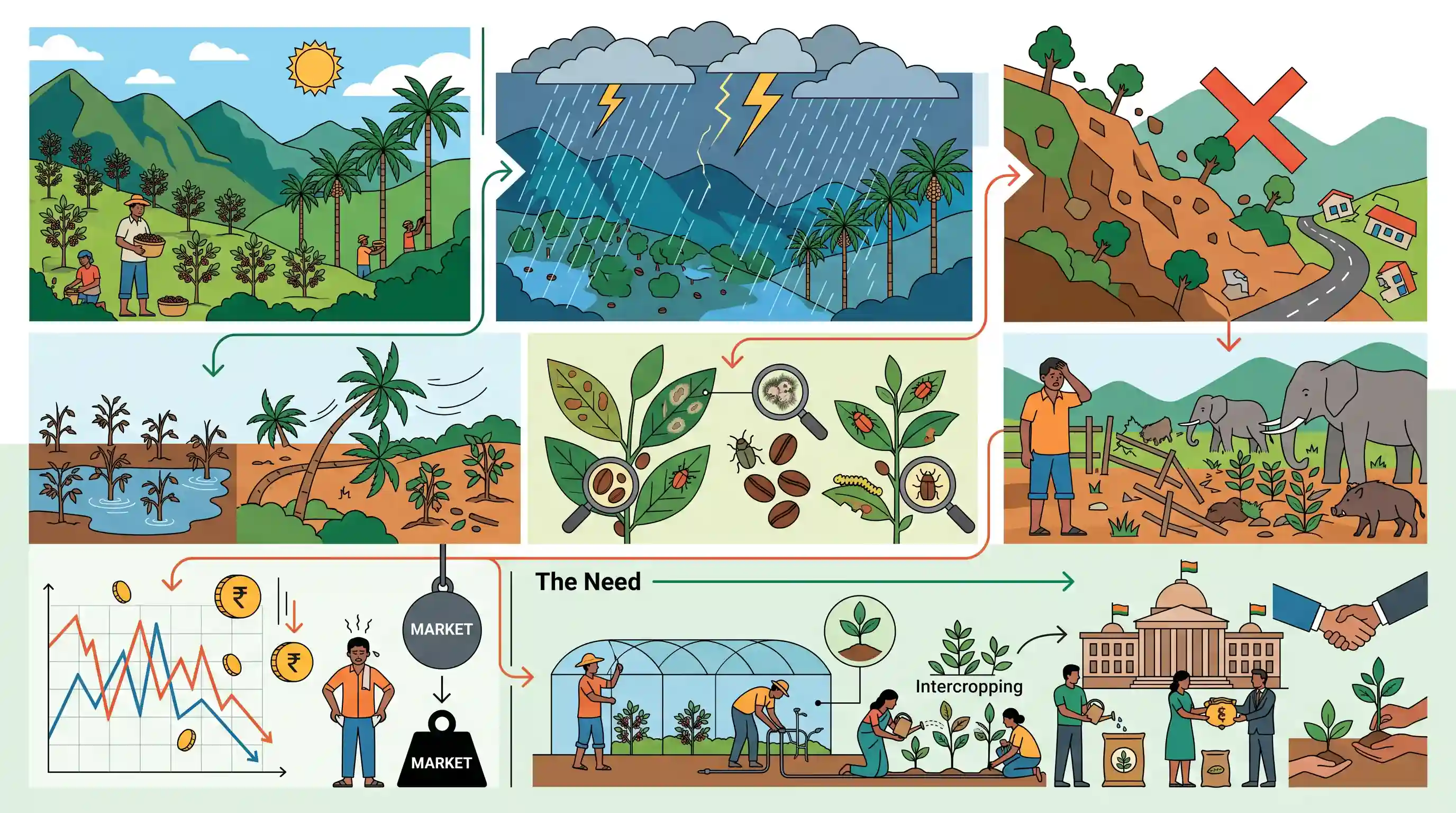
The Malnad region in Karnataka, situated within the ecologically fragile Western Ghats, is experiencing a severe agrarian crisis affecting farmers and plantation growers. Traditionally reliant on cash crops like coffee, arecanut, and spices, the region's agricultural economy is buckling under the weight of erratic weather patterns. Unseasonal heavy rains and storms have led to destructive landslides and significant crop losses. These climate anomalies have also driven up the incidence of fungal diseases and pest attacks. Coupled with increasing human-wildlife conflict and volatile commodity prices, the situation underscores the pressing need for climate-resilient farming techniques and stronger institutional support for plantation agriculture.
Key Points
- The Malnad region of Karnataka is a crucial hub for plantation crops such as coffee, arecanut, cardamom, and pepper, which form the backbone of the local economy.
- Erratic weather patterns, including unseasonal storms and heavy rains, have triggered landslides and caused massive crop destruction, threatening the livelihoods of farmers.
- Climate shifts have also exacerbated the spread of crop diseases, such as 'Kole Roga' (fruit rot) in arecanut and stem borer attacks in coffee.
- Beyond climate risks, growers face compounding challenges from escalating human-wildlife conflicts (such as elephant incursions) and unpredictable market fluctuations.
Important Terms
Malnad Region

A hilly, high-rainfall geographical region in Karnataka representing the western slopes of the Western Ghats, critical for India's plantation economy including coffee and spices.
UPSC context
GS Paper I: Indian Geography; tests knowledge of regional physiographic divisions and their distinct agricultural significance.
Coffee Board of India
A statutory organization under the Ministry of Commerce and Industry (Coffee Act, 1942) responsible for the research, development, and global promotion of the Indian coffee industry.
UPSC context
GS Paper III: Agricultural Institutions; tests understanding of statutory bodies managing key commercial plantation sectors.
Arecanut
A major commercial plantation crop (betel nut) primarily grown in Karnataka, vulnerable to climate-induced fungal diseases like Leaf Spot and volatile international market prices.
UPSC context
GS Paper III: Major crops and cropping patterns; focuses on regional cash crops and agrarian challenges.
Climate-Resilient Agriculture
Farming practices designed to withstand climate shocks and variability through biotechnology, water conservation, and adaptive crop varieties while ensuring long-term food security.
UPSC context
GS Paper III: Environment and Agriculture; critical for questions on climate adaptation and sustainable food systems.
Human-Wildlife Conflict
Negative interactions between humans and wildlife resulting in loss of life or property, often exacerbated by habitat fragmentation and changing weather patterns in forest-fringe areas.
UPSC context
GS Paper III: Biodiversity and Environment; tests mitigation strategies and the socio-economic impact of man-animal friction.
Ecologically Sensitive Area (ESA)
A global biodiversity hotspot under the Environment (Protection) Act, 1986, where developmental activities are restricted based on Gadgil and Kasturirangan committee recommendations to prevent ecological degradation.
UPSC context
GS Paper III: Environmental Conservation; vital for topics on protecting fragile ecosystems from unplanned development.
Prelims Trap
"The Coffee Board of India is a statutory organization operating under the Ministry of Agriculture."
Major commodity boards (Coffee, Tea, Rubber, Spices, Tobacco) function under the Ministry of Commerce and Industry, not the Ministry of Agriculture.
Static Concepts Connected
How do landslides in the Western Ghats differ from those in the Himalayas?
- Himalayan (Tectonic): Himalayan landslides are heavily driven by tectonic instability, young fold mountain geology, and seismic activity causing rockfalls and debris avalanches.
- Western Ghats (Rain-induced): Western Ghats landslides are largely triggered by intense, unseasonal rainfall saturating highly weathered lateritic soils on steep slopes.
- Anthropogenic Factors: Deforestation, unscientific plantation agriculture, and mining in the Western Ghats severely exacerbate slope instability compared to natural geological factors in the Himalayas.
Which major plantation crops have statutory boards in India?
- Coffee Board: A statutory body established under the Coffee Act of 1942, headquartered in Bengaluru, Karnataka.
- Tea Board: A statutory body under the Tea Act of 1953, headquartered in Kolkata, West Bengal.
- Rubber Board: A statutory body under the Rubber Act of 1947, headquartered in Kottayam, Kerala.
- Nodal Ministry: Unlike regular agricultural bodies, all these commodity boards fall under the Ministry of Commerce and Industry.
Cross-Topic Patterns
Western Ghats ecology vs. plantations
The Malnad agrarian crisis highlights the persistent tension between commercial plantation agriculture and the Kasturirangan Committee's recommendations to declare parts of the Western Ghats as Eco-Sensitive Areas (ESAs).
Climate anomalies and disease vectors
Erratic rainfall and humidity directly correlate with agricultural pests. Just as locust swarms link to Indian Ocean Dipole anomalies, 'Kole Roga' (fruit rot) outbreaks link to abnormal monsoon distribution.

Expect a multi-statement prelims question contrasting Western Ghats vs Himalayan landslides alongside commodity board ministry mappings.
Linked PYQs · 5
Linked PYQs · 5
- 2021MainsGS1
Differentiate the causes of landslides in the Himalayan region and Western Ghats.
- 2013MainsGS1
Bring out the causes for more frequent occurrence of landslides in the Himalayas than in the Western Ghats.
- 2023MainsGS3
Explain the changes in cropping pattern in India in the context of changes in consumption pattern and marketing conditions.
- 2021MainsGS3
What are the present challenges before crop diversification? How do emerging technologies provide an opportunity for crop diversification?
- 2022PrelimsGS1
With reference to the "Tea Board" in India, consider the following statements : 1. The Tea Board is a statutory body. 2. It is a regulatory body attached to the Ministry of Agriculture and Farmers Welfare. 3. The Tea Board's Head Office is situated in Bengaluru. 4. The Board has overseas offices at Dubai and Moscow. Which of the statements given above are correct?
