Systemic judicial reforms for accessible justice in India
Source:The Hindu ↗
Why It Matters
The article provides multidimensional arguments for Mains GS-2 answers regarding judicial reforms (diversity and the collegium system), the practical challenges in ensuring qualitative free legal aid under Article 39A, and the necessary shift towards rights-based institutional accommodations for Persons with Disabilities (PwD) in public infrastructure.
Summary
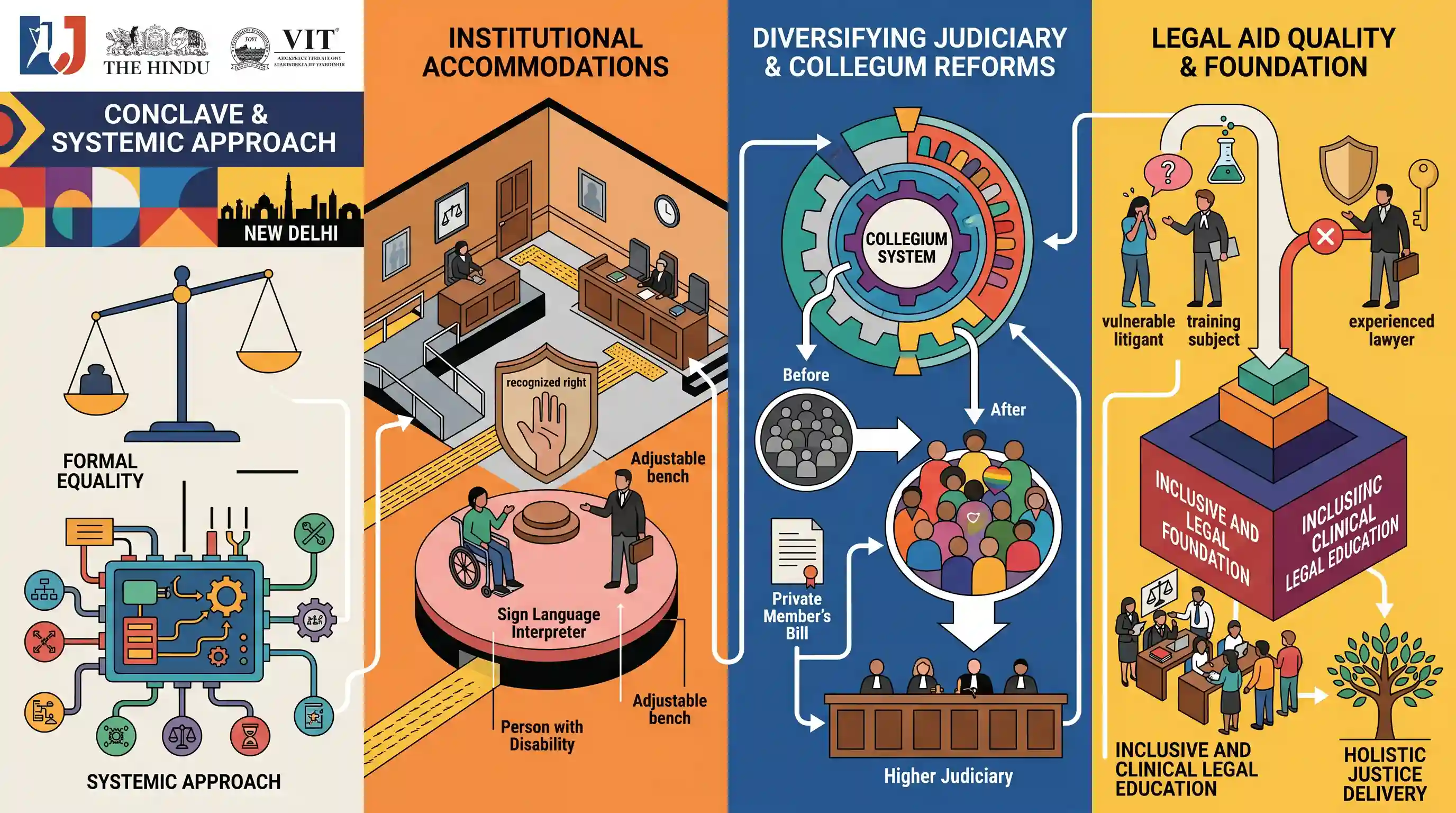
At 'The Hindu Justice Unplugged 2026' conclave, legal experts emphasized that making justice accessible requires a systemic approach that goes beyond formal equality. The panel highlighted the need for institutional accommodations—such as sign language interpreters as a recognized right—for persons with disabilities in courts. Discussions also focused on the urgency of structural reforms in the collegium system to diversify the higher judiciary across caste, gender, and sexual orientation. Furthermore, experts raised concerns about the uneven quality of statutory legal aid, warning against treating vulnerable litigants as training subjects for inexperienced lawyers. The role of inclusive and clinical legal education was underscored as the foundational step toward holistic justice delivery.
Key Points
- Institutional accommodation, rather than individual sympathy, is essential to ensure persons with disabilities can equally access and participate in the judicial system.
- Addressing historical exclusion in the higher judiciary requires structural reforms in the collegium system to ensure representation across gender, caste, disability, and queer identities.
- Despite robust statutory frameworks for legal aid, the quality of representation remains a concern; vulnerable litigants should not be subjected to inexperienced counsel.
- Systemic access to justice begins with accessible legal education, where clinical legal education can connect students directly with community justice issues.
Important Terms
Collegium System

A system for judge appointments and transfers in High Courts and the Supreme Court, evolved through judicial precedents (Three Judges Cases) rather than constitutional text or legislation.
UPSC context
GS Paper II: Appointments to Constitutional posts and judicial independence; critical for debates on transparency and social diversity in judiciary.
Statutory Legal Aid
Free legal services provided to marginalized citizens under the Legal Services Authorities Act, 1987, to ensure justice is not denied due to economic or other disabilities.
UPSC context
GS Paper II: Welfare schemes for vulnerable sections; linked to Article 39A (Directive Principles of State Policy).
Substantive Equality
A constitutional principle (rooted in 'equal protection of laws') that seeks equitable outcomes by treating different groups differently to address historical or systemic disadvantages.
UPSC context
GS Paper II: Fundamental Rights (Article 14); distinguishes between formal equal treatment and achieving actual parity in social justice.
Reasonable Accommodation
Necessary adjustments, such as sign language interpreters, provided to persons with disabilities to ensure they enjoy rights and access services on an equal basis with others.
UPSC context
GS Paper II: Protection of vulnerable sections; specifically PwD rights under the RPwD Act, 2016 and judicial accessibility.
Clinical Legal Education
A practical method of legal training where students work on real cases or simulations, often through legal aid clinics, to bridge the gap between theory and practice.
UPSC context
GS Paper II: Management of Social Sector/Services relating to Education and its role in enhancing legal literacy and access to justice.
Supreme Court
The highest judicial forum and final court of appeal under the Constitution of India, possessing original, appellate, and advisory jurisdictions.
UPSC context
GS Paper II: Structure, organization, and functioning of the Judiciary; central to constitutional interpretation and judicial activism.
Prelims Trap
Reasonable accommodation for Persons with Disabilities in courts is a discretionary welfare measure.
The Supreme Court ruled that 'reasonable accommodation' is a substantive equality mandate and a legally enforceable right under the RPwD Act, not a concession.
Static Concepts Connected
What is the difference between Formal and Substantive Equality?
- Formal Equality: Treats all individuals identically under the law, strictly prohibiting discrimination but ignoring entrenched historical and socio-economic disadvantages.
- Substantive Equality: Requires proactive state interventions, affirmative action, and reasonable accommodations to dismantle structural barriers and achieve true parity in outcomes.
What is the constitutional and statutory framework for Free Legal Aid?
- Article 39A: Inserted by the 42nd Amendment (1976), it directs the State to provide free legal aid to ensure justice is not denied due to economic or other disabilities.
- LSA Act 1987: Established NALSA and State authorities to provide free legal services to eligible groups, including women, children, SC/ST, and PwDs, regardless of their income limits.
Cross-Topic Patterns
Collegium opacity vs. Social diversity
Judicial reform debates are expanding beyond the 'independence vs. executive' (NJAC) binary to highlight the collegium system's failure to ensure representation of marginalized castes, women, and queer identities.
RPwD Act & Judicial Infrastructure
The statutory mandate for reasonable accommodation under the RPwD Act directly intersects with the ongoing e-Courts phase III project and severe infrastructural deficits in the subordinate judiciary.

Expect a 2026 Mains GS2 question linking Article 39A, the uneven quality of statutory legal aid, and substantive equality in judicial access.
Linked PYQs · 4
Linked PYQs · 4
- 2021MainsGS2
Discuss the desirability of greater representation to women in the higher judiciary to ensure diversity, equity and inclusiveness.
- 2025MainsGS2
Discuss the evolution of collegium system in India. Critically examine the advantages and disadvantages of the system of appointment of the Judges of the Supreme Court of India and that of the USA.
- 2023MainsGS2
Who are entitled to receive free legal aid? Assess the role of the National Legal Services Authority (NALSA) in rendering free legal aid in India.
- 2017MainsGS2
Does the Rights of Persons with Disabilities Act, 2016 ensure effective mechanism for empowerment and inclusion of the intended beneficiaries in the society? Discuss.
