Climate Proofing Indian Agriculture and Food Systems Resilience
Source:The Hindu ↗
ఇది ఎందుకు ముఖ్యం
Climate change poses a severe threat to food security and agricultural livelihoods in India. Understanding the interventions required to climate-proof agriculture is critical for answering questions on sustainable development, cropping patterns, and environmental conservation in both Prelims and Mains.
సారాంశం
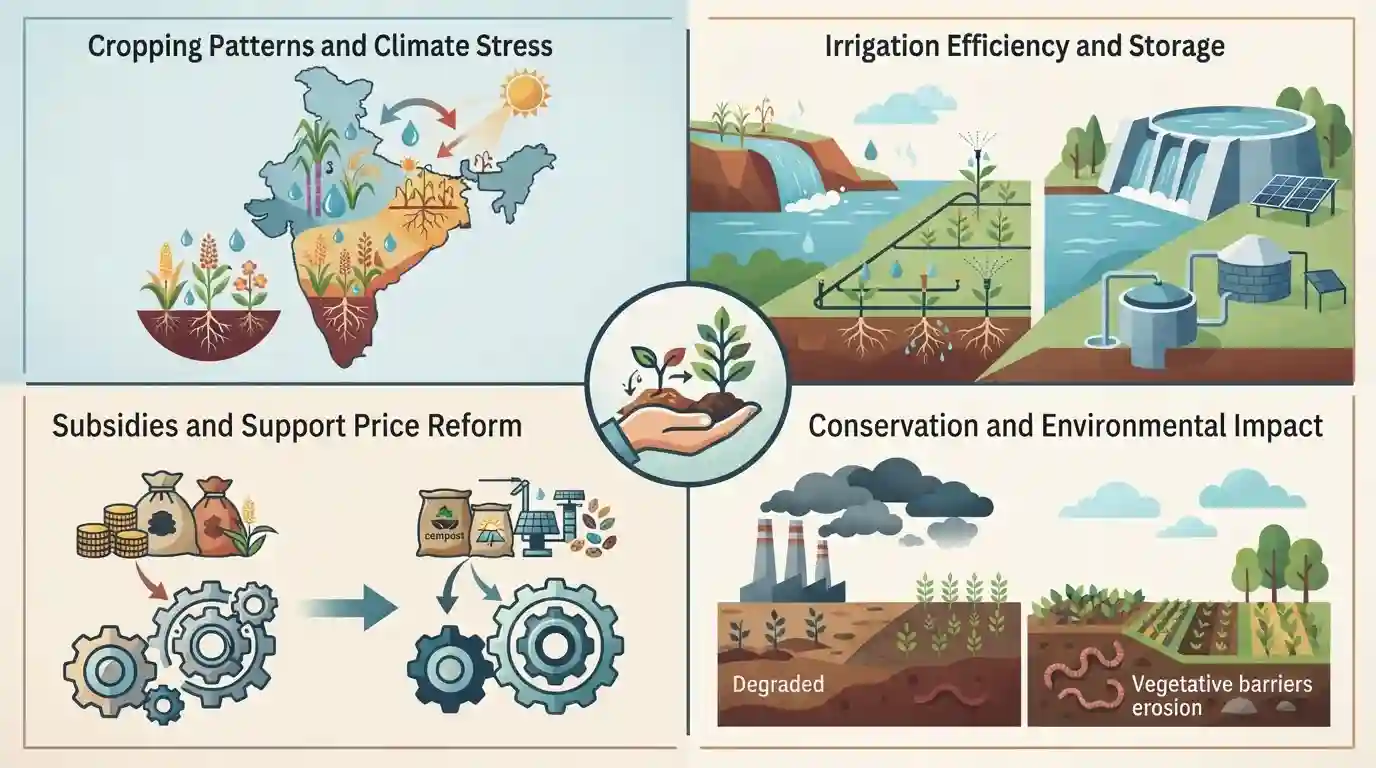
The article underscores the urgent necessity to climate-proof India's food systems against the growing threats of global warming and erratic weather patterns. It argues that the over-reliance on water-guzzling crops and outdated agricultural practices compromises long-term food security and environmental sustainability. By advocating for a shift towards climate-smart agriculture—such as adopting millets, improving irrigation efficiency, and restructuring subsidies to promote crop diversification—the piece highlights that immediate policy and technological interventions are required to build a resilient and sustainable agricultural framework in India.
ముఖ్య అంశాలు
- Indian agriculture remains highly vulnerable to climate change impacts, such as erratic monsoons, extreme temperatures, and unseasonal rainfall.
- There is an urgent need to transition from water-intensive crops like paddy and sugarcane towards climate-resilient staples such as millets and pulses.
- Current agricultural policies and subsidies must be re-aligned to incentivize sustainable farming practices and crop diversification rather than resource depletion.
- Integrating modern technologies, such as micro-irrigation, climate-smart agriculture techniques, and better early-warning systems, is crucial for securing India's food systems.
ముఖ్యమైన పదాలు
Minimum Support Price (MSP)

A guaranteed floor price set by the government for select crops to protect farmers against sharp market price falls and incentivize production. It is recommended by the Commission for Agricultural Costs and Prices (CACP).
UPSC context
GS Paper 3 (Agriculture). Tests understanding of procurement policies, PDS efficiency, market interventions, and WTO subsidy issues.
Climate-Smart Agriculture (CSA)
An integrated farming approach that sustainably increases agricultural productivity and incomes, adapts and builds resilience to climate change, and reduces or removes agricultural greenhouse gas emissions.
UPSC context
GS Paper 3 (Agriculture/Environment). Essential for analyzing sustainable agriculture, climate adaptation strategies, and long-term food security.
Crop Diversification
The transition from growing predominantly water-intensive monocultures, like rice and wheat, to cultivating a broader variety of crops such as pulses, oilseeds, and millets to improve soil health and resilience.
UPSC context
GS Paper 3 (Cropping Patterns). Tests knowledge of sustainable farming, groundwater conservation, and policies to shift agricultural dependency.
Millets (Nutri-cereals)
A diverse group of small-seeded, highly nutritious, drought-resistant crops (e.g., jowar, bajra, ragi). They require fewer inputs and less water, making them highly suitable for climate-resilient agriculture.
UPSC context
GS Paper 3 (Agriculture). Critical for discussions on nutritional security, climate-proof agriculture, and shifting cropping patterns.
Farm Subsidies
Financial assistance given to the agricultural sector. Direct subsidies involve cash transfers to farmers, whereas indirect subsidies artificially lower the cost of inputs like fertilizers, water, and electricity.
UPSC context
GS Paper 3 (Agriculture). Evaluated regarding fiscal deficits, environmental degradation (due to overused inputs), and WTO trade compliance.
ప్రిలిమ్స్ ఉచ్చు
The Crop Diversification Programme (CDP) is a pan-India scheme designed to shift land away from water-guzzling paddy.
CDP is not pan-India. It specifically targets original Green Revolution states (Punjab, Haryana, Western Uttar Pradesh) to mitigate groundwater depletion from intensive paddy cultivation.
అనుసంధానమైన స్థిర భావనలు
Why are C4 crops like millets more climate-resilient than C3 crops like rice?
- Reduced Photorespiration: C4 plants concentrate CO2 around the Rubisco enzyme, minimizing wasteful photorespiration and maximizing carbon fixation even in extremely hot conditions.
- Water-Use Efficiency: They maintain high photosynthesis rates with partially closed stomata, significantly reducing water loss through transpiration in arid environments.
- Heat Tolerance: C4 crops are evolutionarily adapted to environments with high light intensity and temperatures, making them highly resilient to extreme weather shocks.
How does the WTO classify agricultural subsidies relevant to India's MSP and climate-smart transitions?
- Amber Box: Trade-distorting price supports like MSP fall here. Developing nations are subject to a 10% de minimis limit on the total value of agricultural production.
- Green Box: Subsidies for environmental protection, R&D, and climate-smart agriculture fit here. These are considered non-trade-distorting and face no spending limits under WTO rules.
- Peace Clause: Protects developing countries like India from WTO disputes if their public stockholding (PSH) programs breach the Amber Box limits, pending a permanent solution.
అంతర-అంశ నమూనాలు
MSP Policies & Groundwater Depletion
The economic incentive of MSP for water-guzzling crops directly drives the geographic phenomenon of critical groundwater 'dark zones' in naturally semi-arid states like Punjab, Haryana, and Maharashtra.
CGIAR and Climate-Smart Villages
UPSC frequently tests international agri-research frameworks. The Climate-Smart Village approach connects localized Indian farming practices with global governance via the CGIAR partnership and Hyderabad's ICRISAT.

Expect a multi-statement question blending the biological traits of millets (C4 pathway) with the scope of crop diversification schemes.
అనుసంధాన PYQలు · 5
అనుసంధాన PYQలు · 5
- 2017MainsGS3
What are the major reasons for declining rice and wheat yield in the cropping system? How crop diversification is helpful to stabilise the yield of the crops in the system?
- 2017MainsGS3
'Climate change' is a global problem. How India will be affected by climate change? How Himalayan and coastal states of India will be affected by climate change?
- 2022MainsGS3
What is Integrated Farming System ? How is it helpful to small and marginal farmers in India?
- 2021PrelimsGS1
Among the following, which one is the least water-efficient crop?
- 2021PrelimsGS1
In the context of India's preparation for Climate-Smart Agriculture, consider the following statements : 1. The 'Climate-Smart Village' approach in India is a part of a project led by the Climate Change, Agriculture and Food Security (CCAFS), an international research programme. 2. The project of CCAFS is carried out under Consultative Group on International Agricultural Research (CGIAR) headquartered in France. 3. The International Crops Research Institute for the Semi-Arid Tropics (ICRISAT) in India is one of the CGIAR's research centres. Which of the statements given above are correct?
