Climate resilient agriculture is imperative for food security
Source:The Hindu ↗
हे का महत्त्वाचे आहे
The intersection of climate change and agriculture is a recurring and highly important theme in the UPSC examination. Understanding adaptation strategies (like climate-smart villages and crop diversification) is crucial for GS Paper 3 (Agriculture and Environment) and relevant for essay topics on sustainable development and food security.
सारांश
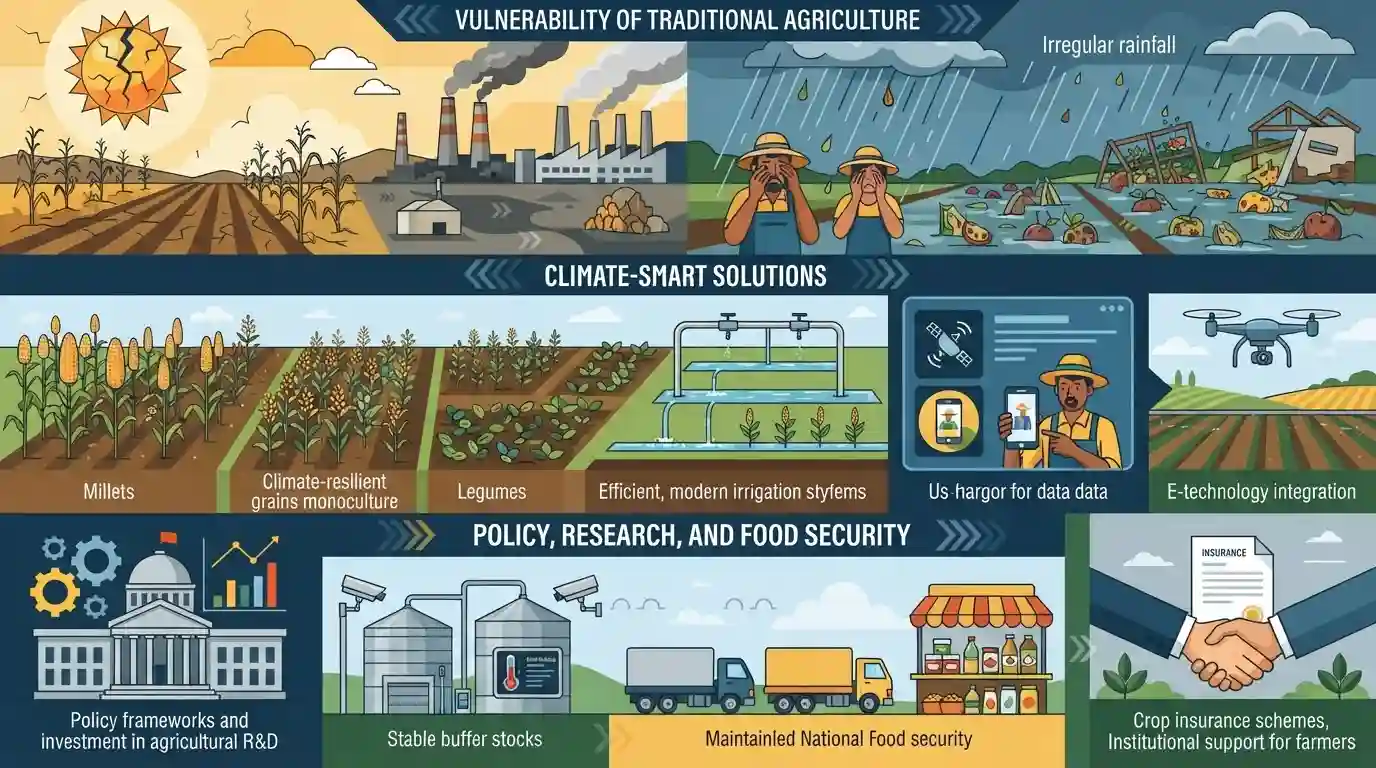
The article underscores the urgent necessity of making India's food system climate-proof in response to the escalating threats posed by climate change, such as irregular rainfall and extreme temperatures. It argues that the traditional agricultural model is highly vulnerable, threatening national food security and the livelihoods of millions of farmers. To build resilience, the piece advocates for widespread adoption of climate-smart agriculture practices, including crop diversification, the cultivation of resilient crops like millets, and the integration of emerging agricultural technologies. Furthermore, it highlights the need for robust policy frameworks, increased investment in agricultural research and development, and enhanced institutional support systems like crop insurance to safeguard the agricultural sector against future climate shocks.
मुख्य मुद्दे
- India's food system faces severe threats from climate change, including erratic monsoons, heatwaves, and extreme weather events that depress crop yields.
- There is an urgent need to transition to climate-proof or climate-smart agriculture to protect both food security and farm livelihoods.
- Promoting crop diversification, shifting towards drought-resilient crops like millets, and adopting precision farming are critical adaptation strategies.
- Policy support must focus on agricultural research for heat- and flood-resistant seeds, improved crop insurance mechanisms, and sustainable water management.
महत्त्वाच्या संज्ञा
National Mission for Sustainable Agriculture (NMSA)

A core mission under the National Action Plan on Climate Change that promotes climate-resilient farming, resource conservation, integrated farming, and efficient water management to achieve sustainable agricultural growth in India.
UPSC context
GS3 (Agriculture). Crucial for questions on sustainable farming practices, natural resource management, and India's climate change mitigation strategies.
Indian Council of Agricultural Research (ICAR)
India's premier autonomous organization coordinating agricultural research and education. It spearheads initiatives like National Innovations in Climate Resilient Agriculture (NICRA) to develop stress-tolerant crop varieties and climate-smart technologies.
UPSC context
GS3 (E-technology/Agriculture). Essential for understanding institutional R&D efforts in developing climate-resilient seeds and advancing agronomic technologies.
Intergovernmental Panel on Climate Change (IPCC)
The UN body responsible for assessing science related to climate change. Its Assessment Reports guide global climate policies and highlight vulnerabilities, such as the impacts of extreme weather on agricultural systems.
UPSC context
GS3 (Environment). Foundational for substantiating climate change impacts on food security, analyzing vulnerabilities, and understanding international climate negotiations.
Climate-Smart Agriculture (CSA)
An integrated farming approach aimed at sustainably increasing agricultural productivity, building resilience to climate change, and reducing greenhouse gas emissions through practices like precision irrigation, zero-tillage, and cultivating stress-tolerant seeds.
UPSC context
GS3 (Agriculture). Frequently tested in Prelims and Mains regarding adaptation strategies, sustainable farming techniques, and national climate-resilience missions.
Crop Diversification
The practice of shifting from water-intensive monocultures (like rice and wheat) to a wider variety of resilient crops, such as millets and pulses, to enhance soil health and reduce climate risks.
UPSC context
GS3 (Cropping Patterns). Key to answering questions on agricultural sustainability, buffer stocks, nutritional security, and farmer income stabilization.
पूर्वपरीक्षा सापळा
PMFBY remains mandatory for all farmers who have availed institutional crop loans (loanee farmers).
In 2020, the scheme was restructured to make enrollment completely voluntary for all farmers, including those with outstanding institutional crop loans (loanee farmers).
संबंधित स्थिर संकल्पना
What is Zero Tillage and how does it aid climate-resilient agriculture?
- Carbon sequestration: Avoids soil disturbance, keeping carbon locked in the soil and preventing organic matter decomposition.
- Water conservation: Retains soil moisture by leaving crop residues on the surface, reducing evaporation losses.
- Cost reduction: Saves energy, fuel, and labor costs by eliminating primary tillage operations before sowing.
How does Direct Seeded Rice (DSR) differ from traditional transplanting?
- No puddling: Seeds are sown directly in the field, bypassing the water-intensive seedling transplantation and constant flooding phase.
- Methane reduction: Aerobic soil conditions under DSR significantly lower anaerobic methane emissions compared to flooded fields.
- Resource efficiency: Reduces water consumption by 15-20% and saves crucial manual labor during peak sowing seasons.
आंतर-विषय नमुने
Millets procurement + WTO Amber Box limits
Scaling up millet procurement under PDS to combat climate vulnerability risks hitting WTO Aggregate Measurement of Support (AMS) ceilings, challenging India's food security peace clause stance.
Agri-shifting + Inter-state water disputes
Crop diversification away from water-intensive paddy in the northwest directly affects basin-level hydrology, potentially mitigating inter-state water sharing disputes.

Expect questions linking NICRA's technological interventions (like DSR and zero-tillage) with India's INDC carbon sink commitments.
संबंधित PYQ · 5
संबंधित PYQ · 5
- 2021MainsGS3
What are the present challenges before crop diversification? How do emerging technologies provide an opportunity for crop diversification?
- 2017MainsGS3
How do subsidies affect the cropping pattern, crop diversity and economy of farmers? What is the significance of crop insurance, minimum support price and food processing for small and marginal farmers?
- 2023MainsGS3
Explain the changes in cropping pattern in India in the context of changes in consumption pattern and marketing conditions.
- 2024MainsGS3
Explain the role of millets for ensuring health and nutritional security in India.
- 2017MainsGS3
What are the major reasons for declining rice and wheat yield in the cropping system? How crop diversification is helpful to stabilise the yield of the crops in the system?
