Demand to Elevate Right to Vote to Fundamental Right Status
Source:The Hindu ↗
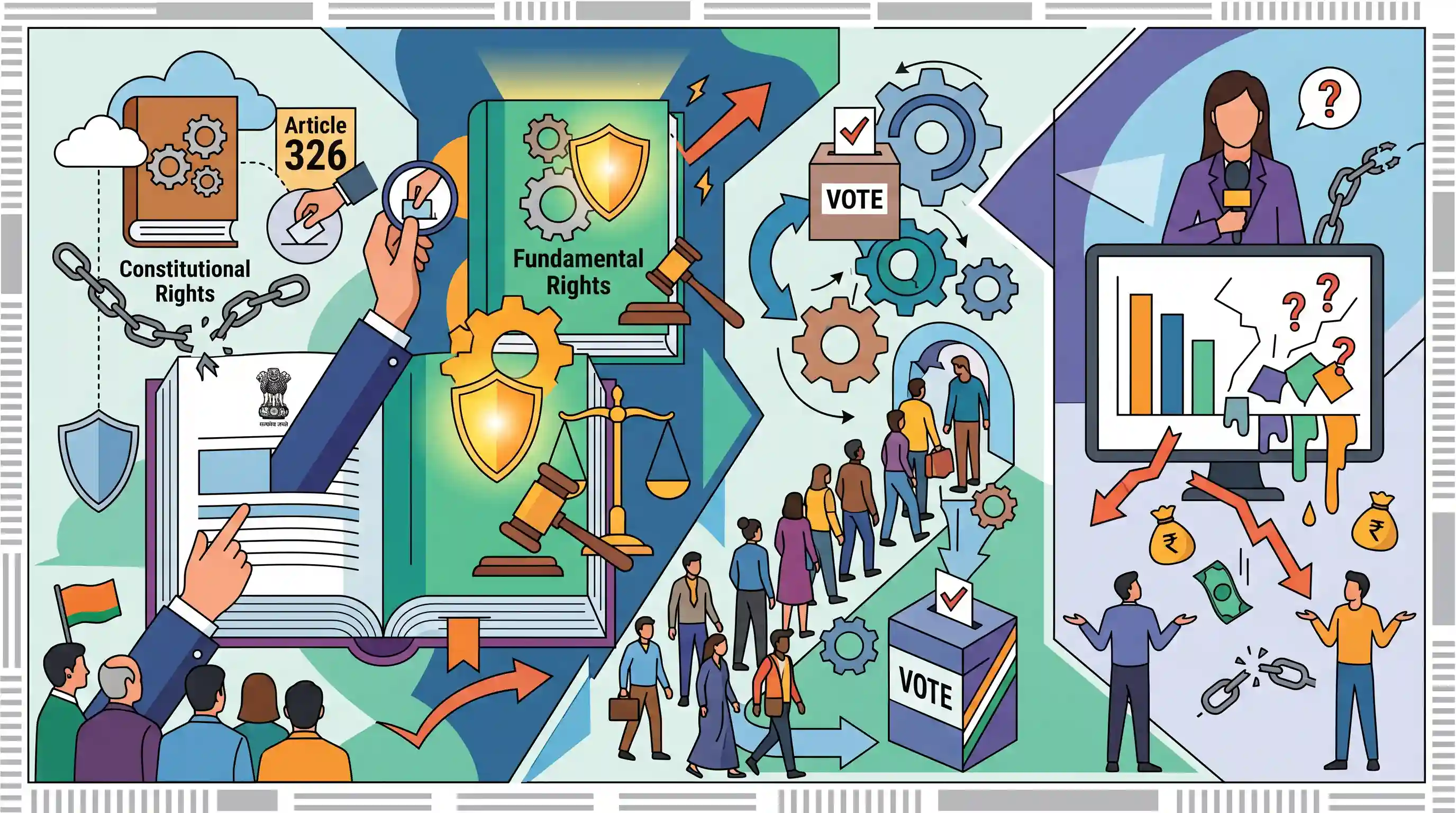
Why It Matters
The debate over the nature of the right to vote (Fundamental vs. Constitutional vs. Statutory) is a recurring UPSC theme. Elevating it to a Fundamental Right would make it enforceable under Article 32 and Article 226, significantly altering India's electoral jurisprudence. Furthermore, the credibility of exit polls and opinion polls ties directly into the broader GS2 topic of electoral reforms and the role of media in democracy.
Summary
The Congress party has demanded that the right to vote be made a Fundamental Right under the Indian Constitution, stating that it is currently 'under threat'. Congress leader Jairam Ramesh argued that making it a justiciable fundamental right would provide stronger legal protection for citizens' electoral participation. Currently, the right to vote is recognized as a Constitutional Right under Article 326. Additionally, the party dismissed exit polls as an untransparent 'racket' lacking credibility, raising concerns about the integrity of election forecasting.
Key Points
- The Congress party, through leader Jairam Ramesh, advocated for elevating the 'right to vote' to the status of a Fundamental Right to make it justiciable and more secure.
- Currently, the right to vote in India is primarily a Constitutional Right under Article 326, which guarantees adult suffrage, while its exercise is governed by statutory laws like the Representation of the People Act, 1951.
- The party also strongly criticized the practice of exit polls, dismissing them as a 'racket' that lacks credibility, transparency, and accountability.
Important Terms
Fundamental Rights

Enshrined in Part III of the Constitution, these are basic justiciable rights protected by the judiciary (Articles 32 and 226) from state interference.
UPSC context
GS Paper II: Core polity topic testing the nature, scope, and enforceability of civil liberties versus statutory rights.
Article 326
The provision establishing universal adult suffrage, ensuring every citizen aged 18+ can vote in Lok Sabha and State Assembly elections, unless disqualified.
UPSC context
GS Paper II: Key constitutional provision for electoral democracy; often tested in Prelims and Mains regarding adult franchise.
Representation of the People Act
Essential parliamentary laws that govern constituency delimitation (1950) and the actual conduct of elections, including candidate disqualification and electoral offenses (1951).
UPSC context
GS Paper II: Explicitly mentioned in the UPSC syllabus; tests knowledge of the legal framework for democratic elections.
Election Commission of India (ECI)
An autonomous constitutional body established under Article 324 to administer and oversee Union and State election processes in India.
UPSC context
GS Paper II: Constitutional Bodies; tests the mechanism for ensuring free and fair elections.
Constitutional Right
A right derived from any part of the Constitution other than Part III, which may not be directly enforceable through Article 32 writs.
UPSC context
GS Paper II: Important for distinguishing the hierarchy of rights (Fundamental vs. Constitutional vs. Statutory).
Prelims Trap
"The Right to Vote is purely a Statutory Right derived from the Representation of the People Act, 1951."
UPSC 2017 officially classified the Right to Vote as a Constitutional Right (Article 326). While its exercise is regulated by the RPA 1951 (statutory), its origin is constitutional, not merely statutory.
Static Concepts Connected
What is the current constitutional and legal status of the Right to Vote?
- Constitutional origin: Enshrined in Article 326, which guarantees universal adult suffrage to citizens above 18 years of age without discrimination.
- Statutory regulation: The actual mechanics, qualifications, and limitations of voting are operationalized via the Representation of the People Act, 1951.
- No Article 32 protection: As it is not in Part III, citizens cannot directly approach the Supreme Court under Article 32 if denied the right to vote.
How does the RPA 1951 regulate exit polls and prisoner voting rights?
- Exit poll ban: Section 126A strictly prohibits publishing exit polls from the start of the first phase until 30 minutes after the final phase of polling concludes.
- Prisoner disenfranchisement: Section 62(5) bars undertrials and convicts in custody from voting. However, individuals under preventive detention are permitted to vote via postal ballot.
Cross-Topic Patterns
Right to Property parallels
The Right to Property was transitioned from a Fundamental Right to a Constitutional Right (Art 300A). Both voting and property currently lack direct enforceability via Supreme Court Article 32 writ jurisdiction.
RPA limits vs Universal Adult Suffrage
The statutory ban on undertrials voting (Section 62 RPA) triggers debates on whether statutory laws can reasonably restrict the Constitutional right under Article 326 without violating basic democratic principles.

Expect a 2026 multi-statement question contrasting the writ enforceability of fundamental rights with constitutional rights like voting.
Linked PYQs · 2
Linked PYQs · 2
- 2017PrelimsGS1
Right to vote and to be elected in India is a
- 2022MainsGS2
Discuss the procedures to decide the disputes arising out of the election of a Member of the Parliament or State Legislature under The Representation of the People Act, 1951. What are the grounds on which the election of any returned candidate may be declared void ? What remedy is available to the aggrieved party against the decision ? Refer to the case laws.
