Methodological Review of Climate Change GDP Impact Studies
Source:The Hindu ↗
Why It Matters
Demonstrates the intersection of climate modeling and global economic policy, illustrating how scientific data directly informs institutions like the World Bank and IMF. It also serves as a case study for GS-4 and GS-3 concerning scientific integrity, peer review, and the potential impact of methodological errors on global policy-making.
Summary
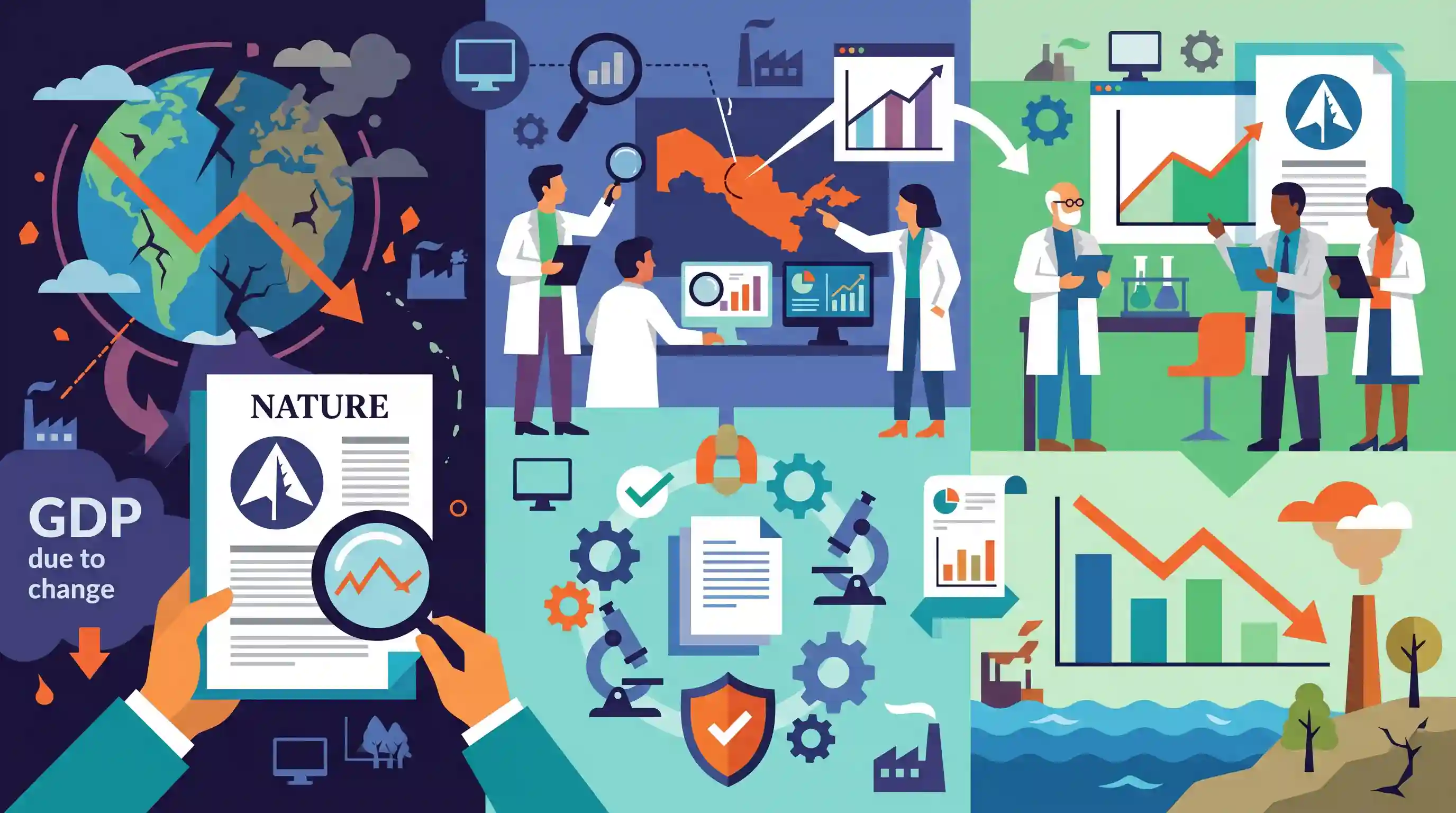
A prominent climate economics study published in the journal Nature, which previously warned of a 62% global GDP reduction by 2100 due to climate change, is under review after Stanford University researchers found significant methodological errors. The original authors at the Potsdam Institute for Climate Impact Research have acknowledged the mistakes, which involved data anomalies from Uzbekistan. While the projected economic hit is now estimated to be about three times smaller, experts note that the economic impacts of global warming still remain severe. The incident is being highlighted as a strong example of scientific transparency and the rigorous peer-review process, rather than a disproof of climate risks.
Key Points
- A highly influential 2024 Nature study estimating a 62% global GDP drop by 2100 due to climate change is facing a potential retraction.
- Stanford University researchers re-analyzed the data and found the actual projected hit to be roughly three times smaller, bringing it in line with earlier estimates.
- The discrepancy was traced to anomalous provincial growth figures related to Uzbekistan and currency exchange issues.
- The original authors from the Potsdam Institute for Climate Impact Research (PIK) have acknowledged the methodological flaws and submitted a corrected version.
- Despite the error, scientists emphasize that the economic impacts of climate change remain substantial and that this episode demonstrates the self-correcting nature and transparency of the scientific method.
Important Terms
Potsdam Institute for Climate Impact Research (PIK)

A leading German government-funded research institute focused on global change, climate impacts, and sustainable development.
UPSC context
GS III (Environment); tests understanding of global research bodies influencing international climate policy and IPCC assessments.
Nature (Journal)
A prestigious international weekly journal publishing high-impact, peer-reviewed research across all fields of science and technology.
UPSC context
GS III (S&T); emphasizes the role of peer-reviewed science in shaping global consensus and evidence-based policymaking.
World Bank
An international financial institution providing loans and grants to low- and middle-income countries for development projects and climate resilience.
UPSC context
GS III (Economy); relevant for studying multilateral funding, climate-economy projections, and infrastructure development in the Global South.
International Monetary Fund (IMF)
A global organization that promotes monetary cooperation and financial stability, increasingly analyzing climate change as a systemic macroeconomic risk.
UPSC context
GS III (Economy); concerns the intersection of environmental stability and global financial governance.
Carbon Brief
A specialized website providing data-driven reports and analysis on climate science, energy policy, and international climate negotiations.
UPSC context
GS III (Environment); a key resource for contemporary data on emissions, energy transitions, and COP outcomes.
Prelims Trap
Revisions in recent climate models prove that global warming will have negligible impacts on global GDP by 2100.
While the magnitude of projected GDP loss was reduced due to a data anomaly, experts emphasize the macroeconomic damage remains severe.
Static Concepts Connected
How does climate change directly impact India's macroeconomic stability?
- Labor Productivity: Extreme heat reduces working hours, with the RBI estimating up to a 4.5% hit to India's GDP by 2030 if adaptation measures are not scaled up.
- Sectoral Vulnerability: Agriculture and MSMEs suffer disproportionately because they lack sufficient capital for adequate cooling, crop insurance, and disaster adaptation.
- Climate Inflation: Cascading extreme weather events disrupt critical supply chains and agricultural output, driving persistent structural food inflation.
What is the Planetary Boundaries framework associated with the Potsdam Institute (PIK)?
- Safe Operating Space: A framework outlining nine critical Earth system processes, defining a safe operating space within which humanity can continue to develop.
- Key Boundaries: It includes climate change, biosphere integrity, land-system change, and freshwater use. Several of these boundaries have already been transgressed by human activity.
Cross-Topic Patterns
Heat stress and labor productivity
Linking climate economics to human capital: ILO projects India could lose 34 million jobs by 2030 due to heat stress, heavily impacting informal manual labor and the MSME sector.
Scientific transparency in policy-making
PIK's swift error acknowledgment models GS-4 'intellectual honesty'—critical for ensuring that global public policy and climate financing are not misdirected by flawed data models.

Expect a 2026 Prelims question linking RBI's climate-GDP estimates, heat stress on informal labor, and climate-driven food inflation.
Linked PYQs · 4
Linked PYQs · 4
- 2022MainsGS3
Discuss global warming and mention its effects on the global climate. Explain the control measures to bring down the level of greenhouse gases which cause global warming, in the light of the Kyoto Protocol, 1997.
- 2017MainsGS3
'Climate change' is a global problem. How India will be affected by climate change? How Himalayan and coastal states of India will be affected by climate change?
- 2025PrelimsGS1
Consider the following statements : Statement I: Circular economy reduces the emissions of greenhouse gases. Statement II: Circular economy reduces the use of raw materials as inputs. Statement III : Circular economy reduces wastage in the production process. Which one of the following is correct in respect of the above statements?
- 2021MainsGS4
Besides domain knowledge, a public official needs innovativeness and creativity of a high order as well, while resolving ethical dilemmas. Discuss with suitable example.
