Uttar Pradesh transfers numerous provincial civil service officers
Source:the-statesman ↗
Why It Matters
Provincial Civil Services (PCS) officers and local administrative heads like SDMs play a pivotal role in grassroots administration, policy execution, and law and order in the state. For UPPSC PCS Prelims, understanding the administrative structure of Uttar Pradesh, constitutional provisions governing State Public Service Commissions (Articles 315-323), and general administrative reforms is crucial.
Summary
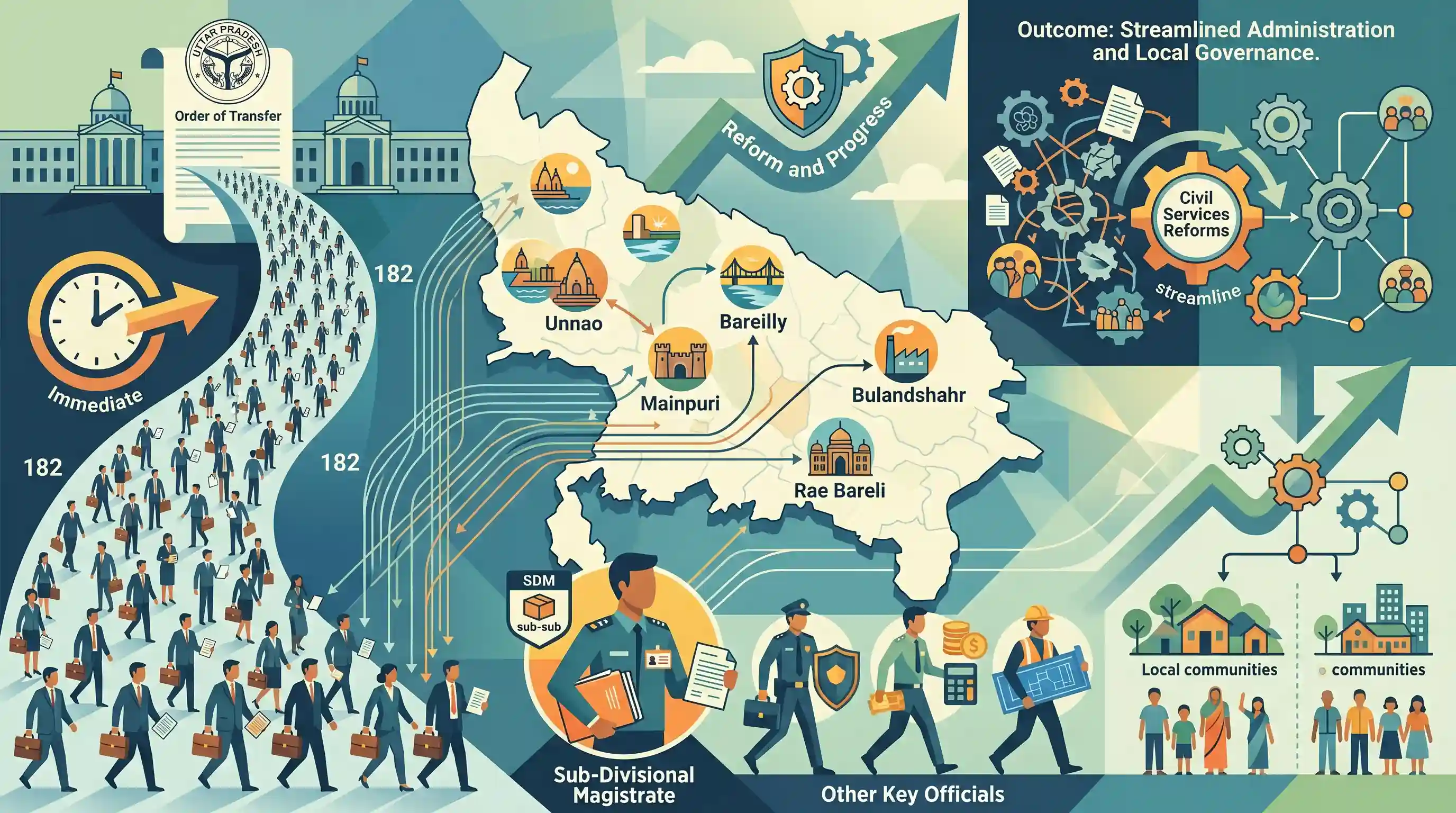
The Uttar Pradesh government has initiated a massive administrative reshuffle by transferring 182 Provincial Civil Services (PCS) officers with immediate effect. The exercise primarily reshapes district-level administration by reassigning Sub-Divisional Magistrates (SDMs) and other key officials across regions like Unnao, Mainpuri, Bareilly, Bulandshahr, and Rae Bareli to streamline state administration and local governance.
Key Points
- The Uttar Pradesh government enacted a major administrative reorganization by transferring 182 Provincial Civil Services (PCS) officers.
- The reshuffle predominantly impacts district-level administration, reassigning Sub-Divisional Magistrates (SDMs) and municipal officials across multiple districts with immediate effect.
- Key postings include Lovleet Kaur (SDM Hathras) appointed as Officer on Special Duty (OSD) in the Greater Noida Authority, and Veer Singh (2020 PCS batch, Assistant Municipal Commissioner Aligarh) posted as SDM of Rae Bareli.
- Other notable transfers of SDMs spanned across major regions including Unnao, Mainpuri, Bareilly, Kanpur Dehat, Bulandshahr, Ambedkar Nagar, Baghpat, Firozabad, and Barabanki.
- This deployment constitutes one of the largest administrative shake-ups in recent months, highlighting the state government's operational oversight and personnel management of the state's administrative machinery.
Important Terms
Provincial Civil Services (PCS)

The state-level administrative service recruited through competitive exams by State Public Service Commissions, filling critical executive, revenue, and law-enforcement posts in state government departments.
UPSC context
GS Paper II: Role of civil services, State public service commissions, state administration and governance.
Sub-Divisional Magistrate (SDM)
The administrative head of a district subdivision who exercises executive, revenue, and magisterial duties, maintaining law and order, administering land revenue, and coordinating local development.
UPSC context
GS Paper II: District and local administration, role of civil services, and execution of government schemes.
Uttar Pradesh Public Service Commission (UPPSC)
A constitutional body established under Articles 315-323 of the Constitution, responsible for conducting competitive exams and direct recruitments to state civil services in Uttar Pradesh.
UPSC context
GS Paper II: Constitutional bodies, public service commissions, state administrative framework.
Civil Services Reforms
Systematic policy interventions aimed at improving administrative efficiency, accountability, and neutrality, focusing on issues like security of tenure, transparent transfers, and performance-based promotions.
UPSC context
GS Paper II: Role of civil services in a democracy, administrative reforms, second ARC recommendations.
Greater Noida Industrial Development Authority (GNIDA)
A statutory body established in 1991 under the Uttar Pradesh Industrial Area Development Act, 1976, acting as the planning and municipal administrative authority for Greater Noida.
UPSC context
GS Paper II: Statutory bodies, regional urban planning, and infrastructure development.
Prelims Trap
The Governor of a State, being the appointing authority, holds the power to remove members of the State Public Service Commission (SPSC).
Under Article 317, SPSC members/chairperson can only be removed by the President of India, not the Governor, ensuring constitutional independence.
Static Concepts Connected
What are the key constitutional safeguards and reporting requirements for State Public Service Commissions?
- Appointment & Removal: Appointed by the Governor, but can only be removed by the President under Article 317, safeguarding their independence.
- Function Expansion: Article 321 empowers the State Legislature (not executive orders) to expand SPSC's jurisdiction over local bodies and corporate public authorities.
- Annual Accountability: SPSC submits annual reports to the Governor, who must lay them before the State Legislature under Article 323.
What statutory authority do SDMs hold under the Indian administrative framework?
- Executive Magistracy: SDMs function as Executive Magistrates, serving as the vital link between district administration and sub-divisional public order.
- Preventive Powers: They exercise key preventive, maintenance of public order, and peace-keeping powers under the Bharatiya Nagarik Suraksha Sanhita (BNSS), 2023.
Cross-Topic Patterns
Civil Service Transfers vs Policy Continuity
Frequent state administrative shuffles run counter to the 2nd ARC and Hota Committee recommendations advocating fixed tenures to prevent administrative ad-hocism.
Bureaucracy vs Local Self-Governance
Deputing state PCS officers as municipal commissioners highlights the persistent administrative dependency of 74th Amendment urban local bodies on state-level executive machinery.

Constitutional provisions on SPSC autonomy and BNSS executive magistrate roles likely to feature in 2026 Prelims polity section.
Linked PYQs · 2
Linked PYQs · 2
- 2021UPPSC_PRELIMSGS1
The functions of the State Public Service Commission of Uttar Pradesh can be extended by
- 2021UPPSC_PRELIMSGS1
In which year (P.C. Hota Committee on Civil Services Reforms was constituted ?
