Himachal Pradesh Court Enforces Interim Orders to Protect Disabled Man
Source:indianexpress ↗
Why It Matters
This case illustrates the practical application of civil procedure and inherent judicial powers to protect the fundamental rights of marginalized individuals. It serves as a clear example for GS2 answers concerning the proactive role of the judiciary, the enforceability of interim court orders, and state mechanisms for accommodating persons with severe disabilities.
Summary
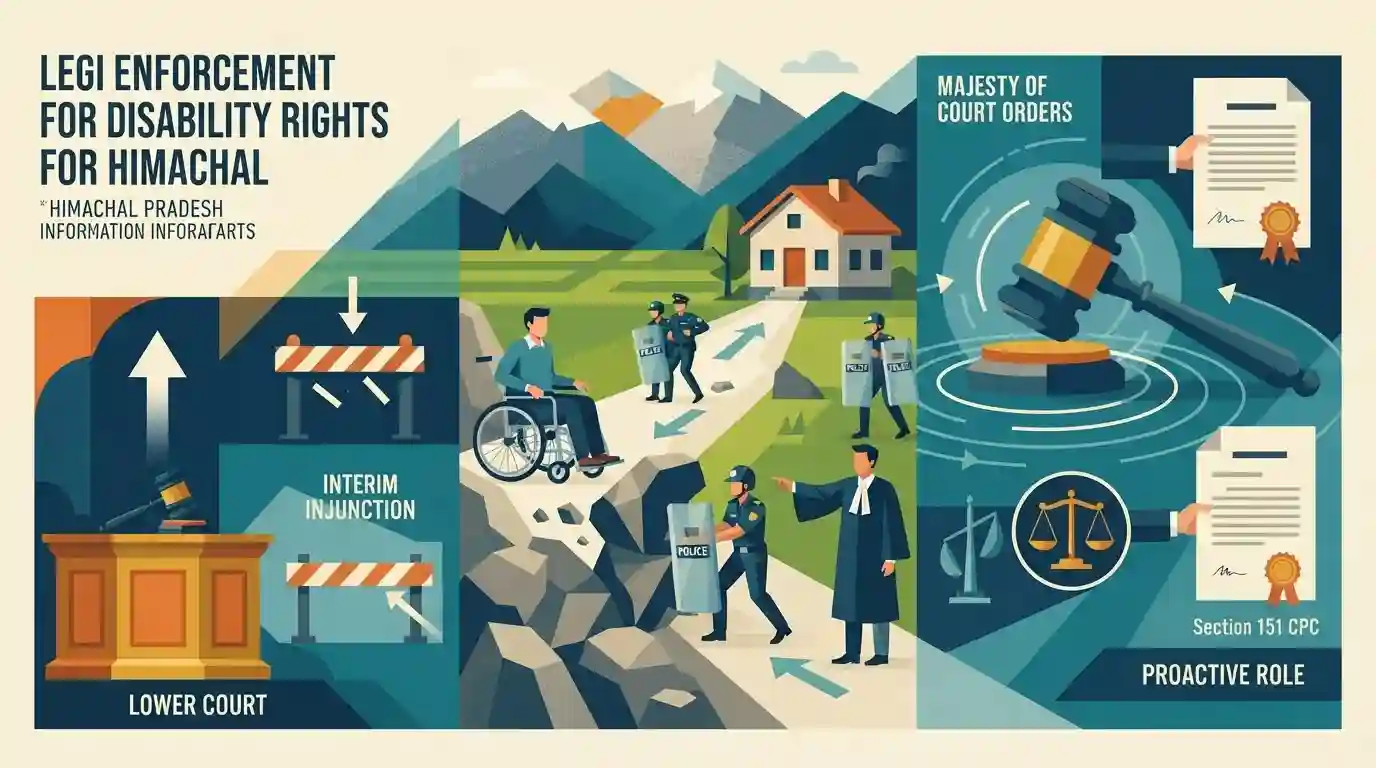
The Himachal Pradesh High Court strongly reaffirmed the necessity of enforcing interim injunctions, upholding a lower court order that directed police assistance to clear a blocked link road for a 100% disabled man. Justice Sandeep Sharma emphasized the "majesty of court orders," declaring that courts must actively ensure compliance to prevent irreversible harm to vulnerable citizens. The underlying property dispute involved land initially allotted under the state's Nautor Rules. The ruling underscores the judiciary's proactive role and inherent powers (under CPC Section 151) in protecting the fundamental access rights of persons with disabilities.
Key Points
- The Himachal Pradesh High Court upheld a lower court's decision to provide police assistance to enforce an interim injunction under Section 151 of the Code of Civil Procedure (CPC).
- The injunction required the removal of stones and mud blocking a link road essential for a 100% disabled man's access to his home.
- The High Court emphasized the "majesty of court orders," stating that courts cannot be mute spectators when their interim orders are brazenly violated.
- The court prioritized the disabled individual's right to ingress and egress, noting that failure to enforce the order would cause him irreparable loss.
- The dispute involved land originally granted under Himachal Pradesh's Nautor Rules, which govern the allotment of uncultivated state land to landless residents.
Important Terms
Code of Civil Procedure (CPC)

Enacted in 1908, it is a foundational law governing civil proceedings in India. It standardizes rules for civil courts to ensure procedural fairness, with Section 151 explicitly preserving courts' inherent powers to prevent abuse of process.
UPSC context
GS Paper 2 (Polity). Essential for understanding civil justice administration, judicial powers, and procedural mechanisms in India.
Nautor Rules
Himachal Pradesh state regulations (1968) that govern the allotment of unused, government-owned wasteland outside urban areas to eligible individuals—primarily landless workers and tribal populations—for agriculture, horticulture, or housing.
UPSC context
GS Paper 2 & 3 (Social Justice, Land Reforms). Important for studying state-specific land redistribution, poverty alleviation, and tribal welfare policies.
Himachal Pradesh High Court
The highest judicial authority in Himachal Pradesh. It exercises original and appellate jurisdiction, playing a critical role in upholding fundamental rights, interpreting state laws, and ensuring compliance with civil orders to protect vulnerable citizens.
UPSC context
GS Paper 2 (Judiciary, Vulnerable Sections). Illustrates the judiciary's proactive role in enforcing legal protections and access rights for disabled persons.
Prelims Trap
"Section 151 of the CPC confers new substantive rights upon civil courts to secure justice."
Section 151 of the CPC does not create or confer any new substantive rights. It merely acknowledges and "saves" the existing inherent powers of civil courts.
Static Concepts Connected
What are the "inherent powers" of courts under Section 151 of the CPC?
- No new rights: It does not confer new rights but saves the pre-existing inherent powers of civil courts.
- Ends of justice: Invoked specifically to issue orders necessary to secure the ends of justice or prevent abuse of court processes.
- Supplemental nature: It is a residual power and cannot be invoked if specific CPC provisions already cover the situation at hand.
How did the RPwD Act 2016 change India's disability framework?
- Rights-based paradigm: Shifted the framework from a charity-based 'medical model' to a 'human rights model', aligning with UNCRPD.
- Enforceable accessibility: Legally mandated that physical, infrastructural, and digital accessibility are enforceable fundamental rights, not just welfare goals.
- Expanded categories: Increased the number of legally recognized disability conditions from 7 to 21.
Cross-Topic Patterns
Judicial enforcement of RPwD mandates
Courts are increasingly relying on inherent powers (CPC Sec 151) and writ jurisdictions to convert the theoretical accessibility rights under the RPwD Act 2016 into enforced infrastructural realities.
Welfare land grants and transfer bars
Similar to tribal land protections, state-level schemes like HP's Nautor Rules impose strict transfer-bars (e.g., 20 years) on welfare-allotted waste lands to prevent real-estate exploitation of vulnerable grantees.

Expect a Prelims question testing the difference between constitutional inherent powers (Art 142/215) and statutory ones (Sec 151 CPC).
Linked PYQs · 3
Linked PYQs · 3
- 2022HPAS_PRELIMSGS1
When any official does not perform his duty, High Court/Supreme Court can issue which writ ?
- 2024HPAS_PRELIMSGS1
Match List I with List II : | List I | List II | |---|---| | (a) Habeas Corpus Writ | (i) Re-examining Lower Court records by Superior Court | | (b) Mandamus Writ | (ii) Exercising Power under which authority | | (c) Certiorari Writ | (iii) Restricting officials to act | | (d) Quo Warranto Writ | (iv) To produce in person | Choose the correct answer from the options given below : Code: (a) (b) (c) (d)
- 2016HPAS_PRELIMSGS1
The Supreme Court issued a contempt notice to the sitting High Court Judge of :
