Artificial Intelligence Risks and Human Oversight in Banking Sector
Source:The Hindu ↗
Why It Matters
The integration of AI in critical sectors like banking presents unique governance, systemic stability, and ethical challenges. This article outlines the regulatory perspective on technology governance, the principle of institutional accountability, and active central bank interventions (like regulatory sandboxes and specific fraud-control tools), making it highly relevant for questions on science and tech policy, economy, and administrative ethics.
Summary
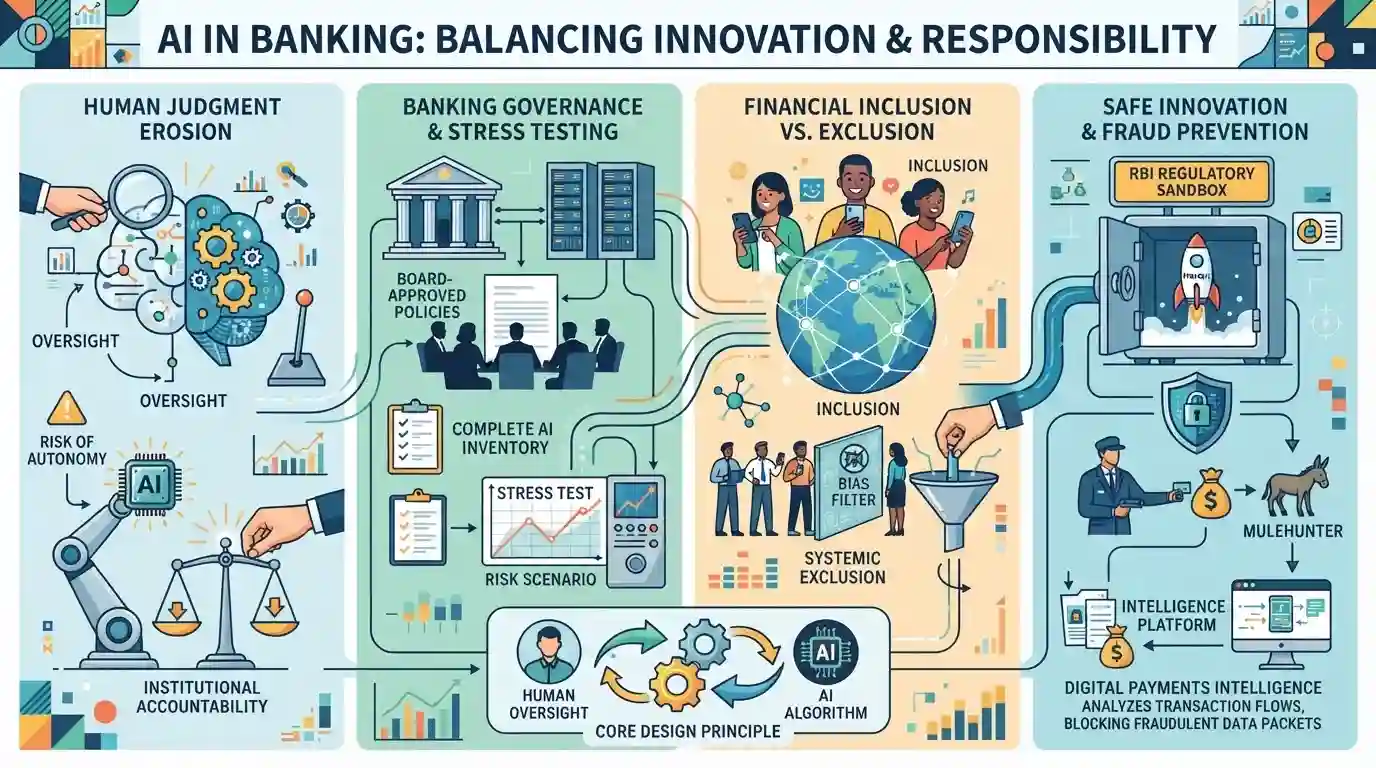
RBI Governor Sanjay Malhotra cautioned that the main risk of deploying Artificial Intelligence (AI) in banking is the erosion of human judgment and accountability. Addressing the FIBAC 2026 Conference in Mumbai, he stated that algorithmic outcomes do not excuse banks from institutional responsibility. He urged banks to integrate human oversight as a core design principle, maintain complete inventories of deployed AI systems, adopt board-approved governance policies, and conduct stress tests. While recognizing AI's potential to drive financial inclusion, he highlighted the risks of systemic exclusion. He reaffirmed RBI's commitment to supporting safe innovation through its Regulatory Sandbox and shared anti-fraud utilities like MuleHunter and the Digital Payments Intelligence Platform.
Key Points
- Reserve Bank of India (RBI) Governor Sanjay Malhotra raised concerns that the primary risk of adopting Artificial Intelligence (AI) in banking is the erosion of human judgment and accountability.
- The Governor emphasized that accountability for financial decisions remains strictly institutional; 'the model decided' cannot be used as an excuse to customers, auditors, or regulators.
- Meaningful human oversight—specifically the capacity to explain, intervene, and override algorithmic outputs—must be embedded as a design principle, not treated as an afterthought.
- Banks must establish board-approved AI governance policies, maintain a thorough inventory of all AI systems (including third-party vendor applications), and regularly stress-test AI models to mitigate financial risks.
- AI holds the potential to accelerate financial inclusion or entrench new systemic exclusions and instability if deployed carelessly, defining this decade of banking just as liberalization did in the 1990s.
- To support safe innovation and fight fraud, the RBI will continue backing technology via its Regulatory Sandbox and common utilities like the 'MuleHunter' and 'Digital Payments Intelligence Platform'.
Important Terms
Regulatory Sandbox

A framework established by the RBI that allows financial innovators and banks to conduct live-testing of new products in a controlled, supervised regulatory environment before a broader market launch.
UPSC context
Important for GS-3 (Indian Economy). It tests understanding of RBI's balancing act between promoting fintech innovation and ensuring financial stability.
MuleHunter.AI
An AI/ML-based fraud detection platform developed by the Reserve Bank Innovation Hub (RBIH). It identifies and blocks "mule accounts" used by criminals to move or launder money obtained through cyber frauds.
UPSC context
Crucial for GS-3 (Cyber Security & Money Laundering). Tests awareness of how India leverages artificial intelligence to counter sophisticated financial crimes.
Digital Payments Intelligence Platform (DPIP)
An AI-driven system developed by the RBI to identify risky digital transactions. It analyzes multi-source data to issue real-time pre-transaction alerts, helping banks block scams before funds are transferred.
UPSC context
Relevant for GS-3 (Internal Security/Digital Economy). Highlights RBI’s proactive infrastructure developments to secure India's rapidly growing digital payment ecosystem.
FIBAC
India's premier annual banking conference, jointly organized by the Federation of Indian Chambers of Commerce and Industry (FICCI) and the Indian Banks' Association (IBA), focusing on strategic financial sector developments.
UPSC context
Relevant for Prelims (Economy). Highlights major industry-policy dialogues involving the RBI, banks, and corporate stakeholders shaping India's banking trajectory.
Prelims Trap
MuleHunter and the Digital Payments Intelligence Platform are cybersecurity operations conducted by CERT-In.
These are actually anti-fraud utilities backed by the Reserve Bank of India (RBI) to track suspicious transactions and prevent banking fraud, not CERT-In initiatives.
Static Concepts Connected
What is the RBI's Regulatory Sandbox framework?
- Controlled testing: Allows financial institutions and fintechs to live-test innovative products on a limited set of customers under direct RBI supervision.
- Regulatory exemptions: Participants receive temporary relaxations from certain regulatory requirements to encourage innovation while containing potential systemic risks.
- Thematic cohorts: Operates in thematic phases, such as cross-border payments, MSME lending, retail payments, and preventing financial fraud.
What constitutes 'Human-in-the-Loop' (HITL) architecture in AI systems?
- Active intervention: A design principle where human operators retain the ability to monitor, explain, and override algorithmic outputs before final execution.
- Institutional accountability: Ensures that legal and ethical responsibility for AI-driven decisions remains with the deploying institution, preventing 'black-box' deflections.
- Bias mitigation: Human feedback is used to continuously correct algorithmic bias, preventing systemic exclusion or 'redlining' in areas like credit scoring.
Cross-Topic Patterns
AI underwriting + DPDP Act limits
Using alternative data (like utility bills) to train banking AI for thin-file clients directly challenges the purpose-limitation and strict consent mandates of the Digital Personal Data Protection (DPDP) Act.
JAM Trinity + Algorithmic redlining
While the JAM trinity solved basic bank access, AI-driven credit scoring risks creating a new layer of systemic financial exclusion through unchecked algorithmic biases against marginalized demographics.

Expect a 2026 GS3 question balancing AI's capacity for financial inclusion against algorithmic bias and strict institutional accountability.
Linked PYQs · 3
Linked PYQs · 3
- 2024MainsGS4
The application of Artificial Intelligence as a dependable source of input for administrative rational decision-making is a debatable issue. Critically examine the statement from the ethical point of view.
- 2023MainsGS3
Introduce the concept of Artificial Intelligence (AI). How does Al help clinical diagnosis? Do you perceive any threat to privacy of the individual in the use of Al in healthcare?
- 2026PrelimsGS1
Which one of the following statements about Unified Payments Interface (UPI) and Central Bank Digital Currency (Digital Rupee) is not correct ?
