Maharashtra inaugurates rural school honoring Mahatma Phule
Source:Indian Express ↗
Why It Matters
The article provides an excellent historical linkage between Mahatma Phule's advocacy (Hunter Commission, 1882) and modern governance (RTE Act 2009), relevant for GS1 and GS2. Furthermore, the collaborative funding and operational model of the school serves as a strong case study for GS2/GS3 topics regarding the role of NGOs and CSR in public service delivery and social sector development.
Summary
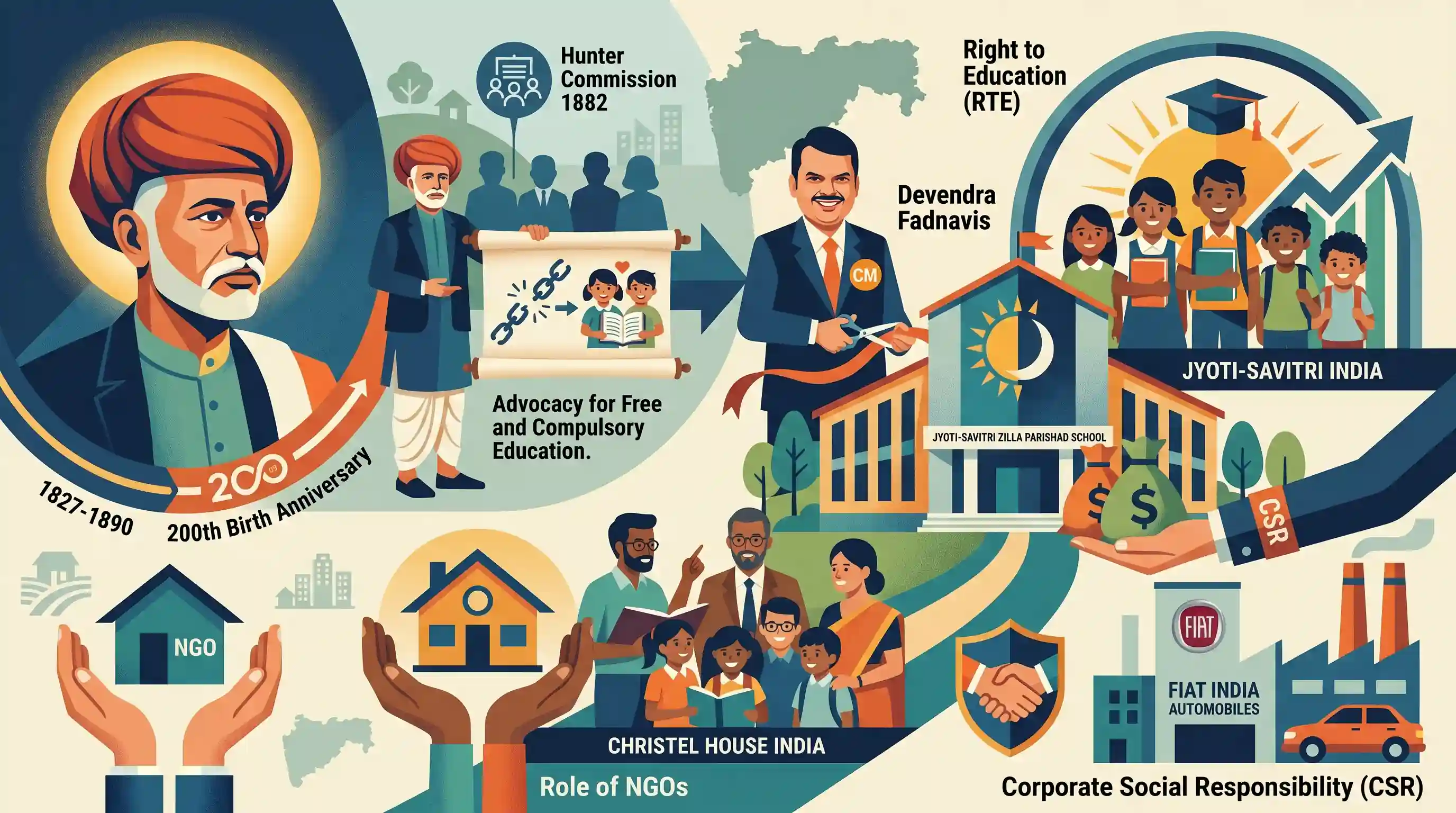
Maharashtra Chief Minister Devendra Fadnavis inaugurated the state's first CBSE-affiliated Zila Parishad school in Khanvadi, Pune, on Mahatma Jyotirao Phule's 200th birth anniversary. Fadnavis credited Phule as the original proponent of the Right to Education (RTE), citing his 1882 deposition before the Hunter Commission where he advocated for free and compulsory education. The Jyoti-Savitri Zilla Parishad School is managed by the NGO Christel House India and was heavily funded through Corporate Social Responsibility (CSR) by Fiat India Automobiles, highlighting an emerging model of public-private partnership and NGO involvement in advancing rural education.
Key Points
- Maharashtra CM Devendra Fadnavis inaugurated the state's first CBSE Zila Parishad school in Khanvadi, the ancestral village of Mahatma Jyotirao Phule.
- Fadnavis credited Phule as the original proponent of the Right to Education, citing his 1882 testimony before the Hunter Commission demanding free and compulsory education for Indians.
- The school, run by NGO Christel House India, provides free education to underprivileged children, marking an innovative public-private partnership in rural education.
- Funding for the school included Rs 21 crore from Fiat India Automobiles via Corporate Social Responsibility (CSR) and Rs 15 crore from the government.
- The state government also plans to establish 1,000 skill training centers under the Department of Skill Development.
Important Terms
Mahatma Jyotirao Phule

19th-century social reformer who founded the Satyashodhak Samaj. He pioneered education for women and lower castes, famously opening India's first school for girls in Pune in 1848.
UPSC context
GS I: Modern History/Reform Movements. Vital for topics on anti-caste struggles and history of Indian education.
Right to Education (RTE) Act
Enacted under Article 21A, it mandates free and compulsory education for children aged 6–14. It shifted India toward a rights-based framework, requiring private schools to reserve 25% of seats for disadvantaged groups.
UPSC context
GS II: Social Justice/Governance. Tests knowledge of fundamental rights and education policy implementation.
Hunter Commission (1882)
Formed in 1882 to review Indian education progress. Mahatma Phule’s deposition before it advocated for universal, compulsory primary education and teacher training for non-Brahmins to combat caste-based educational monopolies.
UPSC context
GS I: Modern History. Essential for understanding pre-independence education reforms and Phule’s advocacy.
Zila Parishad
The highest tier of the Panchayati Raj system at the district level, established via the 73rd Amendment. It coordinates developmental activities and implements government schemes across rural areas.
UPSC context
GS II: Polity/Local Governance. Tests understanding of democratic decentralization and rural administrative structures.
District Planning Committee (DPC)
A constitutional body mandated by Article 243ZD to consolidate development plans from Panchayats and Municipalities. It prepares a draft development plan for the entire district to ensure integrated rural-urban planning.
UPSC context
GS II: Local Governance/Decentralization. Key for questions on bottom-up planning and 74th Amendment provisions.
Corporate Social Responsibility (CSR)
A mandate under Section 135 of the Companies Act, 2013, requiring companies with specific profits/turnover to spend 2% of average net profits on social development projects like education.
UPSC context
GS III: Economy/GS IV: Ethics. Tests the role of private sector in social welfare and public-private partnerships.
CBSE
A national-level board of education in India for public and private schools, managed by the Union Government. It follows a standardized curriculum (NCERT) and conducts national-level examinations.
UPSC context
GS II: Education Policy. Relevant for standardization of schooling and Central government’s role in secondary education.
Prelims Trap
"Gopal Krishna Gokhale was the first Indian to demand free and compulsory education."
While Gokhale introduced a famous bill in 1911, Mahatma Phule demanded free and compulsory primary education much earlier during his 1882 Hunter Commission deposition.
Static Concepts Connected
What was the primary focus of the Hunter Education Commission (1882)?
- Review mandate: Appointed by Lord Ripon to evaluate educational progress in India since Wood’s Despatch (1854).
- Primary focus: Concentrated heavily on primary and secondary education, unlike later bodies like the Raleigh Commission which focused on universities.
- Key recommendation: Suggested transferring the control and management of primary education to newly formed district and municipal boards.
How is Corporate Social Responsibility (CSR) mandated in India?
- Statutory backing: Governed by Section 135 of the Companies Act, 2013, making India the first country to legally mandate CSR spending.
- Eligibility criteria: Applies to companies with a net worth of ₹500 crore or more, turnover of ₹1000 crore or more, or net profit of ₹5 crore or more.
- Spending rule: Requires spending at least 2% of the average net profits of the preceding three financial years on approved social activities like education.
Cross-Topic Patterns
Phule vs. Downward Filtration Theory
Phule’s 1882 deposition explicitly rejected Macaulay’s 'Downward Filtration Theory', arguing that the state must directly fund mass elementary education for subalterns rather than relying on elites to pass down knowledge.
Tripartite PPPs in Rural Education
This model blends State land, CSR funding (Fiat), and NGO operational management (Christel House), reflecting an emerging governance trend to improve public service delivery without fully privatizing state assets.

Expect a chronological Prelims question linking Phule's 1882 Hunter Commission deposition to Gokhale's 1911 Bill and the 86th CAA.
Linked PYQs · 3
Linked PYQs · 3
- 2025MainsGS1
Mahatma Jotirao Phule's writings and efforts of social reforms touched issues of almost all subaltern classes. Discuss.
- 2022MainsGS2
The Right of Children to Free and Compulsory Education Act, 2009 remains inadequate in promoting incentive-based system for children's education without generating awareness about the importance of schooling. Analyse.
- 2013MainsGS3
With a consideration towards the strategy of inclusive growth, the new Companies Bill, 2013 has indirectly made CSR a mandatory obligation. Discuss the challenges expected in its implementation in right earnest. Also discuss other provisions in the Bill and their implications.
