Gandhian Philosophy and RSS Ideology in Contemporary Society
Source:Indian Express ↗
Why It Matters
Understanding the ideological divergences during the Indian national movement (Gandhian non-violence vs. cultural nationalism) is crucial for GS1. It also provides strong philosophical arguments for GS4 (Ethics) regarding tolerance, non-violence, and managing societal polarization.
Summary
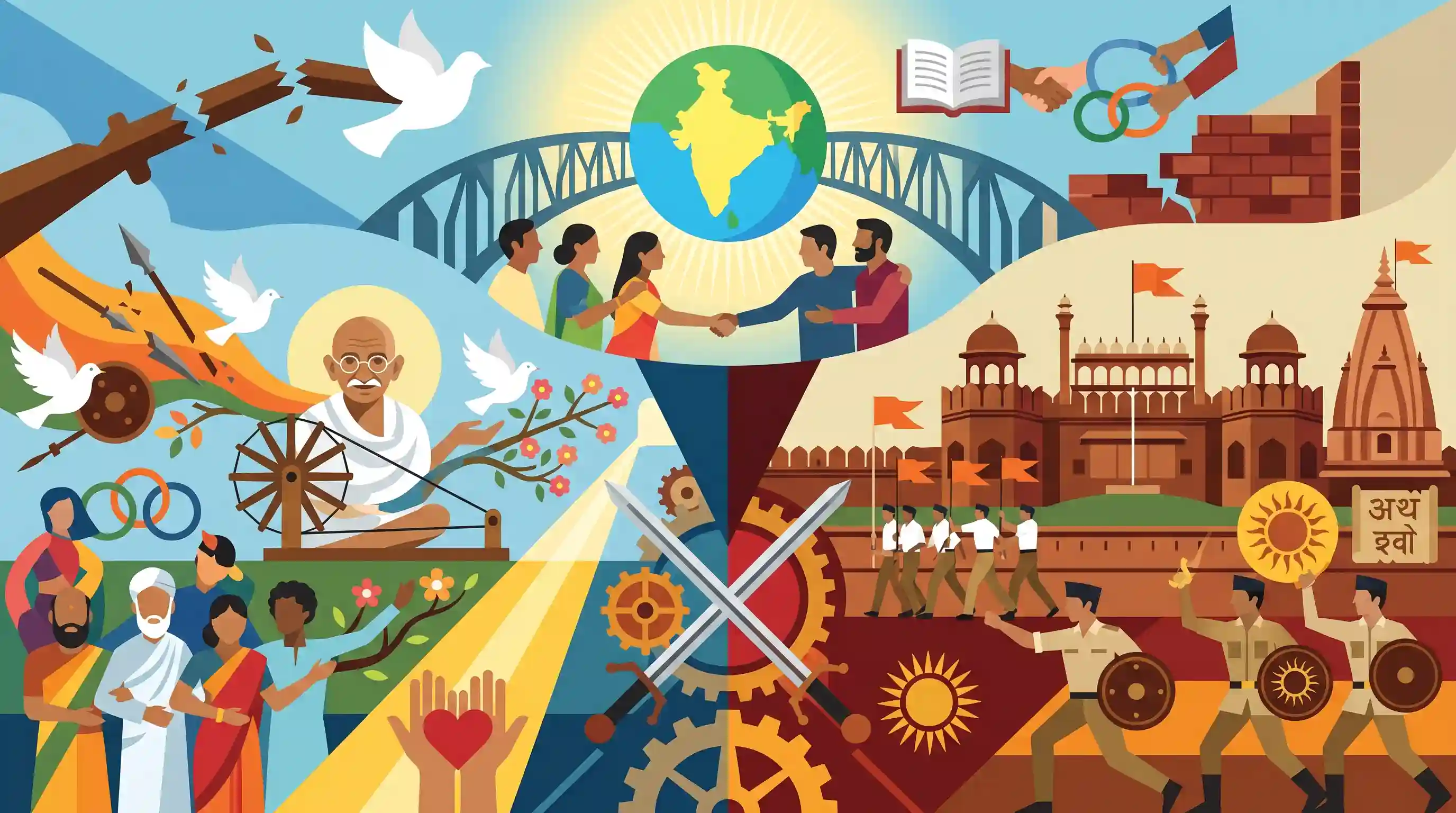
The article reflects on the irony of Mahatma Gandhi's birth anniversary and the RSS centenary sharing public attention. It highlights the stark ideological contrast between Gandhi's commitment to non-violence, inclusivity, and empathy, and the cultural nationalism historically espoused by the RSS. By juxtaposing these two distinct strands of the national movement that emerged in the 1920s, the author emphasizes the contemporary relevance of Gandhian values. In a polarized society, there is an urgent need to transcend violence and embrace tolerance and pluralism, seeing the 'other' not as an enemy, but in a new, empathetic light.
Key Points
- The juxtaposition of Mahatma Gandhi's birth anniversary with the centenary year of the Rashtriya Swayamsevak Sangh (RSS) presents a profound historical and ideological irony.
- Gandhi championed non-violence (Ahimsa), truth (Satyagraha), and secular pluralism, advocating for inclusivity and empathy towards all communities.
- In contrast, the RSS, founded in the 1920s, promoted a brand of cultural nationalism that often positioned different ideological or religious groups as the 'other'.
- The contemporary relevance of Gandhian thought lies in its ability to counter societal polarization, urging society to move beyond violence, anger, and intolerance.
- Empathy and seeing the 'other' in a new, compassionate light are essential for sustaining the democratic and inclusive fabric of Indian society.
Important Terms
Rashtriya Swayamsevak Sangh (RSS)

A Hindu nationalist volunteer organization founded in 1925 by K.B. Hedgewar, aiming to unify Hindu society and promote 'Hindutva' or cultural pride.
UPSC context
GS Paper I (Modern History) & GS Paper II. Tests 1920s-era ideologies and their impact on contemporary politics.
Cultural Nationalism
A form of nationalism where the nation is defined by shared cultural traditions and heritage rather than citizenship or ethnicity alone.
UPSC context
GS Paper I (Indian Society/World History). Distinguishes between civic and cultural identity in nation-building.
Ahimsa (Non-violence)
A core Gandhian principle advocating the avoidance of harm to any living being through thought, word, or deed, even under provocation.
UPSC context
GS Paper IV (Ethics) & GS Paper I. Evaluates the ethical foundation of mass movements and conflict resolution.
Secularism (Indian context)
The principle of "Sarva Dharma Sambhava" (equal respect for all religions), where the state protects all faiths while maintaining a principled distance.
UPSC context
GS Paper II (Constitution). Tests India's unique constitutional identity versus Western models.
Pluralism
A social system that recognizes and celebrates the coexistence of diverse religious, linguistic, and cultural groups within a single political framework.
UPSC context
GS Paper I (Indian Society). Crucial for questions on "Unity in Diversity" and social cohesion.
Communalism
An ideology placing allegiance to one's religious community above society, often leading to hostility toward other groups and political polarization.
UPSC context
GS Paper I (Society) & GS Paper III. Tests analysis of social challenges and national integration.
Satyagraha
Gandhi's method of non-violent resistance based on "truth-force," aiming to convert the opponent through moral pressure and empathy rather than coercion.
UPSC context
GS Paper I (Modern History). Central to understanding Gandhi’s tactical and philosophical approach to the freedom struggle.
Prelims Trap
Gandhian Ahimsa is defined solely as the absence of physical violence against the oppressor.
UPSC tests the depth of Gandhian philosophy. Ahimsa is not just physical restraint; it requires mental non-violence, purging anger, and active empathy (love) towards the opponent.
Static Concepts Connected
How does Civic Nationalism differ from Cultural Nationalism?
- Civic Nationalism: Rooted in shared constitutional values, equal citizenship, and pluralism, regardless of race or religion. Championed by Gandhi.
- Cultural Nationalism: Defines a nation by shared ancestry, culture, and historical traditions, often risking the alienation of minority identities as the 'other'.
What major ideological strands emerged during the 1920s in India's national movement?
- Mass Mobilization: Gandhi shifted the freedom struggle to a mass base anchored in Satyagraha, Ahimsa, and constructive socio-economic programmes.
- Cultural Consolidation: The founding of the RSS (1925) and the rise of the Hindu Mahasabha and Muslim League marked the entrenchment of identity-based politics.
- Leftist Emergence: Inspired by the Russian Revolution, the 1920s saw the rise of the Communist Party of India and robust trade unionism (AITUC).
Cross-Topic Patterns
History meets GS4 Emotional Intelligence
Gandhi’s refusal to view ideological opponents as 'enemies' is a prime example of empathy and emotional intelligence, making it highly applicable to GS4 conflict resolution case studies.
Indian Pluralism vs. Communalism
The 1920s genesis of cultural nationalism is frequently tested alongside the evolution of communalism and its challenge to the pluralistic fabric of Indian society in GS1.

Expect a GS1 Mains question comparing the competing visions of nationalism (cultural vs. civic) that emerged in the pivotal decade of 1920s.
Linked PYQs · 4
Linked PYQs · 4
- 2018MainsGS1
Throw light on the significance of the thoughts of Mahatma Gandhi in the present times.
- 2020MainsGS1
Since the decade of the 1920s, the national movement acquired various ideological strands and thereby expanded its social base. Discuss.
- 2022MainsGS1
Are tolerance, assimilation and pluralism the key elements in the making of an Indian form of secularism? Justify your answer.
- 2018MainsGS4
What do each of the following quotations mean to you in the present context? "Anger and intolerance are the enemies of correct understanding." Mahatma Gandhi
