Wastewater Reuse Implementation for Water Security in Maharashtra
Source:downtoearth-org ↗
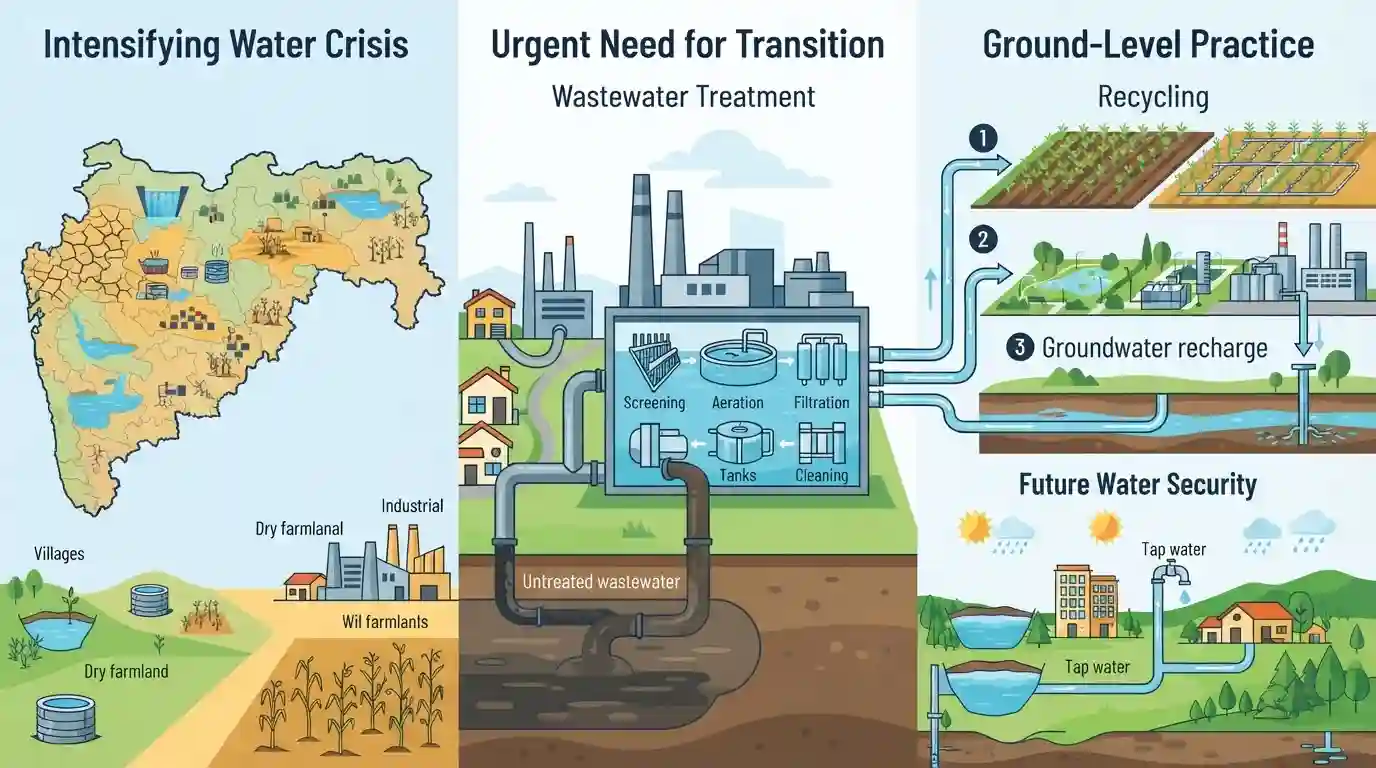
Why It Matters
Water scarcity and wastewater management are critical environmental and socio-economic concerns in Maharashtra, directly impacting state policy, urban planning, and sustainable resource management relevant to MPSC aspirants.
Summary
The article highlights Maharashtra's intensifying water crisis and argues that wastewater reuse must transition urgently from policy frameworks to ground-level practice. Addressing urban and rural water security requires treating and recycling sewage and wastewater to reduce reliance on limited freshwater resources.
Key Points
- Maharashtra faces acute water scarcity challenges, making the transition from mere policy formulation to active wastewater reuse an urgent necessity.
- Wastewater management and recycling are crucial for mitigating urban water stress and reducing pressure on freshwater aquifers and surface reservoirs.
- Bridging the gap between intent and execution requires robust institutional frameworks, infrastructural development for treatment plants, and economic incentives for recycling graywater and sewage.
Important Terms
Atal Mission for Rejuvenation and Urban Transformation (AMRUT)

A flagship Central Sector/Centrally Sponsored urban development mission launched by the Ministry of Housing and Urban Affairs to ensure robust water supply, sewerage networks, and wastewater recycling in Indian cities.
UPSC context
MPSC / UPSC General Studies Paper-II & III: Tests understanding of government policies, urban infrastructure, and sustainable water resource management.
Prelims Trap
Wastewater reuse policies and treatment mandates apply exclusively to metropolitan municipal corporations under urban development jurisdictions.
Aspirants often assume wastewater reuse is exclusively an urban municipal subject under the 12th Schedule, ignoring its critical role in rural drought mitigation under State water policy.
Static Concepts Connected
What are the key institutional frameworks and constitutional provisions for water management in India?
- Constitutional Entry: Water is in the State List (Entry 17 of Schedule VII), subject to Parliament's power under Article 246 for regulation and development of inter-State rivers.
- 74th Amendment: Urban water supply, sanitation, and sewage disposal fall under the purview of Municipalities via the 12th Schedule (Article 243W).
- National Water Policy: Emphasizes that water is a scarce and precious national resource, prioritizing drinking water followed by irrigation, hydropower, and industrial use.
Cross-Topic Patterns
Urban water stress and municipal governance
Urban water scarcity in Maharashtra directly connects to rapid unmanaged urbanization, urban flooding risks, and the implementation of AMRUT and Smart Cities missions.
Agricultural water demand and aquifer stress
Groundwater depletion in agrarian districts links water recycling policies to sustainable agriculture, micro-irrigation subsidies, and drought-prone area development programmes.

Maharashtra water management + AMRUT sewage recycling mandate likely to be tested via multi-statement assertion questions.
Linked PYQs · 2
Linked PYQs · 2
- 2024MPSC_PRELIMSGS1
Which type of drainage pattern is found in Maharashtra ? (a) Dendritic (b) Parallel (c) Indefinite (d) Trellis Answer options :
- 2023MPSC_PRELIMSGS1
Which of the following statements about Atal Mission for Rejuvenation and Urban Transformation (AMRUT) is not correct ?
