Maharashtra Special Public Security Bill Legal Critique
Source:Indian Express ↗
ఇది ఎందుకు ముఖ్యం
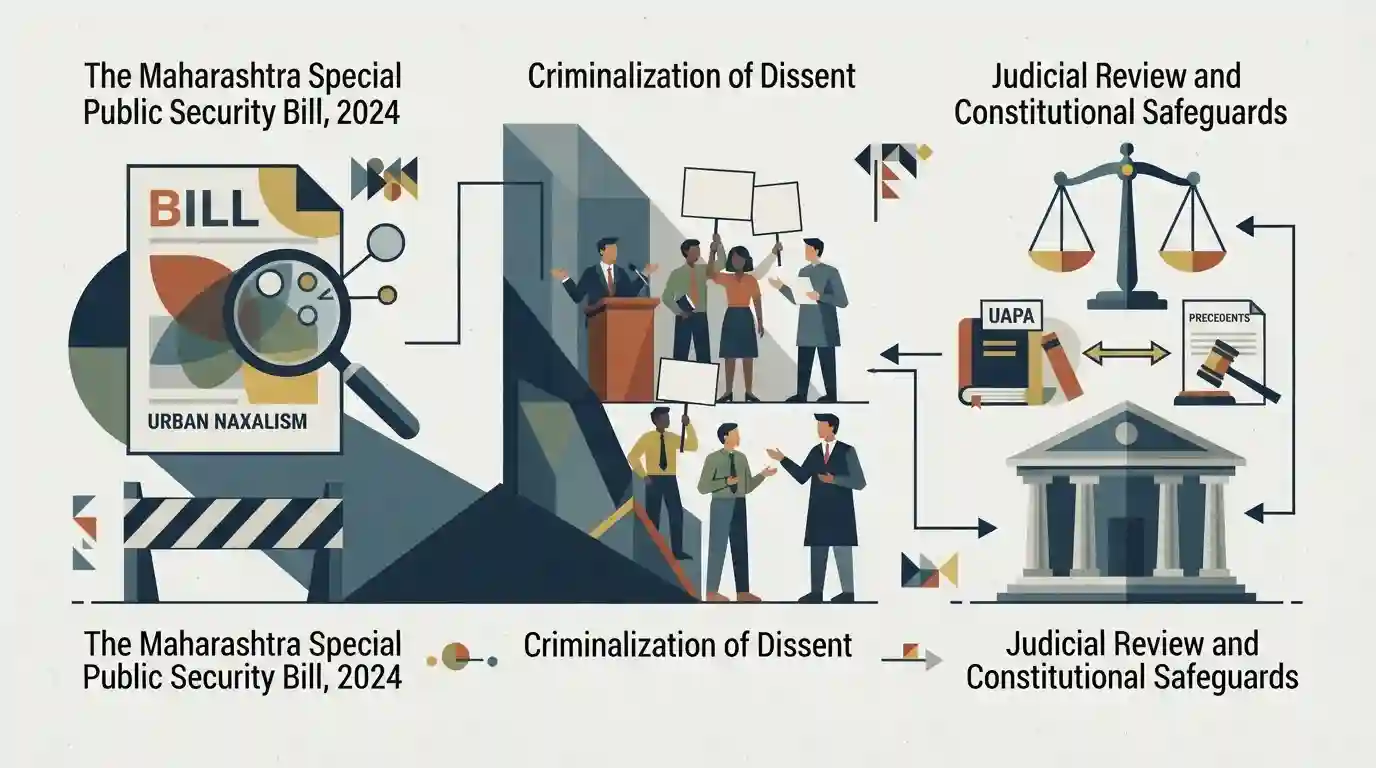
Highlights the critical balance between internal security imperatives and the protection of constitutional rights. It provides a contemporary example of how state security legislations (and terms like 'urban Naxal') can potentially infringe upon the fundamental right to dissent and free speech, a recurring theme in UPSC GS2 and GS3 questions.
సారాంశం
The Maharashtra Special Public Security Bill, 2024, ostensibly introduced to counter "urban Naxalism," relies on broad, ambiguous definitions of "unlawful activity." Such vague phrasing risks criminalising legitimate democratic dissent, debate, and routine political protests. Although currently lapsed, the Bill illustrates a concerning trend of bypassing established legal thresholds and misusing anti-terror frameworks like the UAPA. The editorial argues against reviving the Bill, highlighting judicial precedents that caution against the misuse of stringent security laws to quell opposition.
ముఖ్య అంశాలు
- The Maharashtra Special Public Security Bill, 2024 was introduced to curb alleged 'urban Naxalism' but uses overly broad definitions of 'unlawful activity'.
- The Bill's vague language—defining unlawful activity as anything that poses a 'danger to public order'—risks criminalising legitimate political dissent and routine democratic protests.
- The state government argued that existing national laws like the Unlawful Activities (Prevention) Act (UAPA) are inadequate, despite UAPA already being a highly stringent anti-terror law.
- The higher judiciary (including the Supreme Court) has consistently emphasized that stringent anti-terror laws must have a high threshold for invocation and should not be misused to suppress debate.
- Although the Bill has currently lapsed due to the prorogation of the assembly, the editorial strongly advises against its future revival.
ముఖ్యమైన పదాలు
Maharashtra Special Public Security Bill, 2024

A proposed state legislation targeting 'urban Naxalism' by heavily penalizing broadly defined 'unlawful activities.' It empowers the government to ban organizations and seize properties, sparking widespread constitutional concerns over the suppression of legitimate democratic dissent.
UPSC context
Important for GS-II (Polity) and GS-III (Internal Security), highlighting the delicate balance between state anti-terror measures and the protection of fundamental rights.
Unlawful Activities (Prevention) Act (UAPA)
India’s principal anti-terror law, granting the government extensive powers to ban organizations and designate individuals as terrorists. It features stringent bail conditions and prolonged pre-trial detention, often raising constitutional concerns regarding civil liberties.
UPSC context
A core topic in GS-III (Security) and GS-II (Polity). UPSC frequently tests its provisions, potential for misuse, and the necessity of judicial oversight.
Supreme Court
India's apex judicial body and constitutional guardian. It plays a pivotal role in examining the validity of stringent security laws, establishing precedents to prevent executive overreach and ensuring anti-terror measures do not disproportionately infringe upon fundamental rights.
UPSC context
Relevant to GS-II (Judiciary). Tests the Court's role in judicial review, constitutionalism, and balancing national security imperatives against fundamental rights.
ప్రిలిమ్స్ ఉచ్చు
"Urban Naxalism is officially defined as a distinct category of terrorism under the Unlawful Activities (Prevention) Act (UAPA)."
The term 'Urban Naxalism' lacks any formal legal definition in Indian statutes, including UAPA. It is a political construct, not a legal category.
అనుసంధానమైన స్థిర భావనలు
How does the Supreme Court distinguish 'Public Order' from 'Security of State'?
- Concentric Circles: SC in the Ram Manohar Lohia case defined them as concentric circles: Law & Order (largest), Public Order (middle), Security of State (smallest).
- Threshold of Threat: Every breach of public order does not necessarily threaten the security of the state. Invoking draconian laws requires meeting the higher threshold.
- Article 19(2) Grounds: Both are distinct, explicitly listed grounds for imposing reasonable restrictions on freedom of speech under Article 19(2).
What is the legislative jurisdiction for enacting anti-terror and security laws?
- State List Powers: 'Public order' and 'Police' fall under the State List (List II), allowing states to legislate on regional security issues.
- Central Dominance: The central UAPA relies on Union List powers (Defence) and Concurrent List (Criminal Law).
- Presidential Assent: State security laws that conflict with or are harsher than central criminal laws require the President's assent under Article 254(2).
అంతర-అంశ నమూనాలు
UAPA Tribunals vs. Executive Boards
UAPA mandates a High Court judge-led tribunal to confirm bans, whereas state public security bills often rely on executive-appointed boards, reducing judicial independence and raising constitutional concerns.
LWE Fronts + Article 19 Liberties
GS3 Internal Security focuses on Left Wing Extremism's overground networks, which directly overlaps with GS2 debates on balancing stringent anti-terror laws against Article 19 democratic liberties.

'Public Order' vs 'Security of State' (Ram Manohar Lohia case) and the mandate of UAPA tribunals are highly ripe for a 2026 Prelims MCQ.
అనుసంధాన PYQలు · 3
అనుసంధాన PYQలు · 3
- 2019MainsGS3
Indian Government has recently strengthened the anti-terrorism laws by amending the Unlawful Activities (Prevention) Act (UAPA), 1967 and the NIA Act. Analyze the changes in the context of prevailing security environment while discussing the scope and reasons for opposing the UAPA by human rights organizations.
- 2022MainsGS3
Naxalism is a social, economic and developmental issue manifesting as a violent internal security threat. In this context, discuss the emerging issues and suggest a multilayered strategy to tackle the menace of Naxalism.
- 2018MainsGS3
Left Wing Extremism (LWE) is showing a downward trend, but still affects many parts of the country. Briefly explain the Government of India's approach to counter the challenges posed by LWE.
