महाराष्ट्र में प्रस्तावित धर्मांतरण विरोधी कानून
स्रोत:इंडियन एक्सप्रेस ↗
क्यों मायने रखता है
State anti-conversion laws are a recurring theme in UPSC exams because they sit at the intersection of fundamental rights (Articles 21 and 25), secularism, and judicial interpretations of the Constitution.
सारांश
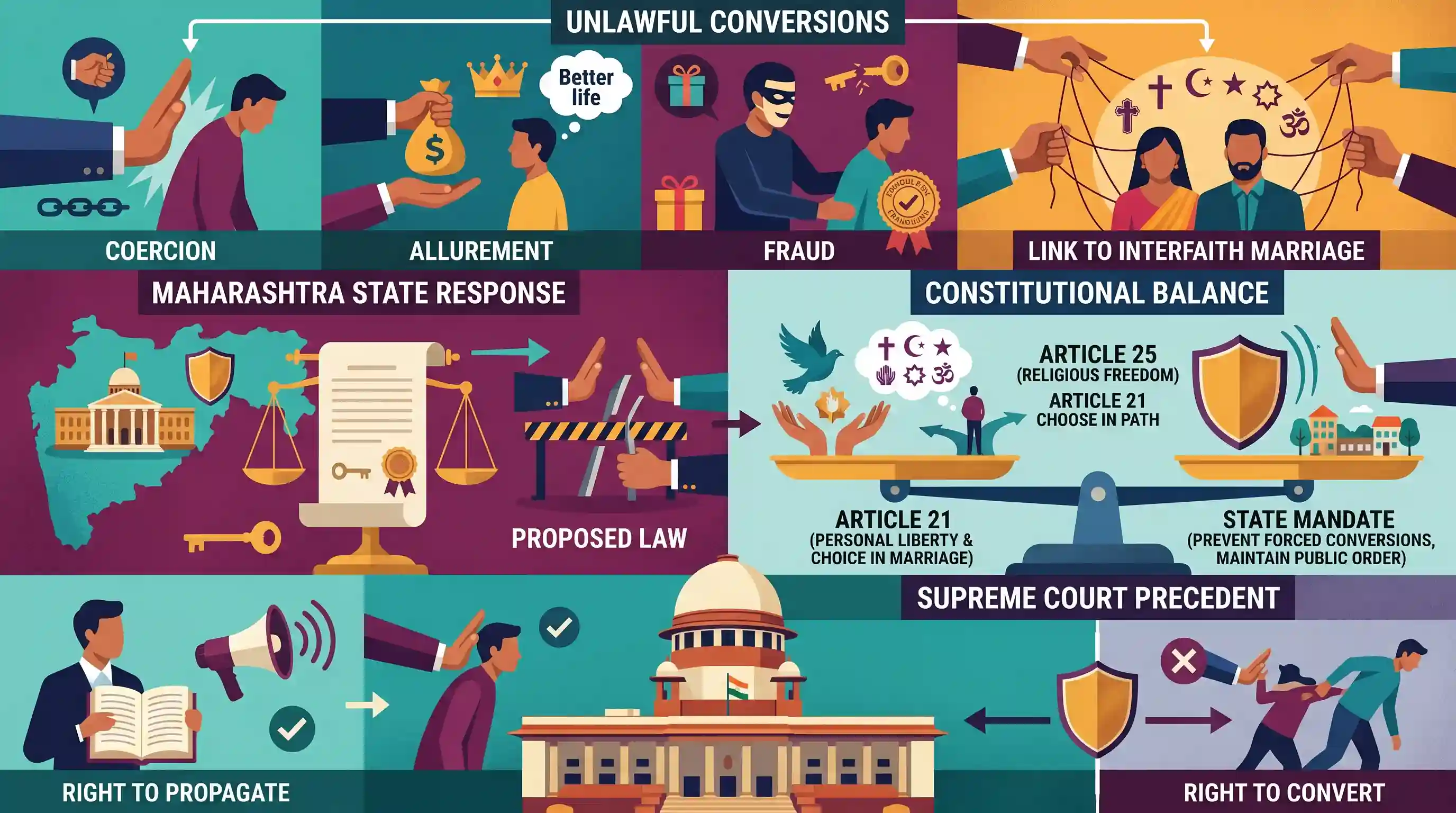
The Maharashtra state government has announced its intention to draft a law aimed at stopping forceful religious conversions. Often termed 'Freedom of Religion' laws, these legislations target conversions achieved via coercion, allurement, or fraudulent means, and frequently address conversions linked to interfaith marriages. The proposed law brings to the forefront the constitutional balance between an individual's fundamental right to religious freedom (Article 25) and personal liberty/choice in marriage (Article 21), versus the state's mandate to prevent forced conversions and maintain public order. The underlying legal precedent stems from the Supreme Court's ruling that the right to propagate one's religion does not equate to a fundamental right to convert another person.
मुख्य बिंदु
- The Maharashtra government announced plans to introduce a law to prohibit religious conversions carried out through force, fraud, or allurement, mirroring "Freedom of Religion" acts in several other Indian states.
- Such legislations frequently spark constitutional debates over Article 25, which guarantees the freedom to profess, practice, and propagate religion, against the State's authority to restrict activities disrupting public order or involving deceit.
- In the landmark Rev. Stanislaus vs. State of Madhya Pradesh (1977) case, the Supreme Court upheld that the constitutional right to 'propagate' religion does not include a fundamental right to convert another person.
- Proposed anti-conversion laws often scrutinize inter-faith marriages, raising potential conflicts with Article 21, which the Supreme Court has interpreted to include the fundamental right to privacy and the right to marry a person of one's choice.
महत्वपूर्ण शब्द
Freedom of Religion Bill (Maharashtra, 2026)

State law (Dharma Swatantrya Adhiniyam) prohibiting religious conversions through coercion, fraud, or allurement; mandates prior notice to district authorities and criminalizes 'unlawful' conversions in interfaith marriages.
UPSC context
GS Paper 2: सरकारी नीतियां, राज्य-संचालित सामाजिक विधान और निजता एवं धर्म जैसे मौलिक अधिकारों पर प्रभाव।
Article 25 of the Constitution of India
Guarantees all individuals freedom of conscience and the right to profess, practice, and propagate religion, subject to public order, morality, and health.
UPSC context
GS Paper 2: Fundamental Rights. Core provision for secularism and individual religious liberty vs. state regulation.
Article 21 of the Constitution of India
Fundamental right protecting life and personal liberty; judicially expanded to include the right to privacy and the right to marry a person of one's choice.
UPSC context
GS Paper 2: Civil liberties and judicial activism. Tests the conflict between state oversight and personal autonomy in marriage.
Rev. Stanislaus v. State of Madhya Pradesh (1977)
Landmark 1977 judgment where the Supreme Court ruled that the right to 'propagate' religion does not include a fundamental right to convert another person.
UPSC context
GS Paper 2: Important judgments. Establishes the legal precedent for state-level anti-conversion laws in India.
Right to Propagate
Under Article 25, the right to transmit or spread one's religious tenets by exposition; distinguished by the judiciary from the act of active conversion.
UPSC context
GS Paper 2: Constitutional Law. Examines the limits of religious expression and proselytization.
Public Order
One of the reasonable restrictions under Article 25; allows the state to regulate religious activities to prevent communal disharmony or social unrest.
UPSC context
GS Paper 2: Balance between fundamental rights and state security/social stability.
Freedom of Conscience
The internal freedom of an individual to hold beliefs and the external right to follow them; the primary protection offered by Article 25.
UPSC context
GS Paper 2: Secularism and Philosophy of the Constitution. Crucial for understanding individual vs. group rights.
प्रारंभिक ट्रैप
The Right to convert another person is protected under the constitutional right to 'propagate' religion in Article 25.
In the 1977 Rev. Stanislaus case, the Supreme Court ruled that Article 25 guarantees the right to transmit tenets, not a fundamental right to convert.
संबंधित अवधारणाएँ
अनुच्छेद 25 के तहत धार्मिक स्वतंत्रता पर संवैधानिक सीमाएं क्या हैं?
- Public Order: The state can regulate or restrict religious practices if they disturb public peace (the primary legal basis for anti-conversion laws).
- Morality & Health: Practices that violate public morals or endanger public health can be restricted by the State.
- Other Fundamental Rights: Unlike most other fundamental rights, Article 25 is explicitly subject to "the other provisions of this Part" (Part III).
How is the Right to Marry protected under the Indian Constitution?
- Right to Choice: In the Hadiya case (Shafin Jahan v. Asokan K.M.), the Supreme Court ruled that the right to marry a person of one's choice is integral to Article 21.
- Right to Privacy: The K.S. Puttaswamy judgment established that personal choices regarding faith and marriage are protected within the fundamental right to privacy.
अंतर-विषय पैटर्न
State vs. Concurrent List jurisdictions
Anti-conversion laws rely on 'Public Order' (State List), while 'Marriage' and 'Divorce' are Concurrent List subjects, creating complex Centre-State legislative overlaps regarding inter-faith marriages.
Special Marriage Act (SMA) friction
Notice requirements under the Special Marriage Act are frequently challenged on privacy grounds, mirroring the legal battles over prior-notice clauses in state anti-conversion laws.

Expect a 2026 Prelims question testing if Art 25 is subject to 'other fundamental rights' and the Rev. Stanislaus 'propagate' distinction.
संबद्ध PYQ · 3
संबद्ध PYQ · 3
- 2019PrelimsGS1
Which Article of the Constitution of India safeguards one's right to marry the person of one's choice?
- 2024MainsGS2
Discuss India as a secular state and compare with the secular principles of the US constitution.
- 2019MainsGS2
What can France learn from the Indian Constitution's approach to secularism?
