Land Fee Waiver for Renewable Energy Units in Maharashtra
Source:constructionworld ↗
Why It Matters
This policy decision directly impacts renewable energy development, fiscal incentives, and infrastructure costs in Maharashtra, making it important for state-level economic and environmental governance questions.
Summary
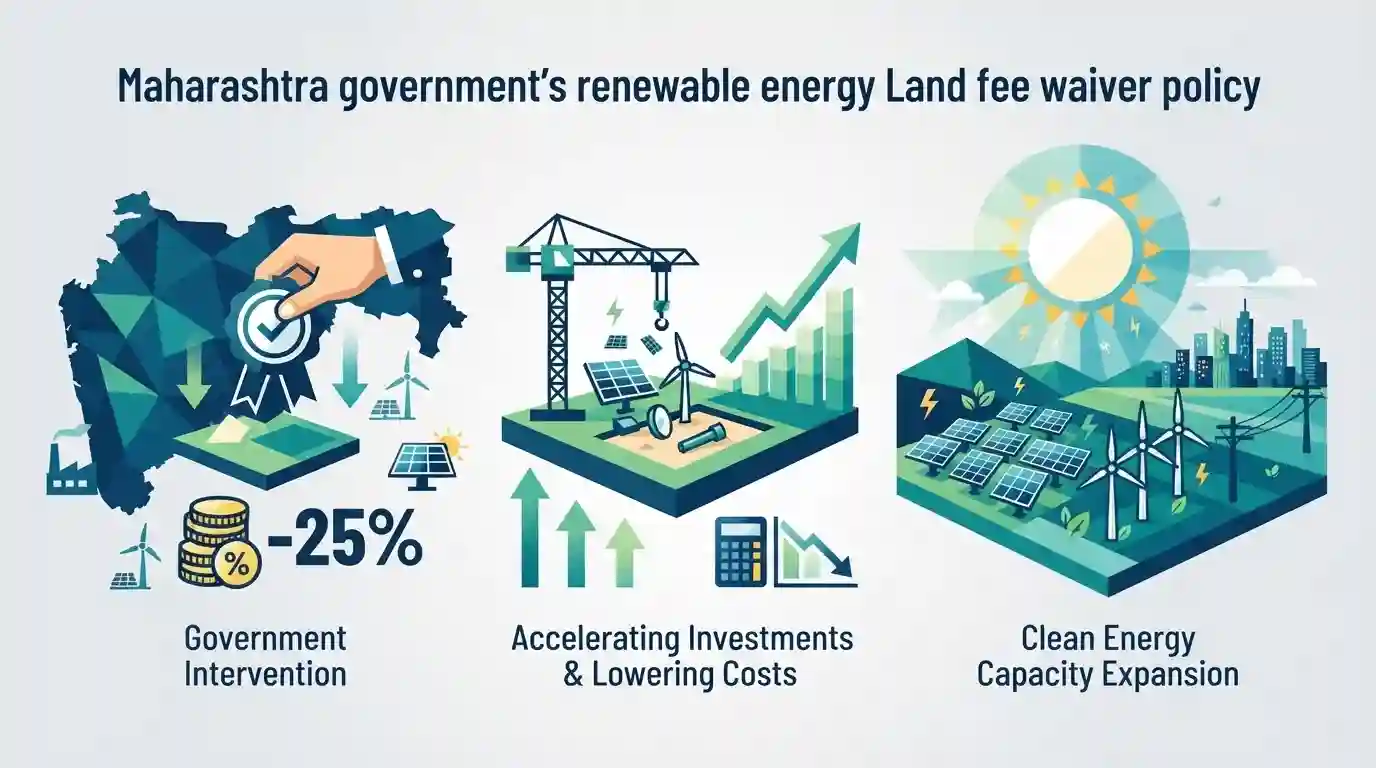
The Maharashtra government has announced a 25 per cent waiver on land fees for renewable energy units, aiming to accelerate investments in green energy, lower project costs, and support clean energy capacity expansion across the state.
Key Points
- The Maharashtra government has waived 25 per cent of the land fee for renewable energy units to boost green energy investments in the state.
- The policy aims to reduce capital expenditure for renewable energy developers, aligning with state and national targets for clean energy generation.
- Maharashtra continues to promote solar and renewable infrastructure, building upon schemes like the Mukhyamantri Saur Krishi Vahini Yojana.
Important Terms
Maharashtra Renewable Energy Land Fee Waiver

A Maharashtra government policy waiver removing the 25% land transfer fee for renewable energy projects when parent companies transfer land titles to specific project subsidiaries.
UPSC context
Important for MPSC General Studies Paper III (Economy & Infrastructure), testing state-level clean energy policies and investment promotion frameworks.
Mukhyamantri Saur Krishi Vahini Yojana
A flagship Maharashtra government scheme aimed at providing reliable daytime electricity to farmers by establishing decentralized solar power plants near agricultural substations.
UPSC context
High priority for MPSC (Mains Paper III - Agriculture and Energy sector reforms), testing state welfare schemes for rural power.
Static Concepts Connected
What are the key provisions and objectives of the Mukhyamantri Saur Krishi Vahini Yojana (MSKVY 2.0)?
- Feeder Solarisation: Feeder Solarisation aims to solarise agricultural feeders across Maharashtra to provide dedicated daytime electricity to farmers.
- Decentralised Capacity: Decentralised Energy reduces transmission losses by installing solar generation units near rural consumption centers.
- Subsidy Burden: Subsidy Reduction targets the lowering of state agricultural power subsidies through cheap solar power generation.
Cross-Topic Patterns
Renewable Incentives vs. Agricultural Land Laws
Renewable energy land fee waivers intersect with Maharashtra's MIDC industrial policies, testing state-level fiscal incentives against agricultural land conversion rules under the Maharashtra Tenancy and Agricultural Lands Act.
Feeder Solarisation and PM-KUSUM Linkages
MSKVY 2.0 decentralised solarisation links state-level feeder solarisation targets with central PM-KUSUM mandates for rural grid resilience and agricultural subsidy rationalisation.

Maharashtra renewable energy policy + land transfer fee waiver (25%) + MSKVY 2.0 likely framed as a multi-statement MPSC economic policy Q.
Linked PYQs · 2
Linked PYQs · 2
- 2024MPSC_PRELIMSGS1
Identify the correct statements regarding the Chief Minister Solar Agricultural Channel Scheme. (a) This Scheme was started in June 2017, when Devendra Fadanvis was Chief Minister. (b) The main purpose of this Scheme is to provide supply of electricity to farmers through the agricultural feeder. (c) The government has decided to pay ₹ 50,000 per acre as rent to the farmers under this Scheme. (d) Solar panels are set up on government land up to ten kilometres from the 33 kV substation.
- 2026MPSC_PRELIMSGS1
Observe the following statements. (a) As per the State Mineral Policy 1999, iron, sulphur, gold, copper and lead mineral production was opened to the private sector. (b) Konkan region has the highest mineral availability after Nagpur region. (c) Maharashtra State Mining Corporation was established in 1973.
