Land Transfer Fee Waiver for Renewable Energy Projects in Maharashtra
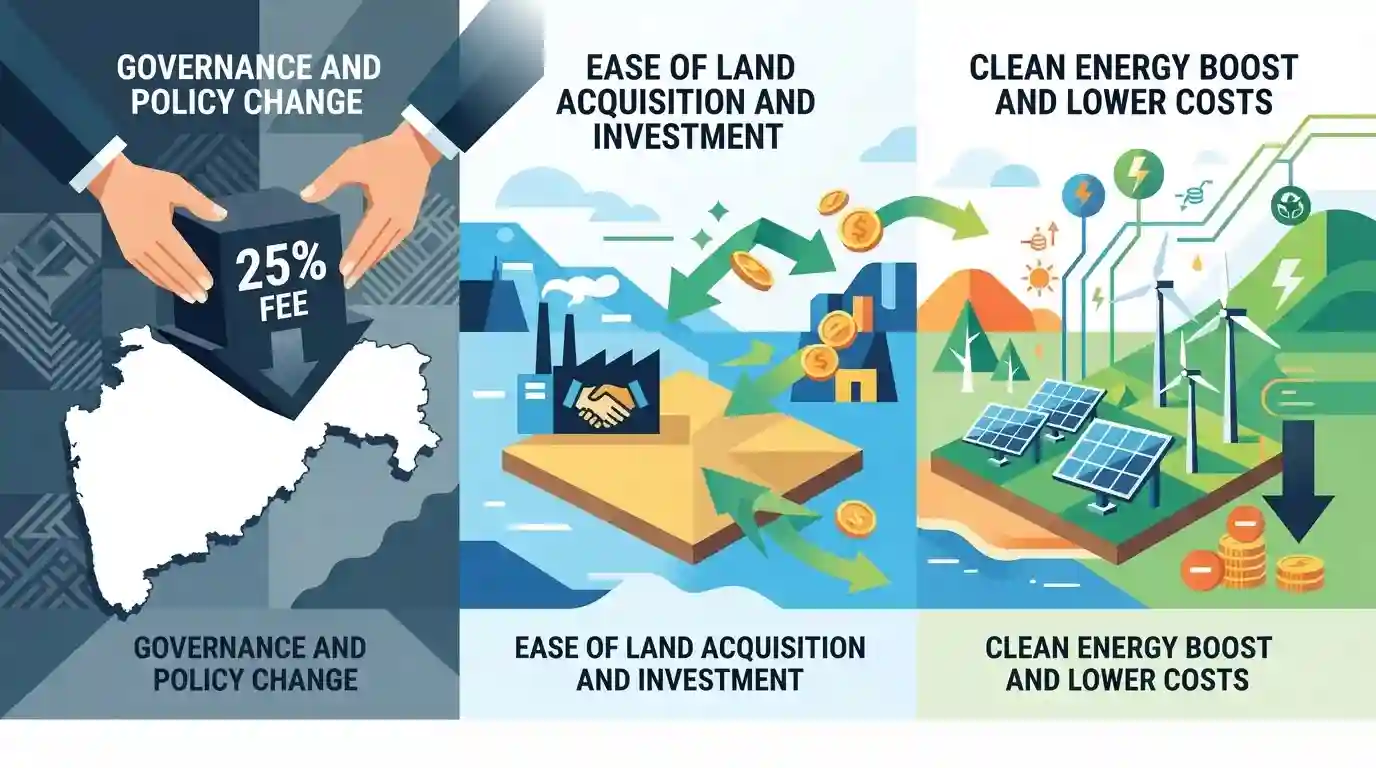
Why It Matters
Crucial policy initiative by the Maharashtra government to remove friction in land acquisition and incentivize large-scale renewable energy infrastructure development.
Summary
The Maharashtra government has waived the 25% land transfer fee for renewable energy projects, aiming to ease land acquisition, lower costs, and boost clean energy investments across the state.
Key Points
- The Maharashtra government has completely waived the 25% land transfer fee for renewable energy projects to accelerate green energy investments in the state.
- This policy move aims to reduce capital expenditure and bureaucratic hurdles for setting up solar, wind, and hybrid renewable energy infrastructure.
- It aligns with Maharashtra's broader climate goals and targets for clean energy adoption, including decentralized solar capacity expansion.
Important Terms
Land Transfer Fee

A statutory levy under state provisions (such as the Maharashtra Tenancy and Agricultural Lands Act) charged at 25% of the land's market value when industrial or agricultural land is internally transferred to a subsidiary or SPV.
UPSC context
Important for MPSC Economy and Governance (State Taxation and Land Reforms). Tests understanding of state fiscal policies affecting renewable energy investments.
Special Purpose Vehicle (SPV)
A Special Purpose Vehicle is a separate legal entity created by a parent corporation to isolate financial risks, commonly utilized by clean energy developers to secure project-specific financing.
UPSC context
Relevant for MPSC Economy (Corporate Structure and Infrastructure Financing). Tests familiarity with corporate mechanisms used in large-scale renewable energy projects.
Government of Maharashtra
The executive body of the state government comprising ministers headed by the Chief Minister, responsible for formulating administrative policies, legislative proposals, and fiscal measures like the renewable land fee waiver.
UPSC context
Essential for MPSC Polity and Governance (State Administration). Tests knowledge of state executive decision-making and policy implementation.
Prelims Trap
Complete exemption of land acquisition costs for renewable energy projects in Maharashtra.
Aspirants often confuse fee waivers (land transfer) with complete land acquisition cost exemptions, missing that capital costs for buying land still apply.
Static Concepts Connected
What are the key institutional mechanisms and policies governing renewable energy development in Maharashtra?
- Policy Framework: Maharashtra Electric Vehicle (EV) Policy and Renewable Energy Policy drive decentralized clean energy adoption.
- Key Agencies: MIDC and Mahagenco play pivotal roles in land acquisition and thermal-to-solar transitions.
Cross-Topic Patterns
Renewable Energy + State Fiscal Deficit
Industrial land allocation policies under MIDC intersect with state renewable energy incentives, directly affecting state fiscal deficit and debt-to-GSDP ratios.

Maharashtra renewable policy land fee waiver likely in a multi-statement MPSC question on state green energy targets and fiscal incentives.
Linked PYQs · 3
Linked PYQs · 3
- 2024MPSC_PRELIMSGS1
Identify the correct statements regarding the Chief Minister Solar Agricultural Channel Scheme. (a) This Scheme was started in June 2017, when Devendra Fadanvis was Chief Minister. (b) The main purpose of this Scheme is to provide supply of electricity to farmers through the agricultural feeder. (c) The government has decided to pay ₹ 50,000 per acre as rent to the farmers under this Scheme. (d) Solar panels are set up on government land up to ten kilometres from the 33 kV substation.
- 2026MPSC_PRELIMSGS1
Observe the following statements. (a) As per the State Mineral Policy 1999, iron, sulphur, gold, copper and lead mineral production was opened to the private sector. (b) Konkan region has the highest mineral availability after Nagpur region. (c) Maharashtra State Mining Corporation was established in 1973.
- 2020MPSC_PRELIMSGS1
What happened in Maharashtra due to fragmentation of agricultural land ? (a) Farmer is not able to produce food grains, sufficient for his family. (b) There are obstacle to supply water to agricultural land. (c) The use of modern agricultural tools is uneconomical. (d) To pay individual attention on agriculture is uneconomical. Answer Options :
