Villagers in Maharashtra protest proposed industrial cement plant
Source:Indian Express ↗
Why It Matters
The article exemplifies the ongoing 'development versus environment' debate, making it highly relevant for UPSC aspirants to understand the practical applications of EIA, land acquisition laws, and the empowerment of local communities through institutions like the Gram Sabha.
Summary
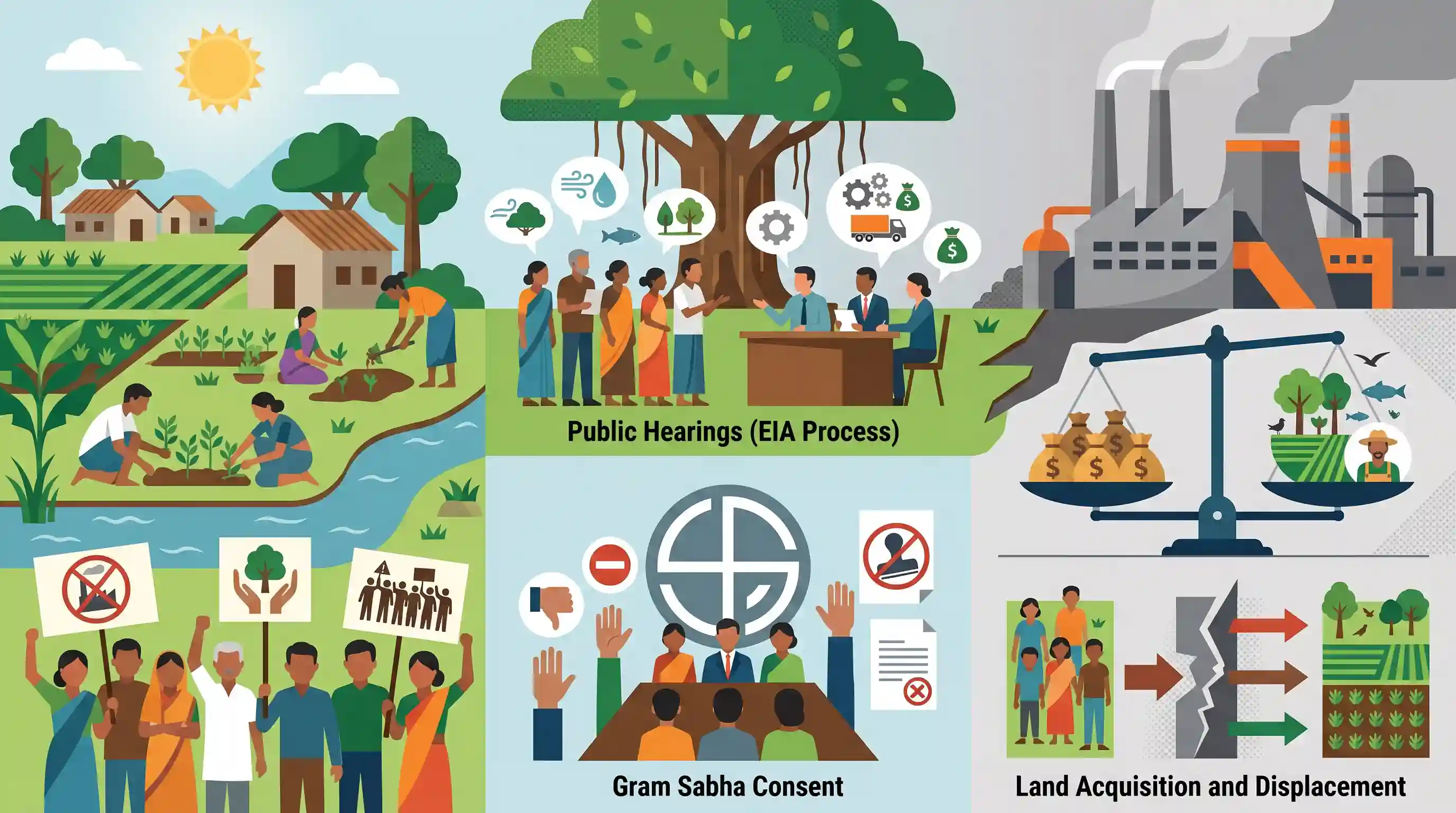
Local villagers in Maharashtra are protesting against the proposed development of an Adani Group cement plant, citing significant concerns over land acquisition, potential displacement, and adverse environmental impacts. The community's opposition underscores the critical role of public hearings mandated by the Environmental Impact Assessment (EIA) process and the necessity of Gram Sabha consent in rural development projects. This conflict serves as a microcosm of the broader tension between large-scale industrialization objectives and the safeguarding of local livelihoods, agriculture, and ecological balance.
Key Points
- Villagers in Maharashtra have been protesting against the establishment of an upcoming cement plant by the Adani Group due to environmental and livelihood concerns.
- The protests emphasize the fear of displacement, loss of agricultural land, and the potential ecological degradation caused by heavy industrial projects.
- Such conflicts highlight the critical importance of public hearings under the Environmental Impact Assessment (EIA) framework to ensure community participation.
- The opposition also brings into focus the rights of the Gram Sabha in providing consent for land acquisition and industrial development, balancing corporate expansion with local rights.
Important Terms
Environmental Impact Assessment (EIA) Notification

A statutory process under the Environment (Protection) Act, 1986, used to evaluate the environmental consequences of a project before granting clearance.
UPSC context
GS Paper 3 (Environment); tests regulatory frameworks, sustainable development, and the 2006 vs 2020 notification debates.
Panchayat Extension to Scheduled Areas (PESA) Act
A 1996 law extending Part IX of the Constitution to tribal areas, empowering Gram Sabhas to manage resources and be consulted on land acquisition.
UPSC context
GS Paper 2 (Governance/Scheduled Areas); tests tribal rights, decentralization, and protections against land alienation.
Gram Sabha
The primary assembly of a village panchayat comprising all registered voters, serving as the core unit of grassroots democracy and social audit.
UPSC context
GS Paper 2 (Polity); tests the 73rd Constitutional Amendment, local self-governance, and participatory decision-making.
Public Hearing
A mandatory step in the EIA process where project proponents interact with local stakeholders to address concerns about environment and livelihood impacts.
UPSC context
GS Paper 3 (Environmental Governance); tests the effectiveness of public participation and transparency in industrial clearances.
Adani Group
A diversified Indian conglomerate; its projects often spark debates regarding industrialization, land acquisition, and the balance between development and environmental protection.
UPSC context
GS Paper 3 (Infrastructure/Economy); relevant for studying land-use conflicts, corporate accountability, and large-scale project implementation.
Prelims Trap
"A public hearing under the EIA process is mandatory for all industrial and infrastructure projects."
False. Under the EIA Notification 2006, Category B2 projects, along with certain linear infrastructure or defense projects, are completely exempt from public consultation.
Static Concepts Connected
What are the four main stages of the EIA process in India?
- Screening: Determines if the project requires a full EIA based on its capacity and potential impact (categorized as A, B1, or exempt B2).
- Scoping: The Expert Appraisal Committee (EAC) formulates detailed Terms of Reference (ToR) required for preparing the comprehensive EIA report.
- Public Consultation: The State Pollution Control Board (SPCB) conducts a public hearing to record the objections and concerns of locally affected persons.
- Appraisal: Final scrutiny of the EIA report and public hearing proceedings by the EAC before recommending environmental clearance or rejection.
How does land acquisition consent differ under the RFCTLARR Act and PESA?
- RFCTLARR Act 2013: Mandates prior consent of 80% of affected families for private corporate projects, and 70% for Public-Private Partnership (PPP) projects.
- PESA Act 1996: Makes it legally binding to hold prior consultation with the Gram Sabha before acquiring any land or resettling people in Scheduled Areas.
- SIA Mechanism: Mandates a Social Impact Assessment in consultation with local self-governments to scientifically evaluate livelihood loss before acquisition begins.
Cross-Topic Patterns
Overlap of LARR, PESA, and FRA
Disputes often mix land acquisition laws with tribal and forest protections. UPSC tests how the Gram Sabha acts as the nodal democratic authority across LARR, PESA, and FRA frameworks.
Corporate expansion vs. EIA dilution
Recent amendments exempting certain sectors from EIA public hearings contrast with grassroots protests. Expect mains questions balancing 'ease of doing business' reforms with 'ecological and livelihood safeguards'.

Expect a multi-statement question in 2026 linking Gram Sabha powers under PESA with the Social Impact Assessment mechanism of the LARR Act.
Linked PYQs · 4
Linked PYQs · 4
- 2024MainsGS3
What role do environmental NGOs and activists play in influencing Environmental Impact Assessment (EIA) outcomes for major projects in India? Cite four examples with all important details.
- 2014MainsGS3
Environmental Impact Assessment studies are increasingly undertaken before a project is cleared by the Government. Discuss the environmental impacts of coal-fired thermal plants located at coal pitheads.
- 2013PrelimsGS1
The Government enacted the Panchayat Extension to Scheduled Areas (PESA) Act in 1996. Which one of the following is not identified as its objective?
- 2016MainsGS3
Rehabilitation of human settlements is one of the important environmental impacts which always attracts controversy while planning major projects. Discuss the measures to be adopted to mitigate the impact of the recent incidents of cloudbursts in many places of Uttarakhand.
