Crop Damage Due to Unseasonal Rains Across Maharashtra
Source:Indian Express ↗
Why It Matters
Understanding agricultural vulnerabilities to unseasonal weather patterns and disaster relief mechanisms is crucial for Maharashtra state governance and economy questions in MPSC Combined Prelims.
Summary
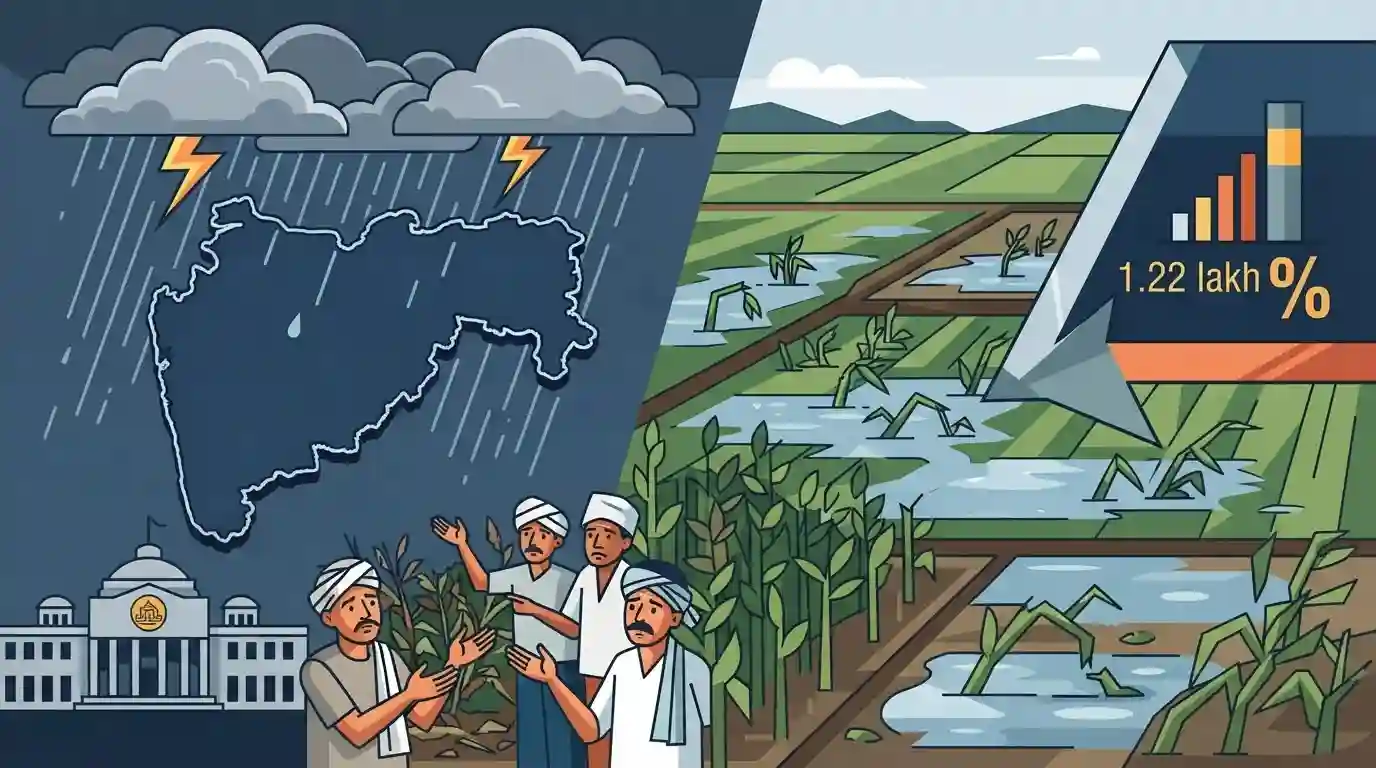
Widespread unseasonal rains across Maharashtra led to extensive agricultural damage, impacting over 1.22 lakh hectares of crop land and prompting demands for immediate relief and compensation for affected farmers.
Key Points
- Unseasonal rains in Maharashtra caused widespread crop damage affecting over 1.22 lakh hectares of agricultural land.
- Farmers faced massive losses in key Rabi and late-kharif crops due to unseasonal downpours and sudden weather fluctuations.
- The state government is evaluating crop loss assessments to disburse compensation and relief funds under disaster management guidelines (SDRF/NDRF norms).
Important Terms
State Disaster Response Fund

A primary pool of funds made available to state governments by the central government under the Disaster Management Act to meet immediate relief requirements during notified natural calamities.
UPSC context
MPSC Paper III (Economy/Disaster Management): Tests knowledge of disaster financing, resource allocation, and relief mechanisms for agrarian crises.
National Disaster Response Fund
A central fund utilized to provide supplementary financial assistance and relief to states when a natural disaster is of severe magnitude, requiring resources beyond the state's own fund.
UPSC context
MPSC Paper III (Disaster Management): Tests the division of financial responsibilities between Centre and States during catastrophic events.
State Government of Maharashtra
The administrative body responsible for formulating policy, executing agricultural relief packages, and coordinating damage assessments (panchnamas) for farmers affected by unseasonal rains in Maharashtra.
UPSC context
MPSC Paper I & II (Polity & Governance / Maharashtra Specific): Tests understanding of state administration, welfare schemes, and agrarian policy implementation.
Prelims Trap
NDRF provides direct unconditional compensation to all farmers affected by unseasonal rains without state-level assessment.
Aspirants often assume NDRF automatically covers all agricultural losses without requiring the state government to first exhaust SDRF allocations and conduct formal pan-district panchnamas.
Static Concepts Connected
What are the key financial sharing ratios and operational norms governing SDRF and NDRF in India?
- Funding Ratio: Central share is 75% for general states and 90% for North-Eastern and Himalayan states under the State Disaster Response Fund.
- NDRF Role: NDRF supplements SDRF when a calamity is of a severe nature and local funds are inadequate to handle immediate relief.
- Management: Managed through state-level committees headed by the Chief Secretary based on notified natural calamities under MHA guidelines.
Cross-Topic Patterns
Crop Loss Relief & Fiscal Federalism
Agricultural disaster relief financing links state-level fiscal management under FRBM with calamity funding mechanisms like SDRF and NDRF.
Climate Vulnerability & Regional Agrarian Distress
Unseasonal rains in Marathwada and Vidarbha highlight recurring climate vulnerabilities intersecting with district-level agrarian distress and micro-irrigation policies.

Expect statement-based questions on SDRF/NDRF funding ratio, crop loss eligibility criteria, and administrative relief limits in Maharashtra.
Linked PYQs · 3
Linked PYQs · 3
- 2025MPSC_PRELIMSGS1
_______ Monsoon winds blow in Maharashtra from June to September.
- 2024MPSC_PRELIMSGS1
Identify the correct statements regarding the Chief Minister Solar Agricultural Channel Scheme. (a) This Scheme was started in June 2017, when Devendra Fadanvis was Chief Minister. (b) The main purpose of this Scheme is to provide supply of electricity to farmers through the agricultural feeder. (c) The government has decided to pay ₹ 50,000 per acre as rent to the farmers under this Scheme. (d) Solar panels are set up on government land up to ten kilometres from the 33 kV substation.
- 2026MPSC_PRELIMSGS1
Consider the following statements regarding the Public Distribution System (PDS) in Maharashtra. (a) By December 2025, there were 270.48 lakh ration card holders in the state. (b) As of 31 October 2025, 51,636 Fair price shops were functioning in the state. (c) By October 2025, about 1.55 crore families received food grains through Aadhaar - based biometric authentication. Which of the statements given above is/are correct ?
