Maharashtra Universities Adopt Common Academic Calendar and ATKT Rules
Source:news-careers360 ↗
Why It Matters
Important for understanding administrative reforms in Maharashtra's higher education system and the uniform implementation of NEP 2020.
Summary
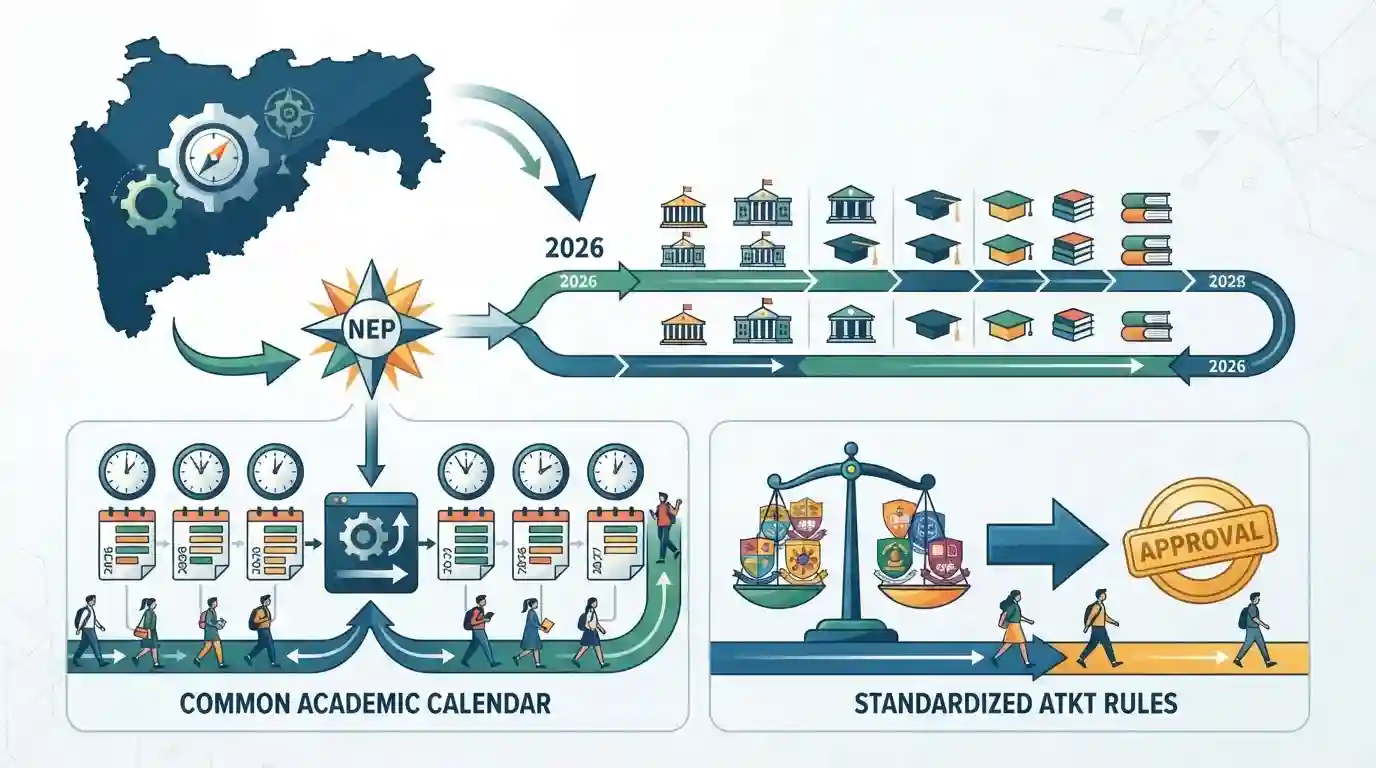
Starting from the 2026-27 academic year, universities across Maharashtra will adopt a common academic calendar and standardized ATKT rules, streamlining higher education administration and aligning with the National Education Policy (NEP) 2020 framework.
Key Points
- Maharashtra universities are adopting a common academic calendar starting from the 2026-27 academic year to streamline higher education schedules.
- The unified framework brings focus to examination schedules, admissions, vacations, and ATKT (Allowed to Keep Term) rules across state institutions.
- The initiative aligns with the broader implementation of the National Education Policy (NEP) 2020 in Maharashtra's higher education sector.
Important Terms
National Education Policy (NEP) 2020

A comprehensive national reform framework introduced in 2020 to overhaul India’s educational structure, emphasizing holistic multidisciplinary learning, flexible curricula, and seamless credit transfers across higher education institutions.
UPSC context
MPSC General Studies Paper II (Social Sector/Education Policy). Tests understanding of structural educational reforms and state-level implementation challenges.
Maharashtra Universities
Statutory higher education institutions established under state legislation across Maharashtra to regulate collegiate instruction, research, and degree certifications, now integrating standardized operational timelines.
UPSC context
MPSC General Studies Paper V (Maharashtra Governance and Higher Education). Evaluates administrative decentralization, state-level institutional coordination, and policy alignment.
Prelims Trap
Starting from the 2026-27 academic year, all universities across Maharashtra including central institutions will adopt a common calendar.
Aspirants may confuse the 2026-27 implementation year with immediate effect, or assume common calendars apply to central universities located in Maharashtra like IIT or TISS.
Static Concepts Connected
What are the key objectives and institutional mechanisms of the National Education Policy (NEP) 2020 in higher education?
- Flexible Entry-Exit: Multiple Entry and Exit options allowing certificate, diploma, or degree completion at various stages.
- Credit Mobility: Academic Bank of Credits (ABC) digital platform to store and transfer academic credits earned from recognized institutions.
- Single Regulator: Higher Education Commission of India (HECI) as a single overarching umbrella body for regulation, excluding medical and legal education.
Cross-Topic Patterns
NEP 2020 + Academic Bank of Credits
Standardizing academic calendars and credit transfers across state universities operationalizes the Academic Bank of Credits (ABC) envisioned under NEP 2020.
State Higher Education Councils + Federalism
State-level coordination bodies like MahaSARC reflect administrative federalism in higher education, balancing state autonomy with national framework goals.

Expect statement-based questions on MahaSARC's role and standardized ATKT rules under Maharashtra's NEP 2020 implementation for 2026-27.
Linked PYQs · 1
Linked PYQs · 1
- 2024MPSC_PRELIMSGS1
Match the following pairs : | List-I | List-II | |---|---| | (a) Dr. Nitin Karmalkar Committee | (i) For implementation of National Education Policy - 2020 in Maharashtra | | (b) Nitin Karir Committee | (ii) To enquire the incident which happened during the distribution of Maharashtra Bhushan Award | | (c) Sunil Pawar Committee | (iii) To study why the rates of onion collapse. | | (d) Dr. K. Kasturirangan Committee | (iv) To make the syllabus for pre-primary to degree according to National Education Policy - 2020 | Code: (a) (b) (c) (d)
