Maharashtra Leopard Translocation to Vantara Facility in Gujarat
Source:The Hindu ↗
Why It Matters
The rising incidence of human-wildlife conflict is a major conservation challenge in India. The involvement of private rehabilitation centers (like Vantara) in managing captured wild animals introduces an important dimension to ex-situ conservation strategies, relevant for GS3 Environment and Ecology.
Summary
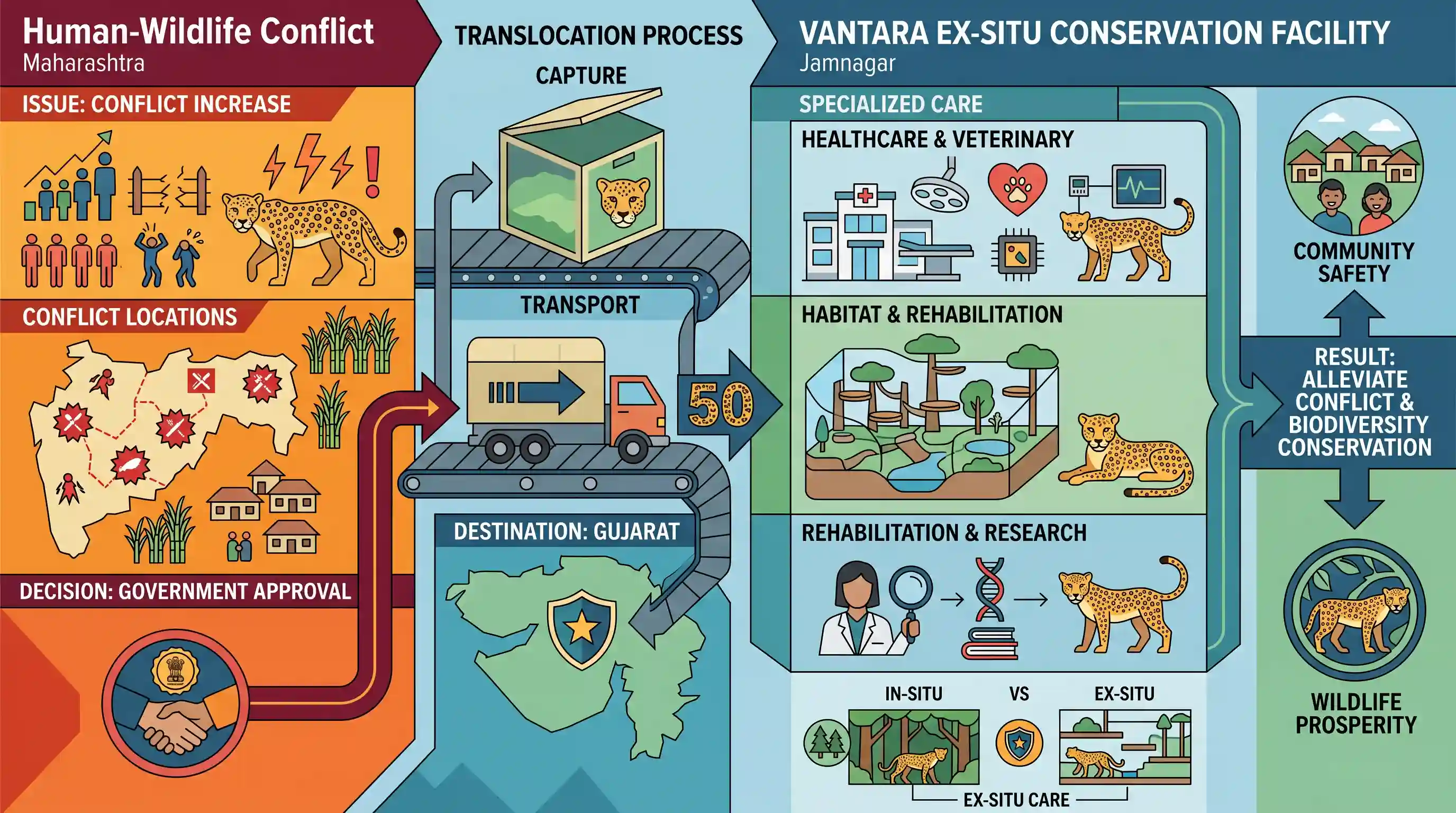
The Maharashtra government has approved the translocation of 50 leopards to the Reliance Foundation's Vantara wildlife rescue and rehabilitation center in Jamnagar, Gujarat. The decision aims to alleviate the increasing human-leopard conflicts in parts of Maharashtra while ensuring that the captured big cats receive specialized care in a dedicated ex-situ conservation facility.
Key Points
- Maharashtra is translocating 50 leopards to mitigate rising human-leopard conflicts within the state.
- The big cats will be relocated to Vantara, a major wildlife rescue and conservation facility in Jamnagar, Gujarat, operated by the Reliance Foundation.
- This move highlights the growing role of private conservation facilities in ex-situ wildlife management and animal rehabilitation.
- Relocating wild animals—especially Schedule I species like leopards—is governed by stringent regulations under the Wildlife (Protection) Act to balance conservation with public safety.
Important Terms
Wildlife (Protection) Act, 1972

A landmark Indian law providing the legal framework for protecting wild animals, plants, and habitats. The 2022 amendment rationalized its schedules and implemented CITES provisions for international trade regulation.
UPSC context
GS Paper III: Environment. Essential for understanding legal safeguards, protected area management, and the powers of Chief Wildlife Wardens.
Ex-situ Conservation
The preservation of biological diversity components outside their natural habitats. This includes zoological parks, botanical gardens, gene banks, and specialized rescue centers like Vantara for rehabilitation and research.
UPSC context
GS Paper III: Biodiversity. Tests knowledge of complementary conservation strategies and the role of human-managed environments in species survival.
Human-Wildlife Conflict (HWC)
Negative interactions between humans and wildlife that lead to damage to life, property, or resources. It is often driven by habitat fragmentation, land-use changes, and increasing animal populations.
UPSC context
GS Paper III: Environment. A major socio-ecological challenge testing mitigation strategies, community participation, and policy-level interventions.
Vantara
A 3,000-acre wildlife rescue and rehabilitation initiative in Jamnagar, Gujarat, established by the Reliance Foundation. It serves as a specialized ex-situ facility for treating and caring for injured or conflict-prone animals.
UPSC context
GS Paper III: Environment/CSR. A case study for private sector participation in large-scale wildlife rehabilitation and advanced veterinary care.
Central Zoo Authority (CZA)
A statutory body under the Ministry of Environment, Forest and Climate Change that regulates and sets standards for the operation of zoos and rescue centers across India.
UPSC context
GS Paper III: Statutory Bodies. Relevant for understanding the regulatory oversight of animal translocation and ex-situ conservation facilities.
Translocation
The intentional movement of wild animals from one location to another, typically to re-establish populations, manage human-animal conflict, or provide specialized care in rescue centers.
UPSC context
GS Paper III: Wildlife Management. Evaluates scientific methods of conflict mitigation and the ecological implications of moving apex predators.
Prelims Trap
Translocation of Schedule I species requires Central Government approval and they can only be housed in state-owned zoos.
Under WPA 1972, the State Chief Wildlife Warden approves capture/translocation. Private rescue centers can house them if regulated by the Central Zoo Authority.
Static Concepts Connected
What is the statutory mandate of the Central Zoo Authority (CZA)?
- Establishment: It is a statutory body established under the Wildlife (Protection) Act, 1972, chaired by the Union Environment Minister.
- Regulation: It oversees, evaluates, and recognizes both public and private zoos, captive breeding centers, and rescue facilities across India.
- Animal Transfers: The CZA strictly regulates and must approve the exchange or transfer of animals between recognized zoos and rescue centers.
How is the Indian Leopard legally protected in India and globally?
- National Law: Listed under Schedule I of the WPA 1972, granting absolute protection. Capture requires written permission from the Chief Wildlife Warden.
- IUCN Status: Categorized as 'Vulnerable' on the IUCN Red List due to habitat fragmentation and retaliatory killings.
- CITES: Listed under Appendix I, which prohibits international commercial trade in the species or its body parts.
Cross-Topic Patterns
CSR funding in Ex-situ Conservation
Private mega-facilities like Vantara signal a shift towards CSR-funded wildlife rehabilitation, blurring lines between private corporate philanthropy and state wildlife management mandates.
HWC as a State-specific Disaster
Rising leopard encounters reflect shrinking buffers. This links to disaster management, as states like UP and Kerala have recently declared human-wildlife conflict a state-specific disaster to access SDRF funds.

Expect a 2026 prelims question pairing the statutory powers of the Chief Wildlife Warden with CZA's mandate over private rescue centers.
Linked PYQs · 3
Linked PYQs · 3
- 2022PrelimsGS1
With reference to Indian laws about wildlife protection, consider the following statements : 1. Wild animals are the sole property of the government. 2. When a wild animal is declared protected, such animal is entitled for equal protection whether it is found in protected areas or outside. 3. Apprehension of a protected wild animal becoming a danger to human life is sufficient ground for its capture or killing. Which of the statements given above is/are correct?
- 2024PrelimsGS1
Consider the following statements: 1. Lions do not have a particular breeding season. 2. Unlike most other big cats, cheetahs do not roar. 3. Unlike male lions, male leopards do not proclaim their territory by scent marking. Which of the statements given above are correct?
- 2017PrelimsGS1
In India, if a species of tortoise is declared protected under Schedule I of the Wildlife (Protection) Act, 1972, what does it imply?
