Maharashtra Policy to Register Women Cooperatives for Public Contracts
Source:The Hindu ↗
Why It Matters
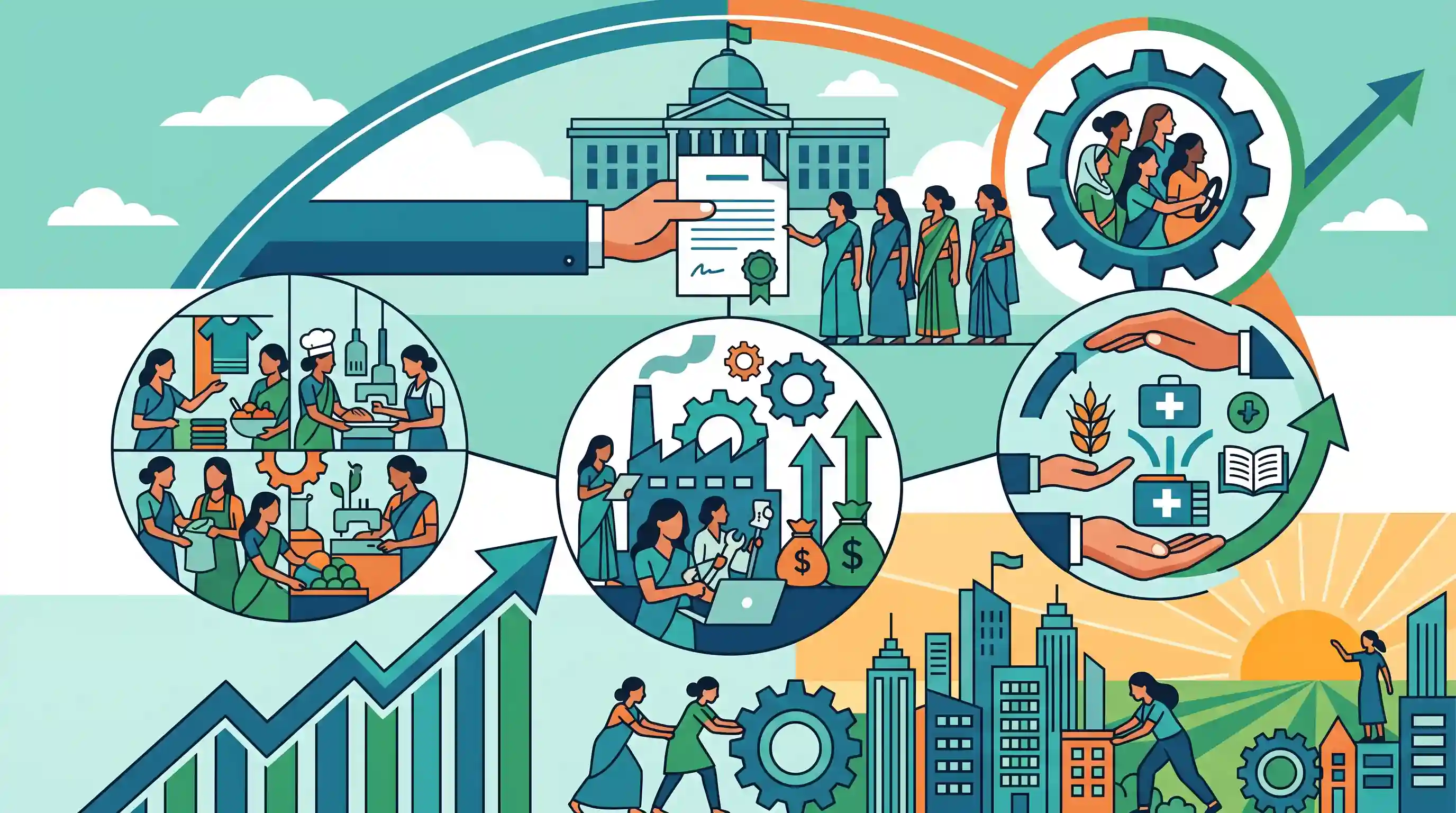
The policy exemplifies state-level interventions for women's economic empowerment beyond traditional welfare, using public procurement and cooperative structures to integrate women into trade and industry. This provides a practical case study for GS2 (Governance/Social Justice) and GS3 (Economy/Cooperatives).
Summary
The Maharashtra government has announced a policy to register women's cooperative societies and allocate state government contracts to them, aiming to enhance women's economic empowerment and participation in trade and industry. Chief Minister Devendra Fadnavis also assured that existing pre-election welfare schemes would continue uninterrupted, highlighting the pivotal role women will play in India's broader economic growth trajectory over the next two decades.
Key Points
- The Maharashtra Government will register women's cooperative societies and award them state contracts to boost their participation in industry, commerce, and trade.
- Decisions will be made regarding the rights and share of women's cooperative societies in government-issued work orders.
- Chief Minister Devendra Fadnavis assured that all welfare schemes announced prior to the 2024 State Assembly elections will continue for the next five years.
- The initiative recognizes the crucial role of women's economic participation as India aims to become the first or second-largest global economy in the next two decades.
Important Terms
Cooperative Societies

Voluntary, member-owned associations providing self-help and mutual assistance. Recognized as a fundamental right (Art 19(1)(c)) and supported by DPSP Art 43B and Part IXB of the Constitution.
UPSC context
GS Paper 2 (Governance/Constitutional Provisions) and GS Paper 3 (Agriculture/Economy). Tests knowledge of cooperative movement and constitutional safeguards.
Public Procurement
The process by which government bodies purchase goods, services, or works from the private sector. It is used as a strategic tool to support MSMEs and women-led enterprises.
UPSC context
GS Paper 3 (Economic Development/MSMEs). Focuses on government e-Marketplace (GeM) and reservation policies for marginalized groups.
Inclusive Growth
Economic growth that creates equitable opportunities and distributes benefits across all sections of society, particularly reducing gender, regional, and social disparities.
UPSC context
GS Paper 3 (Major Topic). Tests understanding of how policies bridge economic gaps for women and rural populations.
Women's Economic Empowerment
The process of increasing women's access to economic resources, decision-making power, and agency, often through credit, training, and market linkages like government contracts.
UPSC context
GS Paper 1 (Social Issues) and GS Paper 2 (Welfare Schemes). Essential for questions on gender justice and development.
Self-Help Groups (SHGs)
Small informal groups of 10-20 people who pool resources for mutual benefit. Their federations are increasingly being formalised into registered cooperative societies to access larger contracts.
UPSC context
GS Paper 2 (Governance/Social Justice). Tests the role of civil society and informal collectives in grassroots development.
97th Constitutional Amendment Act
A constitutional amendment that granted fundamental right status to cooperatives and introduced Part IXB, providing a framework for their democratic control and autonomous functioning.
UPSC context
GS Paper 2 (Constitution). Frequently tested in Prelims and Mains regarding the legal status of cooperative societies.
Prelims Trap
"The central government mandates that 33% of total annual public procurement must be sourced from women-owned enterprises."
Aspirants confuse the 33% political reservation (Nari Shakti Vandan Adhiniyam) with the Public Procurement Policy, which actually mandates a 3% target for women-owned MSEs.
Static Concepts Connected
How are Cooperative Societies regulated under the Indian Constitution?
- Constitutional Status: The 97th Amendment Act (2011) gave cooperative societies constitutional protection and status, adding Part IXB.
- Fundamental Right: Article 19(1)(c) guarantees the right to form cooperative societies as a Fundamental Right.
- State Subject: They fall under Entry 32 of the State List, meaning individual states govern their incorporation and regulation (unless they are multi-state).
What is the National Cooperative Development Corporation (NCDC)?
- Statutory Body: Established under the NCDC Act, 1962, it is a statutory body functioning under the newly created Ministry of Cooperation.
- Core Mandate: It plans and promotes programs for the production, processing, and marketing of agricultural and industrial goods via cooperatives.
- Targeted Schemes: It runs initiatives like the 'Nandini Sahakar Scheme' providing financial assistance and interest subvention specifically to women cooperatives.
Cross-Topic Patterns
SHG to Cooperative Transition
India is shifting from basic micro-credit empowerment (SHG-bank linkages) to formalizing women's economic power through cooperatives capable of securing large public procurement contracts.
Gender-Responsive Public Procurement
Using state buying power to mandate inclusion links economic policy with social justice, a trend increasingly visible in MSME mandates and GeM (Government e-Marketplace) portal reforms.

Expect a multi-statement question combining constitutional provisions of cooperatives (97th CAA) with public procurement quotas for women.
Linked PYQs · 5
Linked PYQs · 5
- 2025MainsGS2
Women's social capital complements in advancing empowerment and gender equity. Explain.
- 2020MainsGS2
Micro-Finance as an anti-poverty vaccine, is aimed at asset creation and income security of the rural poor in India". Evaluate the role of the Self Help Groups in achieving the twin objectives along with empowering women in rural India.
- 2014MainsGS3
In the villages itself no form of credit organization will be suitable except the cooperative society. -All India Rural Credit Survey. Discuss this statement in the background of agricultural finance in India. What constraints and challenges do financial institutions supplying agricultural finance face? How can technology be used to better reach and serve rural clients?
- 2024MainsGS1
Distinguish between gender equality, gender equity and women's empowerment. Why is it important to take gender concerns into account in programme design and implementation?
- 2019MainsGS1
“Empowering women is the key to control population growth.” Discuss.
