Maharashtra Economic Growth Rate and Viksit Bharat Roadmap
Source:the-print ↗
Why It Matters
Understanding state-level contributions to national goals like 'Viksit Bharat 2047' is crucial for MPSC aspirants. The article highlights key developmental frameworks (Sapta Dhara), regional economic strategies (district growth engines), and major agricultural policies in Maharashtra, all of which are highly testable topics under Economy and Geography in the Prelims and Mains.
Summary
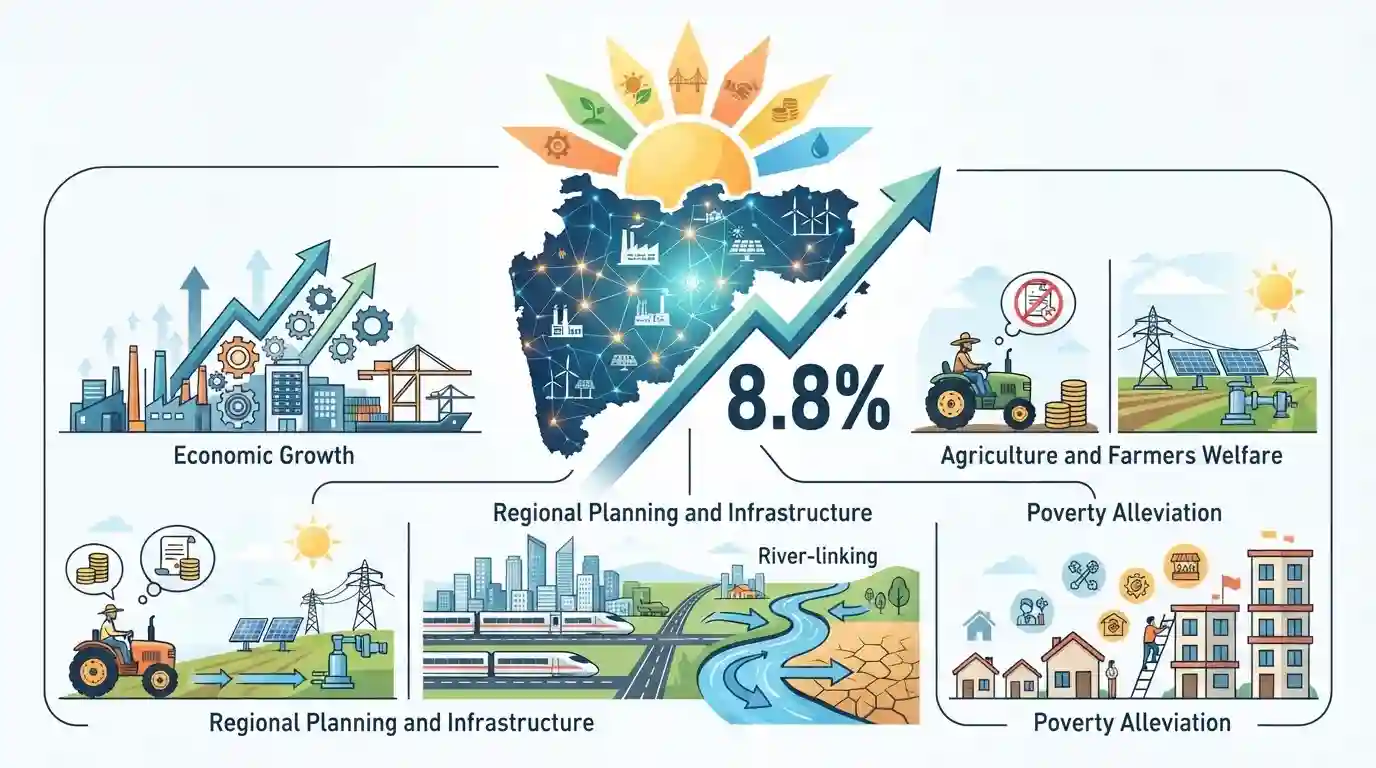
Maharashtra's Deputy Chief Minister Devendra Fadnavis highlighted the state's pivotal role in achieving the 'Viksit Bharat 2047' vision, backed by an impressive 8.8% economic growth rate. Driven by policies that transform districts into 'growth engines' and robust agricultural schemes like a massive farmer loan waiver and improved daytime electricity access, Maharashtra aims to lead the nation's progress. The strategy aligns closely with PM Modi's 'Sapta Dhara' framework, emphasizing comprehensive development across sectors like manufacturing, green economy, and agriculture, alongside critical infrastructure projects such as regional river-linking to combat drought.
Key Points
- Maharashtra recorded an 8.8% economic growth rate in the first half of the year, establishing itself as India's leading economic state and startup capital.
- The state government is focused on making every district a 'growth engine', with 13 districts already achieving significant developmental milestones.
- Prime Minister Modi's 'Sapta Dhara' (seven-point reform framework) focuses on manufacturing, agro-food production, technology, logistics, defence, green/blue economy, and soft power to achieve a developed India by 2047.
- Agricultural support includes a Rs 36,585-crore loan waiver benefiting 56 lakh farmers and an initiative to ensure 100% daytime electricity for agriculture within the next year.
- River-linking projects in North and Western Maharashtra are being prioritized to permanently address drought conditions in these regions.
- Nationally, 25 crore people have been lifted out of poverty over the last 12 years as India became the world's fourth-largest economy.
Important Terms
Viksit Bharat 2047

The Government of India's long-term roadmap aimed at transforming India into a fully developed, inclusive, and technologically advanced economic powerhouse by its 100th year of independence in 2047.
UPSC context
GS-3 (Economic Development). Tests knowledge of long-term national economic targets and their alignment with state-level policies.
Sapta Dhara framework
A seven-pillar national development strategy focusing on manufacturing, agriculture, technology, infrastructure, defense, the green/blue economy, and soft power to accelerate India's journey toward becoming a developed nation.
UPSC context
GS-3 (Economy/Infrastructure). Tests awareness of central macroeconomic strategies guiding subsequent state-level economic planning.
Maharashtra Farm Loan Waiver Scheme
A major state government agricultural relief initiative providing Rs 36,585 crore in debt forgiveness, designed to alleviate the financial burden on over 56 lakh distressed farmers across Maharashtra.
UPSC context
GS-3 (Agriculture) & State Economy. Evaluates understanding of state interventions for agrarian distress and rural poverty alleviation.
Mukhyamantri Saur Krushi Vahini Yojana 2.0
A Maharashtra state scheme (MSKVY 2.0) that develops decentralized solar parks to provide farmers with reliable, continuous eight-hour daytime electricity for irrigation pumps, reducing reliance on night-time power.
UPSC context
GS-3 (Energy/Agriculture). Crucial for questions on renewable energy integration, solarizing agriculture, and improving farmer welfare.
Prelims Trap
River-linking projects in Maharashtra are prioritized exclusively for the Marathwada and Vidarbha regions.
While Marathwada and Vidarbha are historically drought-prone, aspirants may wrongly assume all drought mitigation targets them. This specific river-linking initiative targets North and Western Maharashtra.
Static Concepts Connected
What is the Mukhyamantri Saur Krushi Vahini Yojana (MSKVY)?
- Primary Goal: To ensure 100% reliable, daytime electricity supply to agricultural consumers across the state.
- Methodology: Rapid solarization of agricultural feeders through decentralized solar power projects (typically 0.5 to 10 MW) near substations.
- Economic Impact: It systematically reduces the cross-subsidy burden on industrial consumers and complements the central PM-KUSUM scheme.
What is the 'Sapta Dhara' framework?
- Core Vision: A seven-pillar macroeconomic reform strategy launched by the Prime Minister to achieve 'Viksit Bharat' by 2047.
- The 7 Pillars: Manufacturing, agriculture, technology, logistics (Gati Shakti), defence, green/blue economy, and soft power.
Cross-Topic Patterns
MSKVY + Farm Distress Relief
Daytime solar power for agriculture structurally reduces input costs, complementing short-term fiscal measures like the Rs 36,585-crore farmer loan waiver to alleviate distress.
Sapta Dhara + Regional Planning
The national 7-pillar 'Sapta Dhara' model requires localized execution, directly linking to Maharashtra's decentralized planning strategy of turning individual districts into independent 'growth engines'.

Expect multi-statement MPSC questions identifying the 7 pillars of 'Sapta Dhara' or matching state schemes like MSKVY with their goals.
Linked PYQs · 4
Linked PYQs · 4
- 2010MPSC_PRELIMSGS1
When did Government of Maharashtra declare the farmers debt waive scheme ?
- 2023MPSC_PRELIMSGS1
In the Budget 2023 of Maharashtra State, which Corporations was announced to be established ? A. Raje Umaji Naik Economic Development Corporation. B. Marathwada Milk Development Corporation. C. Jagadjyoti Mahatma Basaveshwar Economic Development Corporation. D. Saint Kashiba Gurav Youth Economic Development Corporation.
- 2026MPSC_PRELIMSGS1
Match the pairs. | Poverty Eradication Programs in India | Year of launch | |---|---| | (a) Integrated Rural Development Programme (IRDP) | (i) 2001 | | (b) Rural Landless Employment Guarantee Programme (RLEGP) | (ii) 1989 | | (c) Jawahar Rojgar Yojana | (iii) 1983 | | (d) Sampoorna Grameen Rojgar Yojana | (iv) 1978 | Code: (a) (b) (c) (d)
- 2025MPSC_PRELIMSGS1
What is India's position in the Sustainable Development Goals Index released in 2020 ?
