Maharashtra Recruitment Examination System Reform Committee
Source:theprint ↗
Why It Matters
Irregularities in state-level recruitment exams directly impact public administration and youth employment. Understanding state mechanisms to curb paper leaks, such as forming expert panels and adopting stringent anti-cheating legislation, is highly relevant for the governance and current affairs sections of the MPSC Combined Preliminary Examination.
Summary
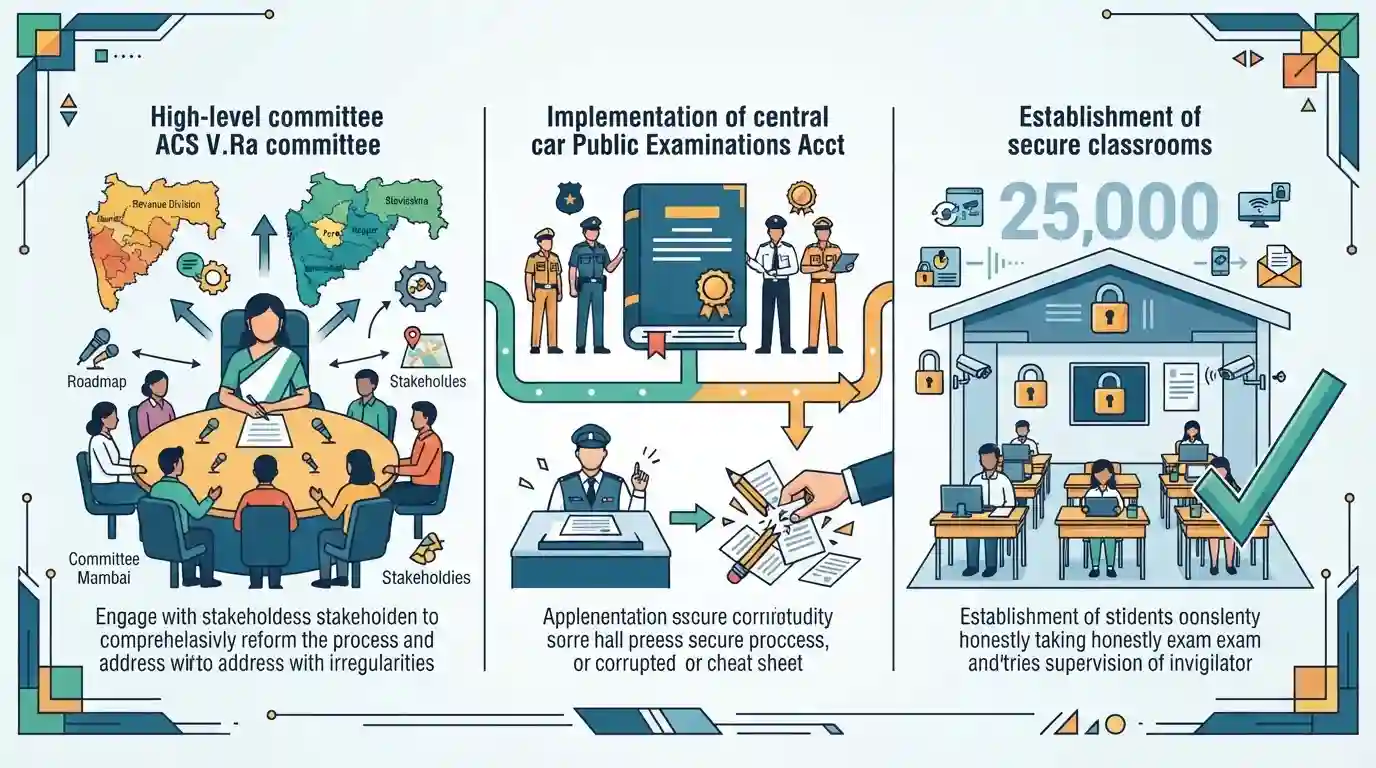
The Maharashtra government has formed a high-level committee led by Additional Chief Secretary V. Radha to comprehensively reform the recruitment examination process. The committee will engage with stakeholders across revenue divisions to address examination irregularities. Additionally, the state will implement the central Public Examinations (Prevention of Unfair Means) Act to strictly curb malpractices, and establish 25,000 secure classrooms to ensure transparent conduct of future recruitment exams.
Key Points
- Maharashtra has constituted a high-level committee headed by Additional Chief Secretary V. Radha to overhaul the state's recruitment examination system.
- The committee includes DGP Sadanand Date, IT Secretary Virendra Singh, Animal Husbandry Secretary N. Ramaswamy, and Nashik Divisional Commissioner Pravin Gedam.
- The state government intends to adopt the stringent central legislation—the Public Examinations (Prevention of Unfair Means) Act—within a fortnight, complementing its own existing laws.
- The Chief Minister directed authorities to set up 25,000 secure classrooms dedicated to conducting recruitment exams efficiently and transparently.
Important Terms
Public Examinations (Prevention of Unfair Means) Act

A central legislation enacted to strictly curb paper leaks, cheating, and organized malpractices in national competitive and recruitment examinations.
UPSC context
Crucial for GS-2 (Governance & Transparency), addressing the integrity and accountability of public institutions and recruitment exams.
V. Radha Committee
A high-level committee formed by the Maharashtra government to comprehensively overhaul the state's public service recruitment examination system through stakeholder consultations.
UPSC context
Important for GS-2 (State Administration) as a case study for consensus-driven structural reforms in governance.
Secure Classrooms Initiative
A Maharashtra administrative directive to establish 25,000 examination classrooms equipped with enhanced security and monitoring protocols to prevent testing malpractices.
UPSC context
Relevant for GS-2 (Governance) as an example of technological and administrative capacity building for transparent public service recruitment.
Prelims Trap
The Central Public Examinations Act, 2024 automatically covers all recruitment exams conducted by State Public Service Commissions.
State Public Services fall under the State List (Entry 41). The central Act covers central bodies (UPSC, NTA); states must explicitly adopt it to cover state exams.
Static Concepts Connected
How are Public Services distributed under the 7th Schedule of the Constitution?
- Union List: Entry 70 covers Union Public Services, All-India Services, and the Union Public Service Commission (UPSC).
- State List: Entry 41 grants states the exclusive legislative domain to design their recruitment systems and State Public Service Commissions.
- Article 312: Under Article 312, Parliament can create new All-India Services if the Rajya Sabha passes a resolution supported by a two-thirds majority.
What are the key provisions of the Public Examinations (Prevention of Unfair Means) Act?
- Nature of offences: All offences related to exam malpractices and paper leaks are explicitly classified as cognizable, non-bailable, and non-compoundable.
- Central bodies: The Act directly covers examinations conducted by central authorities like UPSC, SSC, RRB, IBPS, and the National Testing Agency (NTA).
- Organized syndicates: It targets organized crime by penalizing cheating syndicates and service providers with severe imprisonment (up to 10 years) and massive fines.
Cross-Topic Patterns
Tech-driven oversight in Governance
Radhakrishnan Committee's CPPT model and DIGI-EXAM framework illustrate a syllabus shift towards using deep-tech authentication to plug logistical loopholes in governance.
Ethics in Public Administration
Recurrent paper leaks highlight a severe crisis of integrity, making "institutional safeguards against corruption and organized malpractices" a high-probability case study theme for GS Paper 4.

The central Public Examinations Act's penal provisions and NTA reform committees (Radhakrishnan) are prime targets for Prelims 2026.
Linked PYQs · 2
Linked PYQs · 2
- 2018MPSC_PRELIMSGS1
Recommendations of the Sixth Report of Second Administrative Reforms Commission on Local Government are a. Set up unified metropolitan transport authority in all cities of one million plus population. b. Constitute a local body ombudsman. c. Direct election of the Mayors. d. Set up District Councils and the Collector would work as the Chief Secretary. Answer Options :
- 2016MPSC_PRELIMSGS1
Which one of the following is not a statutory function of UPSC ?
