Sovereign AI Deployment in Maharashtra State Administration
Source:tribune-india ↗
Why It Matters
The initiative serves as a pivotal case study for the integration of emerging technologies like AI into public administration to improve bureaucratic efficiency. It also emphasizes the growing importance of 'sovereign AI' and data localization, ensuring that national or state data remains secure within domestic borders while leveraging advanced technological tools.
Summary
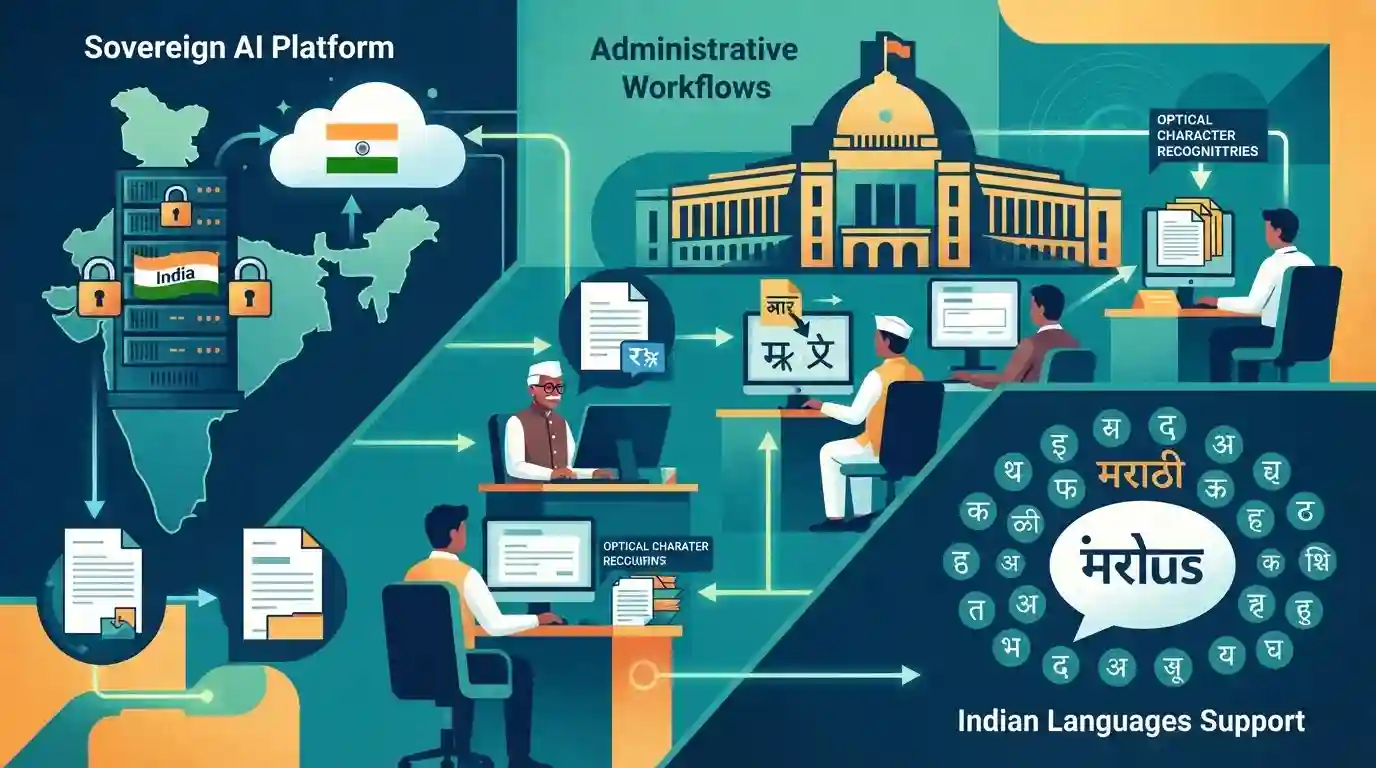
The Maharashtra government has approved the large-scale deployment of 'Indus', a sovereign AI workspace created by Indian startup Sarvam AI, across multiple state departments. Approximately 2,500 officials will leverage the AI platform to expedite administrative workflows, such as translating policy documents, drafting correspondence, and processing scanned records into searchable text. Capable of supporting 22 Indian languages, including Marathi, Indus represents a leap in e-governance efficiency. Crucially, as a 'sovereign AI', the platform ensures that all government data is processed and stored on secure infrastructure located solely within India, guaranteeing data privacy and localized control.
Key Points
- The Maharashtra government is deploying 'Indus', a sovereign AI workspace developed by Bengaluru-based startup Sarvam AI, across its state departments.
- Around 2,500 government officials will use the AI platform to assist with routine tasks like drafting notes, researching policies, and analyzing data.
- Indus supports 22 Indian languages, including Marathi, enabling swift translation and summarization of massive policy documents.
- The platform operates entirely on secure, audited infrastructure within India, reflecting a practical application of 'sovereign AI' and strict data localization.
- This deployment is described as one of the first commitments by an Indian state to use sovereign AI at a sweeping administrative scale, advancing e-governance goals.
Important Terms
Sovereign AI

A nation's capacity to build, deploy, and govern artificial intelligence models using indigenous computing infrastructure, domestic datasets, and local expertise, ensuring technological independence from foreign proprietary software.
UPSC context
GS Paper 3 (Science & Tech). Essential for evaluating digital sovereignty, national security, and strategic technological self-reliance.
Indus
A sovereign AI workspace developed by Sarvam AI, supporting 22 Indian languages. It assists government administrators with deep research, drafting, translating policy documents, and converting scanned records into searchable text.
UPSC context
GS Paper 2 (E-Governance). Tests knowledge of AI deployment in public administration to enhance efficiency, language inclusivity, and localized control.
Sarvam AI
An Indian artificial intelligence startup developing foundational large language models and generative AI platforms optimized for Indian languages, contributing significantly to India's sovereign AI mission and public sector governance.
UPSC context
GS Paper 3 (Indigenization of Technology). Relevant for assessing the contribution of domestic startups to the IndiaAI Mission and digital self-reliance.
Data Localisation
The legal and technical requirement to store, process, and manage digital data on infrastructure physically located within a country's borders, ensuring national jurisdiction, privacy, and protection against foreign surveillance.
UPSC context
GS Paper 2 (Governance) & GS Paper 3. Tests understanding of data protection frameworks, privacy laws, and digital infrastructure sovereignty.
Prelims Trap
Indus, a sovereign AI platform deployed by Maharashtra, was developed entirely by the National Informatics Centre (NIC).
Indus is developed by Sarvam AI, a Bengaluru-based private startup supported under the IndiaAI Mission, not a government body like NIC or C-DAC.
Static Concepts Connected
What are the core pillars of the IndiaAI Mission?
- IndiaAI Compute: Establishing a domestic GPU-based computing infrastructure (10,000+ GPUs) to support startups, researchers, and AI innovation.
- AI Datasets (AIKosh): Creating a unified national data platform to provide high-quality, diverse datasets for training indigenous AI models.
- Foundation Models: Developing indigenous Large Multimodal Models (LMMs) and domain-specific foundational models tailored to Indian languages and needs.
- Safe & Trusted AI: Formulating guidelines, tools, and frameworks to ensure the responsible, ethical, and secure deployment of AI technologies.
What defines Sovereign AI in the context of Indian tech policy?
- Indigenous Development: Building foundational AI models locally from scratch, avoiding the 'wrapper trap' of merely building basic interfaces on restricted foreign APIs.
- Data Localization: Ensuring that AI training data, user inputs, and computational processing are stored and executed entirely on domestic, audited infrastructure.
- Strategic Autonomy: Reducing reliance on foreign tech monopolies for critical administrative, security, and governance workflows, thereby securing national digital sovereignty.
Cross-Topic Patterns
AI E-Governance & Data Localization
Deploying AI for state administration shifts the data localization debate from e-commerce to national security, tying closely with the Digital Personal Data Protection (DPDP) Act's sovereignty mandates.
Language Tech & Digital Inclusion
Indus's 22-language support parallels MeitY's Bhashini initiative, reflecting a consistent policy push to break language barriers and ensure digital inclusion in public service delivery across India.

The distinction between Sovereign AI (built locally) and foreign API wrappers is highly likely to feature in 2026 S&T prelims.
Linked PYQs · 2
Linked PYQs · 2
- 2011MPSC_PRELIMSGS1
Modern technological development is increasingly becoming dependent on
- 2023MPSC_PRELIMSGS1
The formulation and success of a plan require the following : a. Planning Commission, Statistical data, Objectives b. Fixation of Targets and Priorities, Mobilisation of Resources c. Incorrupt and Efficient Administration, Proper Development Policy d. Economy in Administration, Education base
