Maharashtra Legal Status Bill for Women Farmers
Source:Indian Express ↗
Why It Matters
The article covers the crucial intersection of agriculture, women's empowerment, and rural economy. Recognizing women as farmers aligns with the 'feminisation of agriculture' theme in GS1/GS3. Meanwhile, farm loan waivers highlight the ongoing distress in agricultural finance (GS3), and the state's monsoon advisory emphasizes the dependence of Indian agriculture on seasonal rainfall patterns (GS1 Geography).
Summary
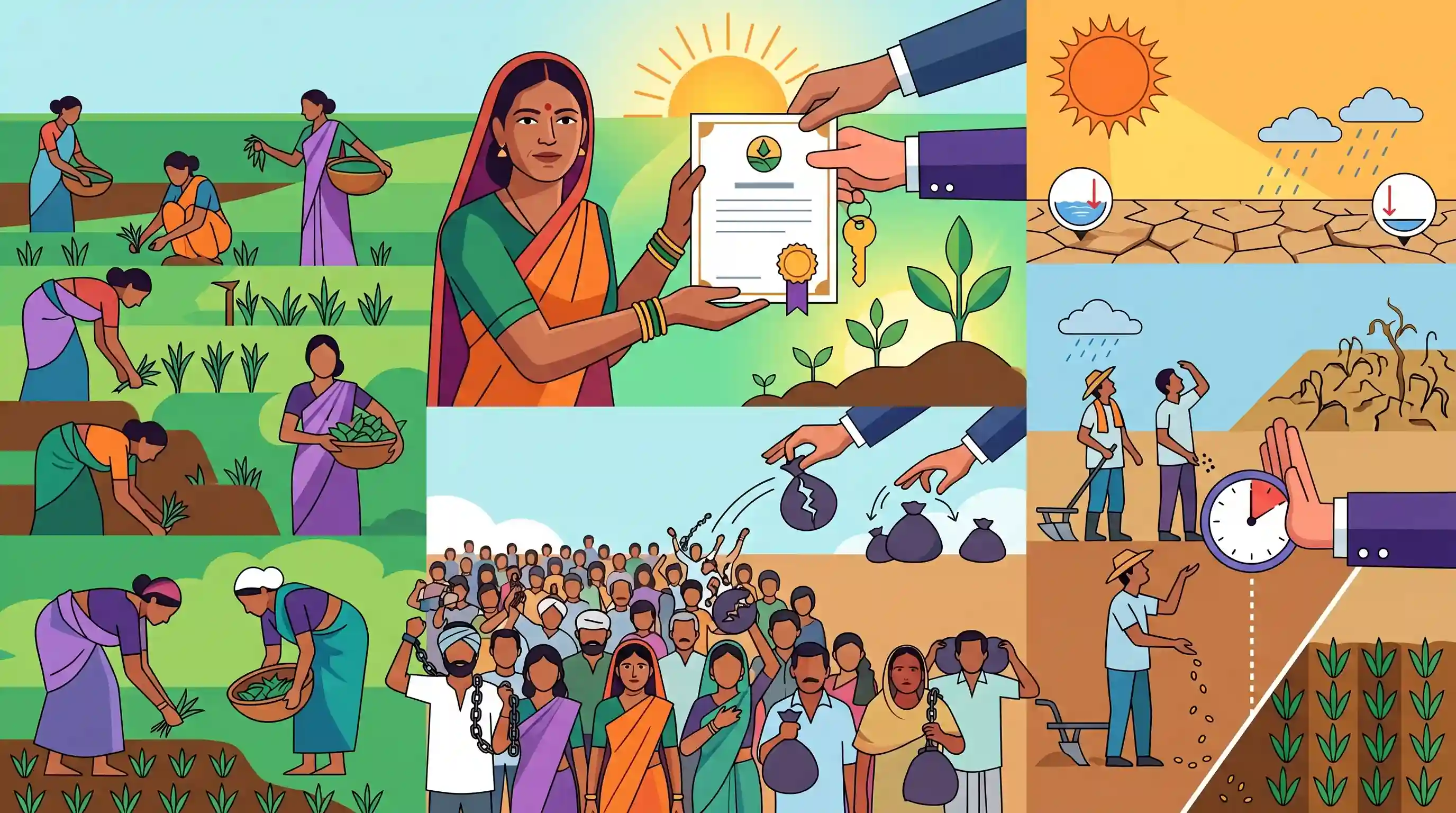
The Maharashtra government has announced plans to introduce a bill during the upcoming Monsoon Session that will grant legal status to women farmers. The initiative addresses the issue that while women form the majority of the agricultural workforce, they often lack land titles and official recognition, depriving them of farmer benefits. Additionally, Chief Minister Devendra Fadnavis announced an unconditional farm loan waiver of ₹36,585 crore benefiting 56 lakh farmers. He also advised farmers to delay sowing operations due to a severe 80% monsoon deficit in the state to prevent crop failure and resowing costs.
Key Points
- The Maharashtra government will introduce a bill to grant legal status to women farmers, recognizing their critical but undocumented role in the agricultural workforce.
- Despite constituting the majority of farm labor, most women lack land ownership, thereby excluding them from being officially recognized as 'farmers' and accessing related benefits.
- A historic, unconditional farm loan waiver of ₹36,585 crore was announced, expected to relieve 56 lakh farmers from rural indebtedness.
- Facing an 80% monsoon rainfall deficit, the government issued an advisory urging farmers to delay sowing until soil saturation reaches 100mm, to avoid the cost of resowing.
Important Terms
Feminisation of Agriculture

The increasing share of women in the agricultural workforce, often driven by male out-migration. It highlights the gap between women's high labour contribution and low ownership of land and credit.
UPSC context
GS-1 (Society), GS-3 (Agriculture); tests understanding of rural demographic shifts and gender-based economic inequalities.
Maharashtra Women Farmers Empowerment Bill, 2026
A proposed legislative framework to grant legal recognition to women farmers in Maharashtra, allowing them to access credit, subsidies, and insurance independently of traditional male-linked land ownership.
UPSC context
GS-2 (Governance), GS-3 (Agriculture); relevant for women's land rights and addressing institutional exclusion in farming.
Mukhyamantri Majhi Ladki Bahin Yojana
A Maharashtra government welfare scheme providing ₹1,500 monthly to eligible women aged 21-65. It aims to improve financial independence, health, and decision-making power within households.
UPSC context
GS-2 (Social Justice/Welfare); tests knowledge of state-level direct benefit transfer (DBT) initiatives for women.
Farm Loan Waiver
A government policy to cancel agricultural debts. While providing immediate relief to distressed farmers, it raises concerns regarding fiscal deficits and 'moral hazard' in the credit culture.
UPSC context
GS-3 (Agriculture/Economy); tests analysis of agrarian distress versus long-term fiscal and credit discipline.
India Meteorological Department (IMD)
India’s principal agency for meteorological observations. It classifies monsoon performance as 'normal', 'deficient', or 'below normal' based on deviations from the Long Period Average (LPA).
UPSC context
GS-1 (Geography), GS-3 (Disaster Management); essential for understanding monsoon patterns and food security risks.
Long Period Average (LPA)
The benchmark average rainfall calculated over a 50-year period (currently 1971-2020). It serves as the baseline for determining whether a monsoon is normal or deficient.
UPSC context
GS-1 (Geography); tests technical understanding of climate data used in agricultural planning and forecasting.
Prelims Trap
"Under current institutional mechanisms, 'farmers' are defined by their active agricultural labor, automatically including landless women."
Institutional credit, crop insurance, and PM-KISAN heavily depend on land ownership records (titling). This systemically excludes most women, sharecroppers, and tenant farmers who cultivate but lack deeds.
Static Concepts Connected
How does the National Policy for Farmers (2007) define a 'farmer'?
- Broad definition: Defines 'farmer' by agricultural activity (cultivators, laborers, pastoralists, fisherfolk) rather than strict land ownership.
- Inclusion objective: Designed to bring landless agricultural workers, sharecroppers, and women into the formal safety net for credit and insurance.
What is the "moral hazard" associated with farm loan waivers?
- Strategic defaults: Waivers incentivize borrowers who have the capacity to repay to intentionally default, expecting future state bailouts.
- Credit culture erosion: Repeated waivers destroy the credit discipline of rural areas, leading banks to restrict future agricultural lending.
- Fiscal crowding out: The RBI consistently warns that state funds spent on waivers crowd out long-term capital investments in irrigation and rural infrastructure.
Cross-Topic Patterns
Feminisation of agriculture & out-migration
Male out-migration leaves women as primary cultivators. However, deeply entrenched patriarchal land inheritance systems keep them formally invisible and excluded from institutional agricultural support.
Climate-smart agriculture & sowing advisories
The advisory to delay Kharif sowing until 100mm of soil saturation is achieved reflects the increasing necessity of micro-level agrometeorological planning to combat erratic monsoons.

Expect a 2026 Prelims question testing PM-KISAN/credit eligibility against the Swaminathan Committee's activity-based farmer definition.
Linked PYQs · 3
Linked PYQs · 3
- 2014MainsGS1
Discuss the various economic and socio-cultural forces that are driving increasing feminization of agriculture in India.
- 2014MainsGS3
In the villages itself no form of credit organization will be suitable except the cooperative society. -All India Rural Credit Survey. Discuss this statement in the background of agricultural finance in India. What constraints and challenges do financial institutions supplying agricultural finance face? How can technology be used to better reach and serve rural clients?
- 2017MainsGS1
What characteristics can be assigned to monsoon climate that succeeds in feeding more than 50 percent of the world population residing in Monsoon Asia?
