राज्य पाठ्यक्रम में ब्रिज कोर्स और एनईपी का कार्यान्वयन
स्रोत:इंडियन एक्सप्रेस ↗
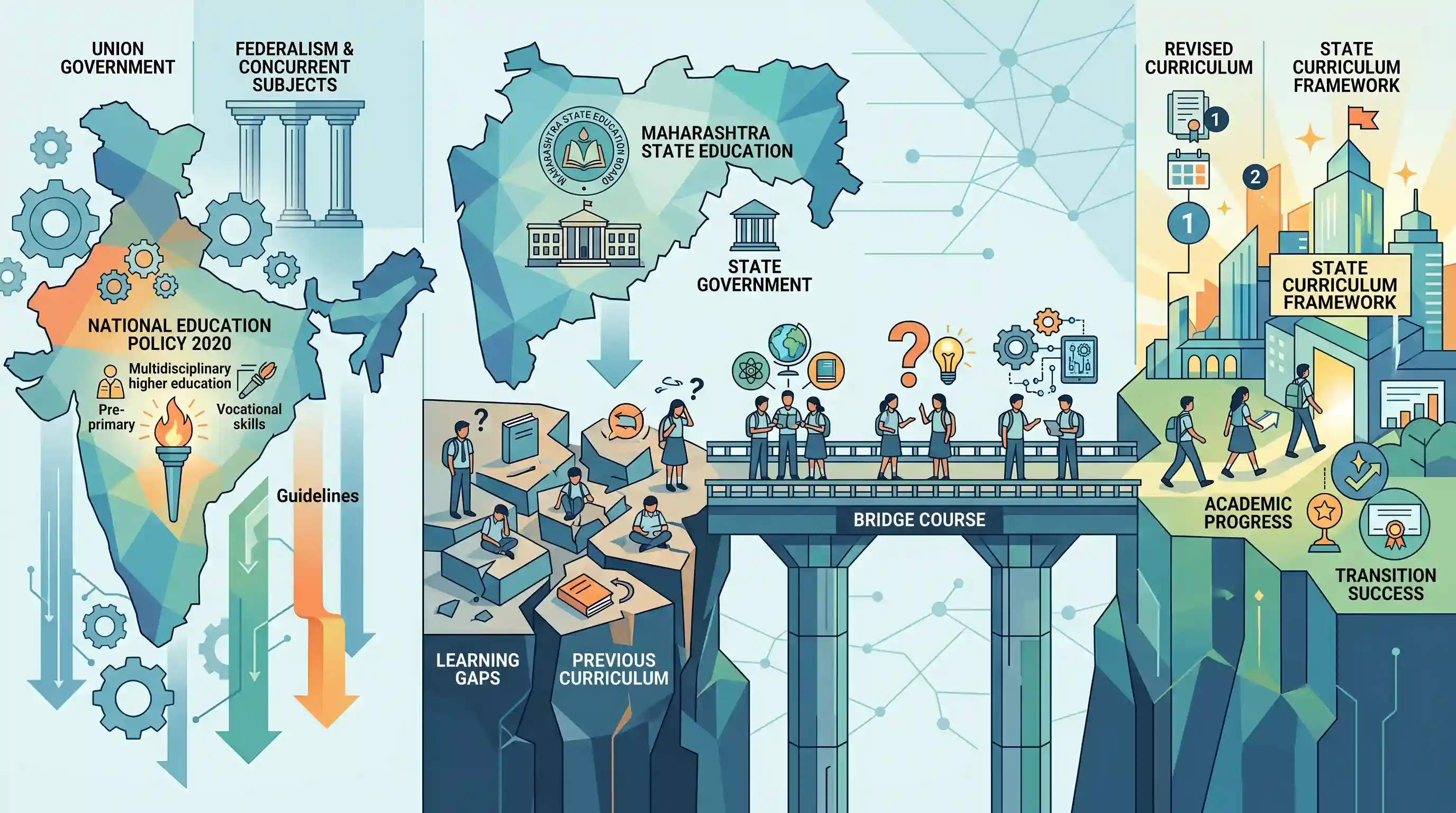
क्यों मायने रखता है
It provides a concrete example of how states are managing the implementation of the National Education Policy (NEP) 2020 on the ground. Understanding these transitional strategies (like bridge courses) is vital for analyzing the practical challenges and solutions in restructuring India's education system.
सारांश
The Maharashtra state education board has decided to implement a 'bridge course' for students to facilitate their transition to a newly revised curriculum. This curriculum update aligns with the broader goals of the National Education Policy (NEP) 2020 and the State Curriculum Framework. The bridge course aims to fill learning gaps and acclimatize students to new pedagogical methods and content structures, ensuring that the shift does not disrupt their academic progress. This initiative highlights the practical steps and transitional mechanisms required at the state level to execute sweeping national education reforms effectively.
मुख्य बिंदु
- The Maharashtra state education board is introducing a bridge course to help students smoothly transition to the newly updated curriculum.
- The curriculum overhaul is aligned with the National Education Policy (NEP) 2020 and the State Curriculum Framework (SCF).
- The bridge course is designed to cover essential academic gaps and prepare students for pedagogical shifts without causing sudden academic strain.
- It reflects the real-world operational strategies adopted by state governments to seamlessly implement national educational reforms.
महत्वपूर्ण शब्द
National Education Policy (NEP) 2020

India's first 21st-century education policy replacing the 1986 framework. It introduces a 5+3+3+4 pedagogical structure, emphasizing holistic development, multidisciplinary learning, and universal access from pre-primary to secondary levels.
UPSC context
GS Paper II: Government Policies & Interventions. Tests understanding of structural educational reforms and socioeconomic developmental goals.
State Curriculum Framework (SCF)
पाठ्यक्रम डिजाइन और पाठ्यपुस्तकों के मार्गदर्शन के लिए राष्ट्रीय पाठ्यचर्या रूपरेखा (NCF) से तैयार किया गया एक राज्य-स्तरीय दस्तावेज़। यह क्षेत्रीय सांस्कृतिक, भाषाई और शैक्षिक आवश्यकताओं के अनुरूप राष्ट्रीय मानकों को अनुकूलित करता है।
UPSC context
GS Paper II: Federalism & Concurrent List. Tests the cooperative mechanism between Centre and States in education implementation.
राज्य शैक्षिक अनुसंधान और प्रशिक्षण परिषद (SCERT) महाराष्ट्र
The apex academic body in the state responsible for curriculum development, teacher training, and academic research. It leads the design of new textbooks and bridge courses under NEP.
UPSC context
GS Paper II: Statutory/Non-statutory Bodies. Focuses on institutional mechanisms for implementing social sector reforms.
Maharashtra State Board of Secondary and Higher Secondary Education (MSBSHSE)
The statutory body responsible for conducting secondary (SSC) and higher secondary (HSC) examinations. It manages the administrative transition of schools to new curricular patterns and assessment models.
UPSC context
GS Paper II: Issues relating to Education. Relevant for examining state-level governance and administrative execution of national policies.
प्रारंभिक ट्रैप
NEP 2020 के तहत राष्ट्रीय पाठ्यचर्या रूपरेखा (NCF) सभी राज्य शिक्षा बोर्डों के लिए अनिवार्य और बाध्यकारी है।
शिक्षा समवर्ती सूची (Concurrent List) का विषय है। राज्य SCERTs के माध्यम से NCF का स्थानीयकरण करने के लिए अपना स्वयं का स्टेट करिकुलम फ्रेमवर्क (SCFs) विकसित करते हैं, जिससे यह कड़ाई से बाध्यकारी होने के बजाय एक सलाहकार दिशानिर्देश बन जाता है।
संबंधित अवधारणाएँ
How is 'Education' distributed in the 7th Schedule of the Constitution?
- Original Status: Originally, Education was placed entirely in the State List (Entry 11) of the Seventh Schedule.
- 42nd Amendment: The 42nd Amendment Act of 1976 transferred Education to the Concurrent List (Entry 25).
- Significance: This enables both Parliament and State Legislatures to enact laws, necessitating cooperative federalism for national policies like NEP 2020.
What is the 5+3+3+4 pedagogical structure under NEP 2020?
- Foundational Stage: 5 वर्ष, जिसमें 3 वर्ष की आंगनवाड़ी/प्री-स्कूल और उसके बाद कक्षा 1 और 2 शामिल हैं।
- Preparatory Stage: 3 years covering Classes 3 to 5, focusing on experiential learning.
- Middle Stage: 3 years covering Classes 6 to 8, introducing subject-oriented learning.
- Secondary Stage: 4 years covering Classes 9 to 12, offering multidisciplinary study and greater critical thinking.
अंतर-विषय पैटर्न
समवर्ती सूची और नीति कार्यान्वयन
NEP 2020's success relies on state-led initiatives like Maharashtra's SCF and bridge courses, highlighting the practical complexities of managing Concurrent List subjects in a federal setup.
PM-SHRI as a catalyst for NEP
Centrally sponsored schemes like PM-SHRI provide the structural and financial backing necessary for states to practically execute and showcase these curricular transitions in model schools.

Expect a multi-statement question on NEP 2020 testing the division of powers (NCERT vs SCERT) and the constitutional shift of Education.
संबद्ध PYQ · 1
संबद्ध PYQ · 1
- 2020MainsGS2
National Education Policy 2020 is in conformity with the Sustainable Development Goal-4 (2030). It intends to restructure and reorient education system in India. Critically examine the statement.
