Maharashtra Special Intensive Revision Electoral Rolls Status
Source:the-week ↗
Why It Matters
Electoral roll revision is a foundational process to ensure free and fair elections, reflecting demographic realities and preventing electoral malpractices like duplicate or bogus voting. For MPSC aspirants, understanding the roles of the ECI, Chief Electoral Officer, and BLOs, as well as the constitutional provisions governing elections (Articles 324-329), is crucial.
Summary
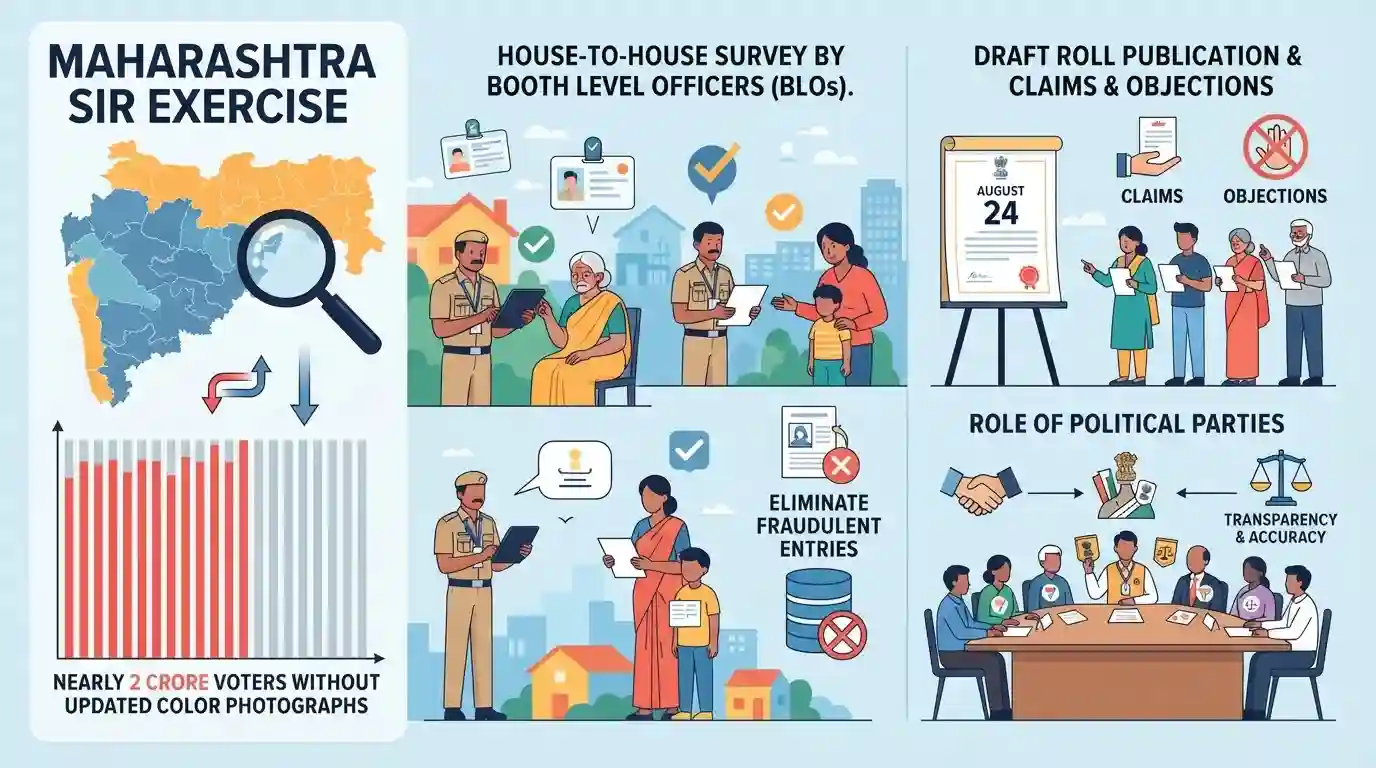
Ahead of the Maharashtra assembly elections, the Election Commission of India has undertaken a Special Intensive Revision (SIR) of the state's electoral rolls. The exercise has revealed that nearly 2 crore registered voters do not have updated colour photographs on the list. To address this, Booth Level Officers (BLOs) are conducting extensive house-to-house surveys to verify voter credentials and eliminate fraudulent entries. The updated draft roll is slated for publication on August 24, following which citizens will be given time to file claims and objections. Chief Electoral Officer S. Chockalingam has called upon political parties to appoint Booth Level Agents to facilitate a transparent and accurate electoral roll revision.
Key Points
- A Special Intensive Revision (SIR) of electoral rolls is currently underway in Maharashtra ahead of the state assembly elections.
- Nearly 2 crore out of 9.5 crore registered voters in Maharashtra lack standard colour photographs in the electoral rolls.
- Booth Level Officers (BLOs) are conducting house-to-house visits to verify voters and update the draft electoral roll scheduled for publication on August 24.
- Political parties have been urged by the Chief Electoral Officer to appoint Booth Level Agents (BLAs) to assist BLOs in eliminating bogus entries and rectifying demographic anomalies.
Important Terms
Representation of the People Act, 1950

An Act of Parliament providing for the allocation of legislative seats, the delimitation of constituencies, and the registration of voters (including qualifications for inclusion in electoral rolls) in India.
UPSC context
MPSC GS-II (Polity). Tests legal provisions governing voter eligibility and constituency seat allocation.
Representation of the People Act, 1951
An Act of Parliament that governs the actual conduct of elections, qualifications/disqualifications of candidates, political party registration, electoral offenses, and election dispute resolutions.
UPSC context
MPSC GS-II (Polity). Tests understanding of electoral conduct, candidate qualifications, and democratic accountability.
Election Commission of India (ECI)
An autonomous constitutional body established under Article 324 of the Constitution to administer Union and State election processes in India, including parliamentary and assembly polls.
UPSC context
MPSC GS-II (Polity). Tests understanding of independent constitutional bodies, their mandate, and structural powers.
Booth Level Officer (BLO)
A local government or semi-government official appointed under Section 13B(2) of the RPA 1950, acting as the ECI's grassroots representative to update and maintain the accuracy of electoral rolls.
UPSC context
MPSC GS-II (Polity). Tests grassroots election administration, voter registration procedures, and civil service duties.
Special Intensive Revision (SIR)
A comprehensive nationwide exercise conducted by the ECI to verify, update, and clean electoral rolls through door-to-door enumeration, eliminating duplicate, deceased, or ineligible entries.
UPSC context
MPSC GS-II (Polity/Current Affairs). Tests electoral reforms, measures to ensure free and fair elections, and voter list integrity.
Prelims Trap
"The State Election Commission conducts the revision of electoral rolls for the State Legislative Assembly elections."
Under Article 324, the ECI prepares electoral rolls for Parliament and State Legislatures. State Election Commissions only handle local body elections (Panchayats/Municipalities).
Static Concepts Connected
How does the Representation of the People Act (RPA) 1950 differ from RPA 1951?
- RPA 1950 focus: Governs the preparation and revision of electoral rolls, allocation of seats, and delimitation of constituencies.
- RPA 1951 focus: Governs the actual conduct of elections, candidate qualifications/disqualifications, corrupt practices, and resolution of electoral disputes.
Who appoints the Chief Electoral Officer (CEO) of a state?
- Appointment process: Designated or nominated by the Election Commission of India (ECI) in consultation with the respective State Government.
- Core responsibility: Supervises the preparation, revision, and correction of all electoral rolls and the conduct of elections within the state under ECI's control.
Cross-Topic Patterns
Electoral roll purification and Aadhaar linkage
Efforts to clean electoral rolls via intensive revisions overlap with the Election Laws (Amendment) Act, 2021, linking voter IDs to Aadhaar, frequently testing Right to Privacy concepts.
Urban voter apathy and governance
Issues of missing entries and roll defects in metropolitan hubs like Mumbai and Pune directly contribute to the ECI's ongoing challenge of "urban voter apathy" and poor turnout metrics.

Expect a multi-statement question contrasting ECI vs SEC roles in electoral roll preparation and distinguishing RPA 1950 from RPA 1951.
Linked PYQs · 2
Linked PYQs · 2
- 2024MPSC_PRELIMSGS1
Which Articles in the Constitution provide for the electoral system in our country ?
- 2019MPSC_PRELIMSGS1
Which one of the following statements about Election Commission of India is false ?
