Maharashtra Converted Tribals Reservation Benefits Committee
Source:theindiantribal ↗
Why It Matters
This policy move by the Maharashtra government addresses the intersection of religious conversion, constitutional reservations, and tribal identity, making it a critical topic for understanding social justice policies and state-level governance in India.
Summary
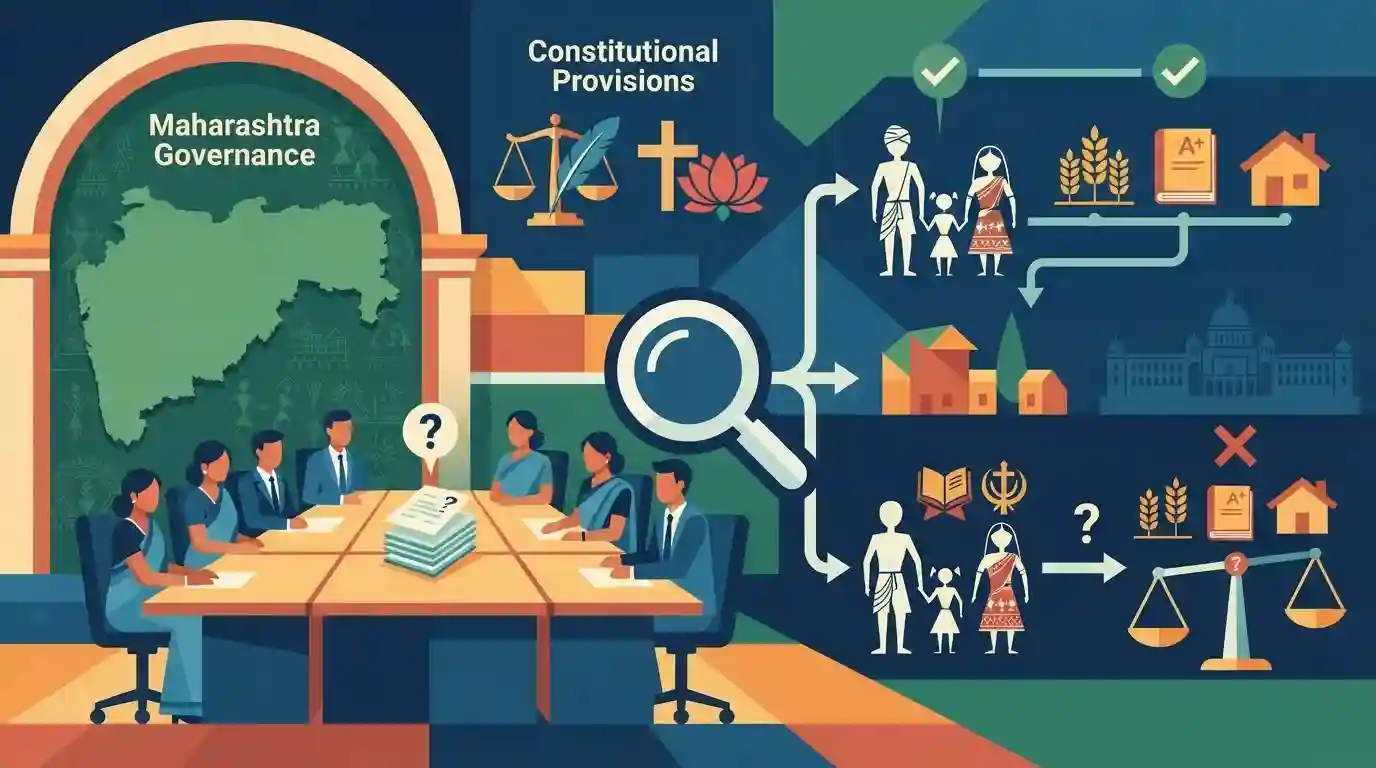
The Maharashtra government has established a panel to evaluate whether tribals who undergo religious conversion should continue to receive associated reservation and welfare benefits, a contentious socio-legal issue with significant implications for constitutional policy and tribal rights.
Key Points
- Maharashtra has set up a committee to examine whether tribal individuals who have converted to other religions should continue to receive tribal welfare benefits and reservations.
- The panel will review legal, constitutional, and social ramifications of extending or withdrawing reservation and welfare benefits upon religious conversion.
- The issue touches upon constitutional provisions regarding Scheduled Tribes (Article 342) and criteria for determining tribal identity.
Important Terms
Article 342

Article 342 of the Indian Constitution empowers the President to specify Scheduled Tribes (STs) in states and UTs. Unlike SCs, it does not explicitly restrict ST status based on religious conversion.
UPSC context
MPSC Polity (Indian Constitution — Part XVI, Special Provisions Relating to Certain Classes); tests understanding of tribal status criteria.
Tribal Research and Training Institute (TRTI)
An autonomous institute under Maharashtra's Tribal Development Department (headquartered in Pune) that conducts tribal socio-economic research, evaluation, and educational support programs.
UPSC context
MPSC Governance and Maharashtra Administration; tests familiarity with specialized state research bodies on tribal welfare.
Tribal Development Department (Maharashtra)
A specialized administrative sector under the Maharashtra government responsible for formulating policies, educational welfare schemes, and protective legislation for the state's Scheduled Tribes.
UPSC context
MPSC Governance (Maharashtra State Administration); tests knowledge of state administrative machinery for tribal development.
Prelims Trap
Tribal individuals who convert to other religions automatically lose their Scheduled Tribe reservation and welfare benefits by law.
Aspirants often assume Scheduled Tribe (ST) benefits are restricted by religion similar to Scheduled Castes (SCs) under the 1950 Presidential Order, overlooking that ST status under Article 342 is primarily based on ethnic and indigenous identity criteria.
Static Concepts Connected
What are the constitutional provisions governing Scheduled Tribes (ST) in India under the Indian Constitution?
- Article 342: Empowers the President, after consulting the Governor of a State/UT, to notify tribes or tribal communities as Scheduled Tribes by public notification.
- Parliamentary Power: Parliament alone has the power by law to include or exclude any tribe or tribal community from the list of Scheduled Tribes.
- Article 15(4) & 16(4): Enables the State to make any special provision for the advancement of any socially and educationally backward classes or for SCs and STs.
Cross-Topic Patterns
Article 342 vs Presidential Orders on Religion
While Article 342 focuses on ethnic characteristics for ST status, the Scheduled Caste order explicitly restricts benefits by religion, creating a complex federal legislative debate on conversion and affirmative action.

Expect a statement-based MPSC question contrasting SC and ST criteria regarding religious conversion and constitutional provisions.
Linked PYQs · 3
Linked PYQs · 3
- 2023MPSC_PRELIMSGS1
Provisions of the Constitution relating to the administration of Scheduled Areas and Scheduled Tribes in Schedule - V
- 2024MPSC_PRELIMSGS1
Consider the following provision/s with respect to various 'National Commissions' in India. (A) 'National Commission for Scheduled Castes and Scheduled Tribes' was established under Article 339 of the Constitution of India. (B) The 'National Commission for Women' was established under the 'National Commission for Women Act' 1990. (C) The 'National Commission for Minorities' was established under the 'National Commission for Minorities Act' 1992. (D) On 27th December 1993 an ordinance was passed to establish the 'National Human Rights Commission'. Which of the above provision/s is/are correct ?
- 2010MPSC_PRELIMSGS1
Article 15 (5) which was inserted with the 93rd Amendment, provides reservation for socially and educationally backward classes of citizens or for scheduled caste or Tribe, paved the way for ________ .
