Maharashtra panel for climate-resilient water management
Source:Indian Express ↗
Why It Matters
Provides a holistic state-level template for integrated water basin management that connects climate resilience, agricultural needs (micro-irrigation), disaster mitigation (urban floods), and infrastructure (inland navigation). It serves as a strong case study for GS3 topics on irrigation, water storage, and climate-induced disaster management.
Summary
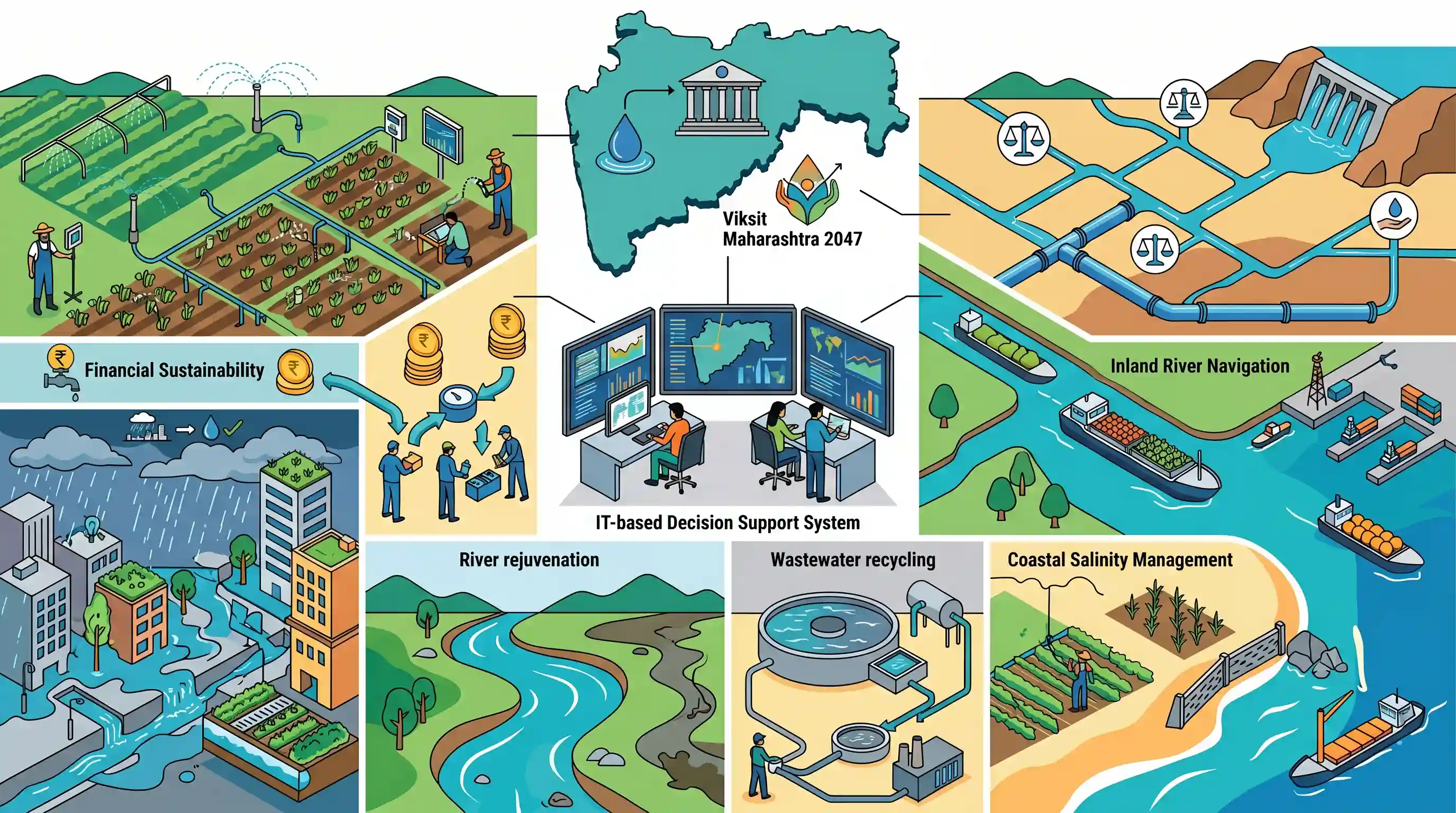
Maharashtra has set up the State Water Resources Development and Management Committee (SWRDMC) to implement climate-resilient water management practices across its river basins, in alignment with the ‘Viksit Maharashtra 2047’ vision. The committee will oversee comprehensive strategies including the expansion of micro-irrigation, inter- and intra-basin water transfers to ensure equitable distribution, and the establishment of an IT-based Decision Support System for governance. It also plans to develop inland river navigation to facilitate the transport of agricultural produce to seaports. Ten targeted sub-committees will address specific challenges such as urban flooding, river rejuvenation, wastewater recycling, coastal salinity management, and the financial sustainability of water utilities through standard pricing mechanisms.
Key Points
- Maharashtra has established the SWRDMC, a 12-member committee headed by CM's adviser Sriram Vedire, to spearhead climate-resilient water management.
- The committee aligns the Integrated State Water Plan with the 'Viksit Maharashtra 2047' vision, focusing on sustainable and equitable water access across all river basins.
- Key strategies include expanding irrigation coverage via micro-irrigation, standardizing pricing mechanisms for financially sustainable water utilities, and scaling water recycling/reuse.
- The initiative notably incorporates plans for inland river navigation to transport agricultural produce to seaports, aiming to enhance rural incomes.
- Ten specialized sub-committees have been formed to tackle diverse issues such as inter/intra-basin water transfers, urban flooding, river rejuvenation, desalination, and wetland restoration using an IT Decision Support System (DSS).
Important Terms
State Water Resources Development and Management Committee (SWRDMC)

A 13-member panel led by the CM's advisor to oversee climate-resilient water planning, inter-basin transfers, and digital governance across Maharashtra's river basins.
UPSC context
GS Paper II (Governance) & GS Paper III (Environment); focuses on institutional mechanisms for climate adaptation.
Viksit Maharashtra 2047
The state's long-term developmental blueprint aiming for a $3.5 trillion economy, focusing on 80% water reuse and 65% irrigation coverage by 2047.
UPSC context
GS Paper III (Economy & Infrastructure); tests knowledge of regional vision documents and sectoral growth targets.
Integrated State Water Plan (ISWP)
A statutory framework under the MWRRA Act 2005 that consolidates basin-level plans to ensure equitable water distribution and bridge regional imbalances.
UPSC context
GS Paper I (Geography) & GS Paper III (Agriculture); tests understanding of integrated water resource management (IWRM).
Maharashtra Water Resources Regulatory Authority (MWRRA)
A quasi-judicial body established in 2005 to regulate water resources, determine entitlements, and ensure sustainable management of surface and groundwater in Maharashtra.
UPSC context
GS Paper II (Statutory Bodies); critical for questions on water governance and regulatory frameworks.
Decision Support System (DSS)
An IT-integrated platform using GIS and real-time data for flood forecasting, drought planning, and scientific monitoring of land and water resources.
UPSC context
GS Paper III (E-governance & Disaster Management); relevant for technological interventions in resource management.
Inter- and Intra-basin Water Transfers
Hydrological projects designed to divert water from surplus basins to deficit regions to balance demand-supply gaps and improve irrigation.
UPSC context
GS Paper I (Geography/Water Resources); tests concepts of river linking and regional water equity.
Prelims Trap
Inland river navigation and basin water transfers are exclusively governed by the Union Government under the National Waterways Act.
States retain full constitutional jurisdiction over intra-state rivers, allowing them to independently develop local inland navigation routes and execute intra-state river basin transfers.
Static Concepts Connected
What is the Constitutional distribution of legislative power regarding water resources?
- State List (Entry 17): Covers water supply, irrigation, canals, drainage, and embankments, but is strictly subject to the provisions of Entry 56 of List I.
- Union List (Entry 56): Empowers the Union government to regulate and develop inter-state rivers and river valleys to the extent declared by Parliament to be expedient in the public interest.
- Article 262: Empowers Parliament by law to provide for the adjudication of any dispute or complaint with respect to the use, distribution, or control of inter-state river waters.
How is the governance and development of Inland Waterways structured in India?
- Union Jurisdiction: Parliament can constitutionally declare a waterway as a 'National Waterway', bringing its shipping and navigation under Central control via the Inland Waterways Authority of India (IWAI).
- State Jurisdiction: Waterways not designated as 'National' remain firmly under state control, allowing state governments to develop them for local transport, agricultural logistics, and tourism.
Cross-Topic Patterns
Inland waterways + Agri-logistics
Linking intra-state river navigation directly to seaports connects GS3 Infrastructure with Agricultural Marketing, aiming to reduce logistics costs and boost rural export incomes.
Urban flooding + Coastal salinity management
Simultaneously addressing urban flooding, wastewater recycling, and coastal salinity reflects the Integrated Water Resources Management (IWRM) approach, a core theme in GS3 Climate Change Adaptation.

Expect a 2026 Mains question linking Integrated Water Resources Management (IWRM) to agricultural export logistics via inland waterways.
Linked PYQs · 5
Linked PYQs · 5
- 2016MainsGS3
What is water-use efficiency? Describe the role of micro-irrigation in increasing the water-use efficiency.
- 2021MainsGS3
How and to what extent would micro-irrigation help in solving India's water crisis?
- 2024MainsGS3
What are the major challenges faced by Indian irrigation system in recent times? State the measures taken by the government for efficient irrigation management.
- 2020MainsGS1
The interlinking of rivers can provide viable solutions to the multi-dimensional inter-related problems of droughts, floods and interrupted navigation. Critically examine.
- 2024MainsGS3
Flooding in urban areas is an emerging climate-induced disaster. Discuss the causes of this disaster. Mention the features of two such major floods in the last two decades in India. Describe the policies and frameworks in India that aim at tackling such floods.
