Maharashtra River Basin Climate Resilient Water Resources Committee
Source:Indian Express ↗
Why It Matters
Provides a concrete state-level policy example of integrating climate resilience, digital governance, and holistic watershed management, highly relevant for GS3 answers on water conservation, agriculture, and disaster management.
Summary
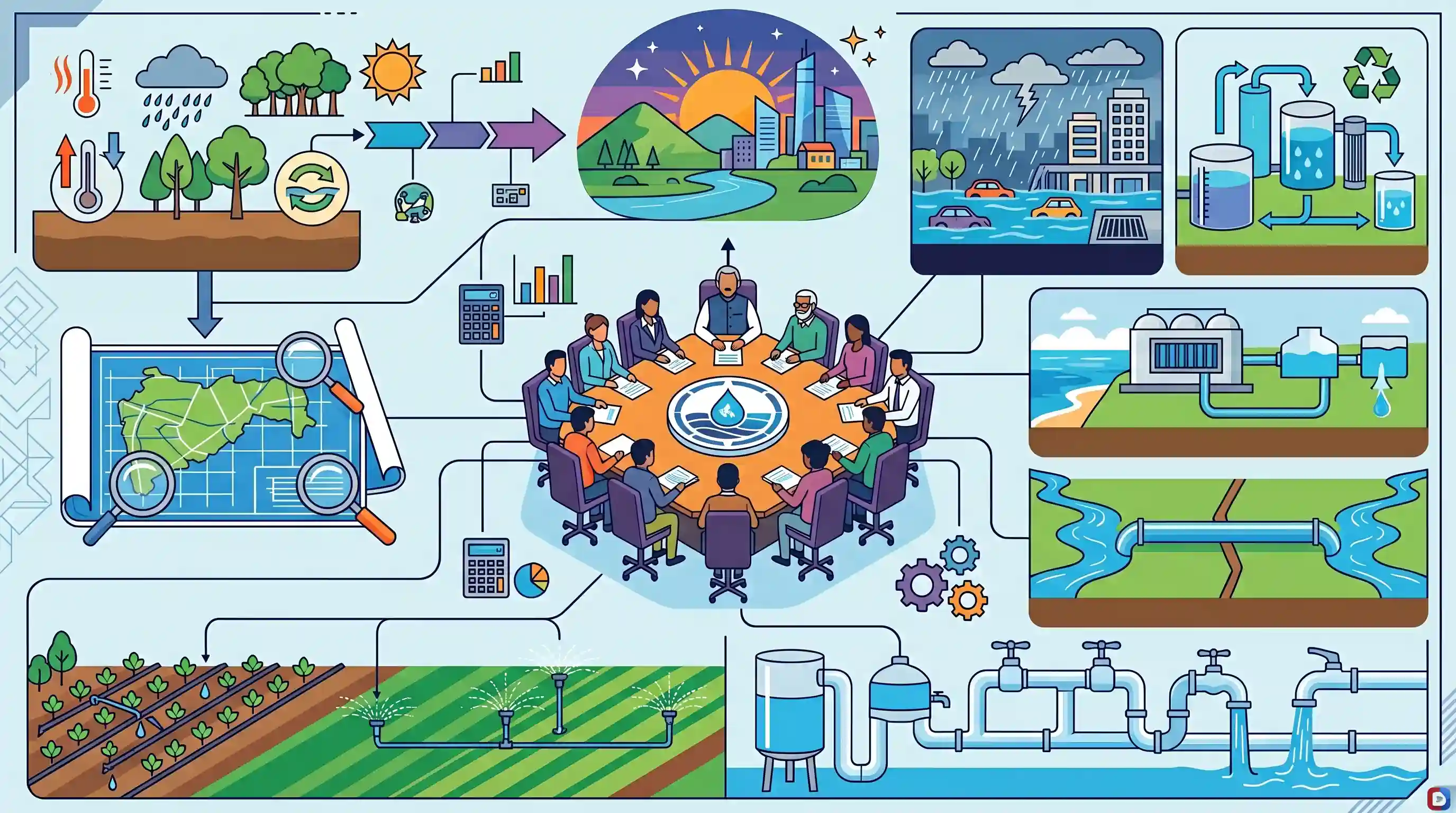
The Maharashtra government has formed the State Water Resources Development and Management Committee (SWRDMC) to ensure climate-resilient water management across the state's river basins. The 13-member panel, headed by Sriram Vedire, will advise the State Water Resources Council to align the Integrated State Water Plan with the vision of 'Viksit Maharashtra 2047'. The committee's mandate includes planning, developing, and assessing irrigation and drinking water projects, while sub-committees will tackle specific issues like urban flooding, water recycling, desalination, and inter-basin transfers.
Key Points
- Maharashtra has established a 13-member State Water Resources Development and Management Committee (SWRDMC) for comprehensive water resource planning across all river basins.
- The committee, headed by Sriram Vedire, will align the state\'s Integrated State Water Plan with the goals of \'Viksit Maharashtra 2047\'.
- Key focus areas include micro-irrigation, water recycling, digital governance in water utilities, and ensuring equitable water access.
- Sub-committees may be formed to address specific challenges such as inter-basin water transfers, urban flooding, desalination, wetland restoration, and inland river navigation.
Important Terms
Integrated State Water Plan

A comprehensive framework for the sustainable development and management of Maharashtra's water resources, incorporating river basin plans to ensure equitable distribution and mitigate regional water stress.
UPSC context
GS Paper 3: Water Resources; essential for questions on integrated management, federalism in resource sharing, and drought mitigation.
SWRDMC
A 13-member expert committee in Maharashtra tasked with advising on climate-resilient irrigation and drinking water projects to align infrastructure with long-term development goals.
UPSC context
GS Paper 3: Environment; tests knowledge of institutional mechanisms for climate adaptation and decentralized water governance.
Viksit Maharashtra 2047
A strategic vision aiming to transform Maharashtra into a $5 trillion economy by 2047, featuring targets like 80% water reuse and 65% gross irrigated area.
UPSC context
GS Paper 2 & 3: Governance; relevant for state-led initiatives contributing to the national 'Viksit Bharat' objective.
State Water Resources Council
The apex statutory body in Maharashtra, chaired by the Chief Minister, responsible for approving water policy and overseeing the Integrated State Water Plan.
UPSC context
GS Paper 2: Governance; relevant for understanding executive hierarchies and policy-making in state-level natural resource management.
Maharashtra Remote Sensing Application Centre
An autonomous nodal agency providing geospatial data and GIS solutions using satellite imagery to track and manage Maharashtra's natural resources and irrigation projects.
UPSC context
GS Paper 3: Science & Technology; tests application of space technology/GIS in improving governance and resource monitoring.
Prelims Trap
States cannot independently execute inter-basin water transfers as river basin management is solely a Union subject.
Under the 7th Schedule, 'Water' is a State subject (Entry 17). States can execute intra-state inter-basin transfers; the Centre steps in primarily for inter-state rivers.
Static Concepts Connected
How is 'Water' distributed in the 7th Schedule of the Indian Constitution?
- State List (Entry 17): Covers water supplies, irrigation, canals, drainage, embankments, and water storage, subject to the provisions of Entry 56 of List I.
- Union List (Entry 56): Covers the regulation and development of inter-state rivers and river valleys to the extent declared by Parliament to be expedient in the public interest.
- Article 262: Empowers Parliament to provide for the adjudication of any dispute or complaint with respect to inter-state river waters.
What are the core principles of Integrated Water Resources Management (IWRM)?
- Basin-level approach: Treats the hydrological basin, rather than administrative borders, as the fundamental unit for resource planning.
- Holistic management: Coordinates the development of water, land, and related resources to maximize economic and social welfare.
- Ecological balance: Ensures equitable distribution across sectors (drinking, agriculture, industry) without compromising the sustainability of vital ecosystems.
Cross-Topic Patterns
Water Pricing & Crop Diversification
Rationalizing water utility pricing in states like Maharashtra is crucial to disincentivize the cultivation of water-guzzling crops like sugarcane in drought-prone regions like Marathwada.
Urban Floods & Hydrological Basins
Shifting urban flood management from localized municipal drainage fixes to broader, climate-resilient basin-level planning aligns directly with NDMA guidelines and the Sponge City model.

Intra-state river linking, water utility pricing, and 7th Schedule water entries are highly likely to merge into a 2026 Prelims question.
Linked PYQs · 5
Linked PYQs · 5
- 2016MainsGS3
What is water-use efficiency? Describe the role of micro-irrigation in increasing the water-use efficiency.
- 2021MainsGS3
How and to what extent would micro-irrigation help in solving India's water crisis?
- 2020MainsGS3
Suggest measures to improve water storage and irrigation system to make its judicious use under depleting scenario.
- 2020MainsGS1
The interlinking of rivers can provide viable solutions to the multi-dimensional inter-related problems of droughts, floods and interrupted navigation. Critically examine.
- 2016MainsGS1
Enumerate the problems and prospects of inland water transport in India.
