Maharashtra Committee for Climate Resilient Water Management
Source:Indian Express ↗
Why It Matters
With climate change causing erratic rainfall and water scarcity, integrated and climate-resilient water management is crucial for sustainable development. Maharashtra's new committee provides a significant case study on comprehensive river basin planning, micro-irrigation expansion, and water governance, highly relevant for GS3 topics encompassing conservation, irrigation, and agricultural resilience.
Summary
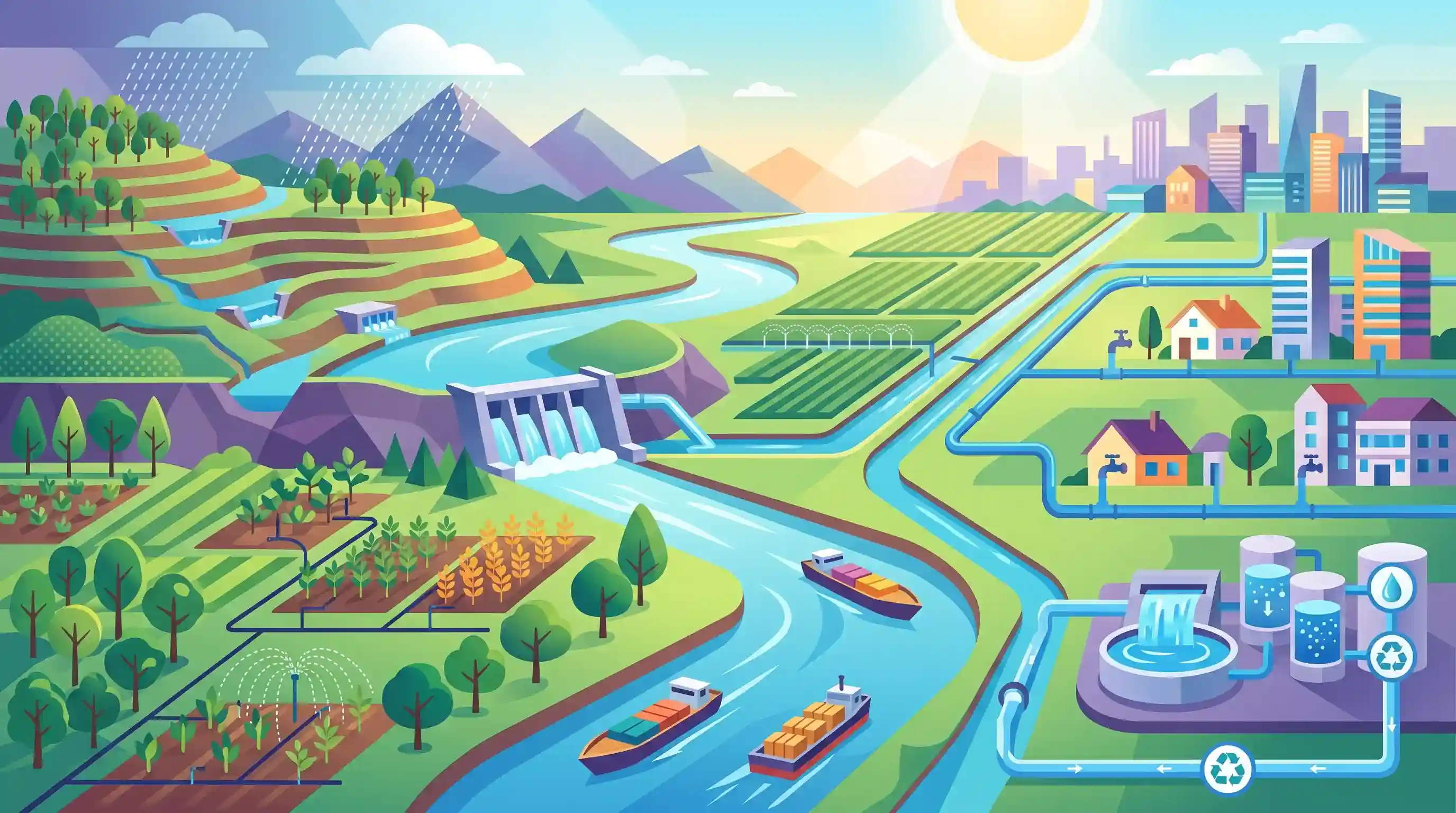
The Maharashtra government has established the State Water Resources Development and Management Committee (SWRDMC) to implement climate-resilient water management strategies across its river basins. Led by Sriram Vedire, the committee will evaluate and optimize all irrigation, drinking water, and multi-purpose water projects in the state. Its comprehensive mandate covers expanding micro-irrigation, achieving universal and equitable tap water access, promoting water recycling, and exploring inland river navigation. These measures are designed to modernize Maharashtra's water infrastructure and align the Integrated State Water Plan with the sustainable development goals of "Viksit Maharashtra 2047".
Key Points
- The Maharashtra government has formed the State Water Resources Development and Management Committee (SWRDMC) for climate-resilient water management.
- Headed by Sriram Vedire, the panel will plan, monitor, and assess irrigation, drinking water, and multi-purpose projects across all state river basins.
- Focus areas include ensuring universal tap water access, expanding micro-irrigation, and introducing appropriate pricing mechanisms.
- The committee will also explore water recycling and reuse, digital governance in water utilities, and the potential for inland river navigation.
- The initiatives aim to align the state's water policies with the "Viksit Maharashtra 2047" vision for sustainable development.
Important Terms
State Water Resources Development and Management Committee (SWRDMC)

A 13-member expert panel established to optimize water projects across Maharashtra's river basins. It advises the State Water Resources Council on climate-resilient planning, irrigation expansion, and infrastructure modernization.
UPSC context
GS Paper 2: Governance/Statutory Bodies. Tests knowledge of state-level institutional mechanisms for resource management and federal alignment.
Integrated State Water Plan (ISWP)
A statutory framework for the harmonious development and equitable distribution of surface and subsurface water. Maharashtra was the first Indian state to implement this basin-specific planning approach.
UPSC context
GS Paper 1 & 3: Geography and Environment. Relevant for questions on water security and sustainable resource management.
Viksit Maharashtra 2047
Maharashtra’s long-term vision document (aligned with Viksit Bharat 2047) targeting a $5 trillion economy. It outlines sectoral roadmaps for agriculture, water, and infrastructure over three phases.
UPSC context
GS Paper 3: Economic Development. Tests understanding of regional growth strategies and their alignment with national development goals.
Micro-irrigation
A modern irrigation technique (e.g., drip or sprinkler) that delivers water directly to plant root zones, increasing water-use efficiency to 80-95% compared to traditional flood irrigation.
UPSC context
GS Paper 3: Agriculture. A core topic for enhancing productivity and achieving 'More Crop Per Drop' objectives.
Integrated Water Resources Management (IWRM)
A process of promoting the coordinated development and management of water, land, and related resources to maximize economic and social welfare without compromising ecosystem sustainability.
UPSC context
GS Paper 1 & 3: Resource Management. Central concept in global and national water policies (e.g., National Water Policy).
Prelims Trap
"The SWRDMC is a central statutory body formed under the Jal Shakti Ministry for inter-state river management."
Aspirants often assume river basin committees are Central statutory bodies. SWRDMC is strictly a state-level executive panel specific to Maharashtra.
Static Concepts Connected
What is the constitutional distribution of powers regarding water?
- State List (Entry 17): Water supplies, irrigation, canals, drainage, embankments, and water storage fall entirely under State jurisdiction.
- Union List (Entry 56): The Centre regulates and develops inter-state rivers and river valleys to the extent declared by Parliament to be expedient in the public interest.
What are the primary methods and benefits of micro-irrigation?
- Drip Irrigation: Delivers water directly to the root zone drop-by-drop, minimizing evaporation and maximizing water-use efficiency (WUE).
- Sprinkler Irrigation: Simulates rainfall through pipes and nozzles; particularly effective for sandy soils and uneven topography.
- Agronomic Benefits: Allows for 'fertigation' (soluble fertilizers applied with water), prevents soil salinization, and limits water-logging.
Cross-Topic Patterns
Water Pricing + Farm Power Subsidies
The push for appropriate water pricing directly clashes with the political economy of subsidized agricultural electricity, which drives unsustainable sugarcane cultivation in semi-arid regions of Maharashtra.
Inland Waterways + Federal Infrastructure
Maharashtra's move to explore inland river navigation ties into GS-3 infrastructure, recalling the National Waterways Act 2016 and the federal coordination required with the Inland Waterways Authority of India (IWAI).

Expect a 2026 Mains question linking climate-resilient state water policies and pricing to the shift away from water-guzzling crops.
Linked PYQs · 5
Linked PYQs · 5
- 2016MainsGS3
What is water-use efficiency? Describe the role of micro-irrigation in increasing the water-use efficiency.
- 2024MainsGS3
What are the major challenges faced by Indian irrigation system in recent times? State the measures taken by the government for efficient irrigation management.
- 2021MainsGS3
How and to what extent would micro-irrigation help in solving India's water crisis?
- 2020MainsGS3
Suggest measures to improve water storage and irrigation system to make its judicious use under depleting scenario.
- 2019MainsGS3
Elaborate the impact of National Watershed Project in increasing agricultural production from water-stressed areas.
