Maharashtra establishes panel for climate resilient water management
Source:Indian Express ↗
Why It Matters
As water scarcity and climate change-induced erratic rainfall increasingly threaten regional water security, this state-level integrated panel provides a strategic model for shifting from fragmented irrigation projects to holistic, basin-level water governance and climate adaptation.
Summary
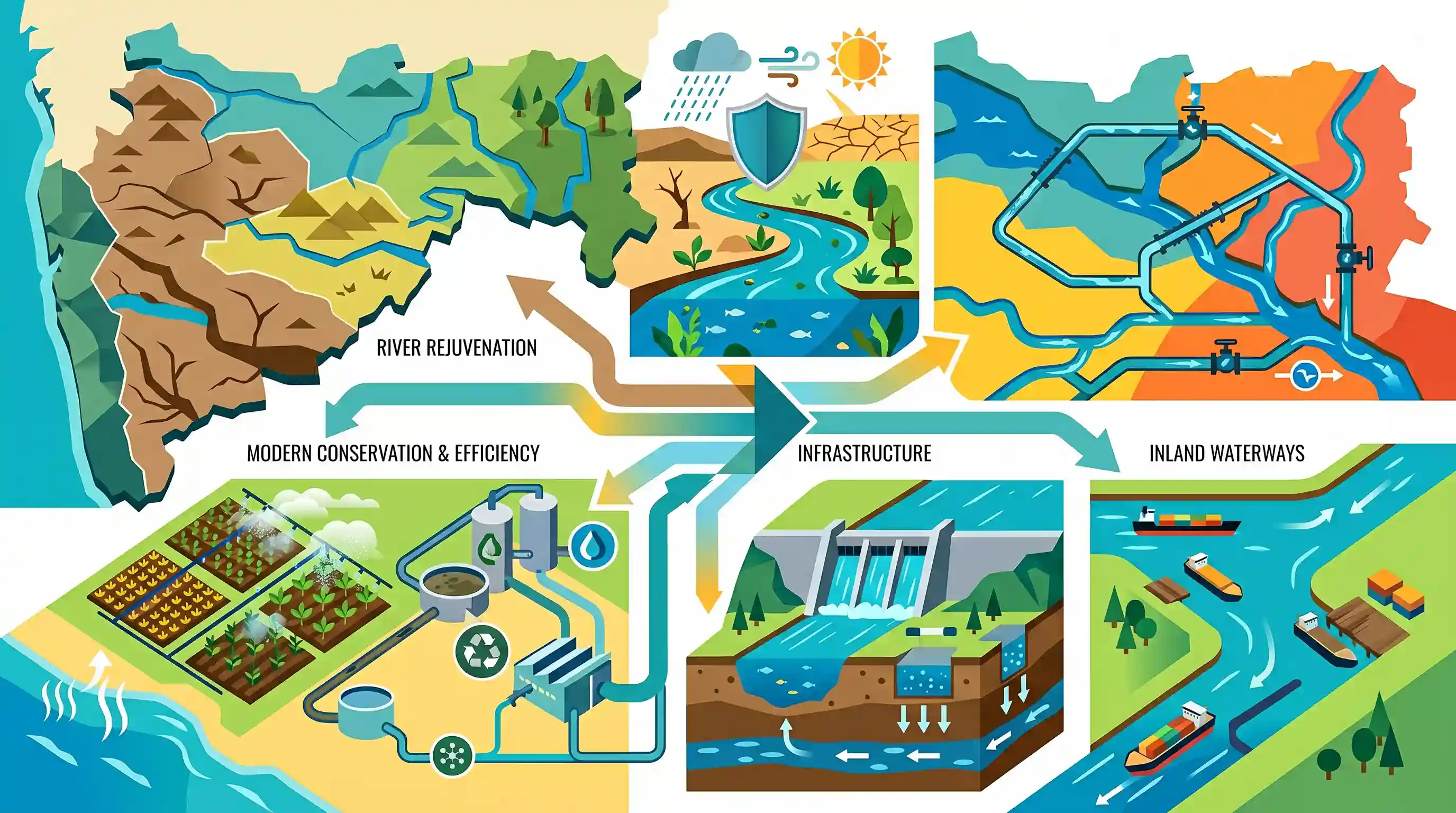
The Maharashtra government has established the State Water Resources Development and Management Committee (SWRDMC) to ensure comprehensive, climate-resilient management of water across the state's river basins. The committee's mandate spans river rejuvenation, restoring natural flows, equitable water distribution via inter-basin transfers, and promoting water conservation through recycling, desalination, and micro-irrigation. Aligned with State and National Water Policies, the initiative also seeks to modernize water storage structures, improve groundwater recharge, and assess the feasibility of inland river navigation. This policy shift underscores the critical necessity of transitioning to Integrated Water Resource Management (IWRM) to tackle escalating climate stresses and water scarcity challenges.
Key Points
- The Maharashtra government has formed the State Water Resources Development and Management Committee (SWRDMC) to comprehensively manage water resources across all river basins in a climate-resilient manner.
- The panel's goals include restoring the natural flow of rivers, river rejuvenation, improving groundwater recharge, and adopting a holistic Integrated Water Resources Management (IWRM) approach.
- It emphasizes equitable water access by planning inter-basin water transfers from surplus to deficit regions like Marathwada and Vidarbha.
- Key operational focuses include promoting micro-irrigation, water recycling, desalination for coastal areas, restoration of wetlands, and evaluating the feasibility of inland river navigation.
Important Terms
Integrated Water Resources Management (IWRM)

A process promoting the coordinated development and management of water, land, and related resources to maximize economic and social welfare without compromising ecosystem sustainability.
UPSC context
GS Paper 1 (Resources) and GS 3 (Environment); tests understanding of sustainable resource management.
National Water Policy
A Union government framework (latest 2012) guiding the development and efficient management of water resources across India, emphasizing conservation and equitable distribution.
UPSC context
GS Paper 2 (Policy) and GS 3 (Infrastructure); tests awareness of national water governance frameworks.
State Water Resources Development and Management Committee (SWRDMC)
A 13-member Maharashtra state committee established to implement climate-resilient water management and advise the State Water Resources Council on river basin planning.
UPSC context
GS Paper 2 (State Governance); relevant for questions on decentralized water management and federalism.
Inter-basin Water Transfer
The diversion of water from surplus river basins to deficit ones through man-made structures to mitigate regional scarcity and droughts.
UPSC context
GS Paper 1 (Geography) and GS 3 (Irrigation); tests knowledge of large-scale hydrological interventions.
Micro-irrigation
High-efficiency irrigation methods, like drip or sprinkler systems, that deliver water directly to the plant root zone, significantly reducing water wastage in agriculture.
UPSC context
GS Paper 3 (Agriculture); vital for topics on "more crop per drop" and sustainable farming.
Prelims Trap
Water is a Concurrent List subject, allowing both states and the Centre to legislate on intra-state river basin management.
Water is a State subject (Entry 17, List II). The Union only regulates inter-state rivers (Entry 56, List I). Intra-state governance belongs to states.
Static Concepts Connected
What are the core principles of Integrated Water Resources Management (IWRM)?
- Hydrological Unit: Plans water management using the river basin or sub-basin as the primary geographical unit, rather than artificial administrative boundaries.
- Holistic Approach: Integrates land, water, and ecosystem management to maximize economic and social welfare without compromising long-term environmental sustainability.
- Participatory Governance: Involves policymakers, planners, and users at all levels, emphasizing decentralization and community-led water governance.
Why are Maharashtra's Marathwada and Vidarbha regions chronically drought-prone?
- Rain Shadow Area: Marathwada lies in the rain shadow of the Western Ghats, receiving highly erratic and deficient Southwest monsoon rainfall.
- Geological Constraints: The hard basaltic rock of the Deccan Plateau severely limits groundwater recharge, making aquifers highly sensitive to over-extraction.
- Crop Pattern Mismatch: The proliferation of water-intensive crops like sugarcane exacerbates acute water stress in these naturally dry ecological zones.
Cross-Topic Patterns
Intra-state linking vs Ecological Flow
Maharashtra's intra-state linking mirrors the Ken-Betwa inter-state project. UPSC frequently explores the ecological viability versus the drought-mitigation benefits of such massive inter-basin water transfers.
Micro-irrigation & PMKSY alignment
State-level micro-irrigation mandates align with the Pradhan Mantri Krishi Sinchayee Yojana (PMKSY), directly tackling the 'water-guzzling crops' crisis that UPSC frequently tests in GS3 Agriculture.

IWRM principles and the constitutional split of water governance (State List vs Union List) will likely fuse into a 2026 Prelims MCQ.
Linked PYQs · 5
Linked PYQs · 5
- 2024MainsGS3
The world is facing an acute shortage of clean and safe freshwater. What are the alternative technologies which can solve this crisis? Briefly discuss any three such technologies citing their key merits and demerits.
- 2020MainsGS3
Suggest measures to improve water storage and irrigation system to make its judicious use under depleting scenario.
- 2016MainsGS3
What is water-use efficiency? Describe the role of micro-irrigation in increasing the water-use efficiency.
- 2021MainsGS3
How and to what extent would micro-irrigation help in solving India's water crisis?
- 2016MainsGS1
Enumerate the problems and prospects of inland water transport in India.
