Maharashtra river basins panel for climate resilient water management
Source:Indian Express ↗
Why It Matters
This development showcases state-level decentralized policy interventions for adapting to climate change. Understanding integrated river basin planning, the use of technology in water security, and infrastructure resilience is crucial for questions on water stress, micro-irrigation, urban flooding, and agriculture in Mains GS1 and GS3.
Summary
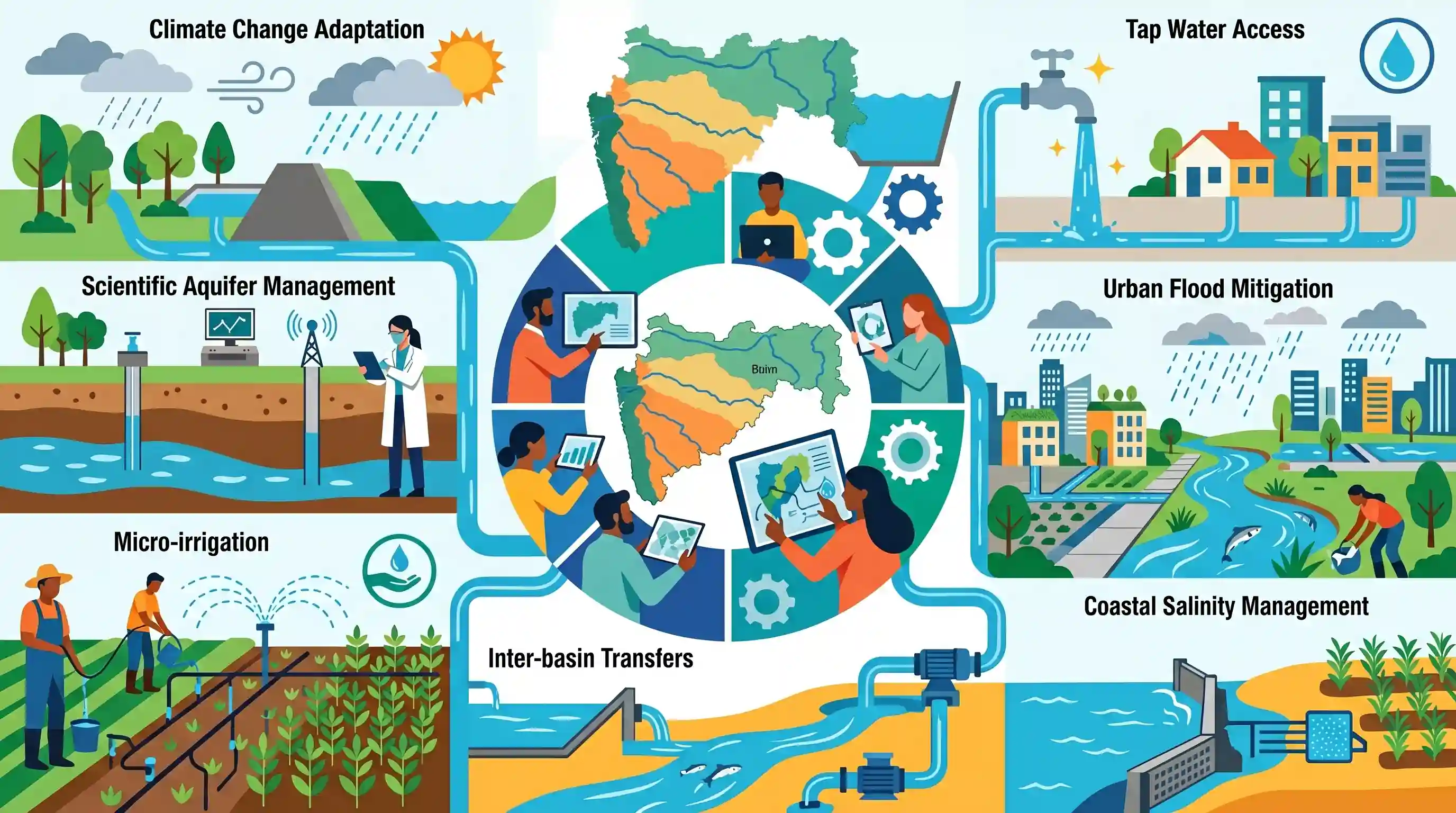
Maharashtra has established a State Water Resources Development and Management Committee (SWRDMC) to ensure climate-resilient water management across its river basins. The 13-member panel, aiming to align the Integrated State Water Plan with 'Viksit Maharashtra 2047', will focus on scientific management of aquifers, micro-irrigation, tap water access, and urban flood mitigation. It can also form working groups addressing complex water resource challenges such as inter-basin transfers, river rejuvenation, and coastal salinity management.
Key Points
- The Maharashtra government has constituted a 13-member State Water Resources Development and Management Committee (SWRDMC), headed by Sriram Vedire.
- The panel aims to align the Integrated State Water Plan with the goals of 'Viksit Maharashtra 2047', focusing on climate-resilient management across river basins.
- Key initiatives encompass equitable water access, scientific management of aquifers and watersheds, modernization of storage infrastructure, and expanding micro-irrigation.
- The committee has the mandate to create sub-committees for critical areas like inter/intra-basin water transfers, urban flooding, desalination, wetland restoration, and inland river navigation.
Important Terms
Integrated State Water Plan (ISWP)

A statutory framework for the sustainable development and equitable distribution of surface and groundwater across Maharashtra's river basins, integrating structural, operational, and demand-side management measures.
UPSC context
GS-III (Environment/Water Resources); tests knowledge of Integrated Water Resources Management (IWRM) and sub-national policy implementation for resource sustainability.
State Water Resources Council
The apex policy-making body in Maharashtra, chaired by the Chief Minister, tasked with approving the Integrated State Water Plan and providing high-level strategic direction for water governance.
UPSC context
GS-II (Governance/Institutional Framework); relevant for understanding the hierarchy of executive decision-making and federal/state water management structures.
Viksit Maharashtra 2047
A strategic vision document aligning Maharashtra's development with India’s 2047 goals, targeting a $5 trillion economy through climate-resilient infrastructure, inclusive growth, and sustainable resource management.
UPSC context
GS-III (Economy/Planning); key for studying long-term regional development strategies and the integration of economic growth with environmental sustainability.
State Water Resources Development and Management Committee (SWRDMC)
A 13-member expert panel established to scientifically plan, monitor, and assess water projects with a focus on climate resilience, inter-basin transfers, and aquifer management.
UPSC context
GS-III (Disaster Management/Environment); tests knowledge of climate-adaptive governance and specialized institutional responses to urban flooding and water scarcity.
Maharashtra Water Resources Regulatory Authority (MWRRA)
A statutory body created by the MWRRA Act, 2005, to regulate water resources, ensure equitable allocation across sectors, and determine water tariffs in Maharashtra.
UPSC context
GS-II (Statutory Bodies); essential for understanding the regulatory mechanisms and dispute resolution frameworks in the management of public utilities and resources.
Prelims Trap
SWRDMC is a statutory national body established to manage inter-state river water disputes and inter-basin transfers.
Aspirants may confuse this Maharashtra-specific state committee with statutory national tribunals or central boards formed under the Inter-State Water Disputes Act.
Static Concepts Connected
How does the Constitution distribute legislative power over water resources?
- State List: Grants states jurisdiction over water supplies, irrigation, canals, drainage, and water storage, subject to the Union List.
- Union List: Empowers the Centre to regulate and develop inter-state rivers and river valleys to the extent declared by Parliament.
- Article 262: Allows Parliament to by law provide for the adjudication of any dispute with respect to inter-state rivers or river valleys.
How does micro-irrigation specifically build agricultural climate resilience?
- Water Efficiency: Drip and sprinkler systems minimize evaporation and runoff, adapting to increasingly erratic monsoon rainfall patterns.
- Salinity Control: Prevents waterlogging and the subsequent capillary rise of salts, critical for maintaining yields in arid or coastal regions.
- Energy-Water Nexus: Reduces the volume of groundwater extracted, thereby lowering the energy required for irrigation pumping and preventing aquifer depletion.
Cross-Topic Patterns
Urban Flooding + Wetland Restoration
Urban flooding is shifting from a pure drainage failure problem to a climate adaptation issue, strongly linking GS1 Urbanization with GS3 Disaster Management and wetland restoration.
Aquifer Management + Desalination
As coastal groundwater faces saline ingress due to sea-level rise and over-extraction, coastal states are increasingly pivoting toward desalination and scientific aquifer mapping (NAQUIM) simultaneously.

Jurisdictional overlap in inter-basin transfers + aquifer mapping (NAQUIM) are prime candidates for a 2026 multi-statement question.
Linked PYQs · 5
Linked PYQs · 5
- 2016MainsGS3
What is water-use efficiency? Describe the role of micro-irrigation in increasing the water-use efficiency.
- 2021MainsGS3
How and to what extent would micro-irrigation help in solving India's water crisis?
- 2019MainsGS3
Elaborate the impact of National Watershed Project in increasing agricultural production from water-stressed areas.
- 2020MainsGS1
The interlinking of rivers can provide viable solutions to the multi-dimensional inter-related problems of droughts, floods and interrupted navigation. Critically examine.
- 2021MainsGS1
What are the environmental implications of the reclamation of water bodies into urban land use ? Explain with examples.
