Maharashtra Economic Growth and Infrastructure Development Vision
Source:the-print ↗
Why It Matters
Understanding state-level infrastructure projects and agricultural welfare schemes is crucial for MPSC Combined Prelims, as questions frequently target specific regional initiatives (e.g., loan waivers, Metro projects) and their socio-economic impacts on Maharashtra.
Summary
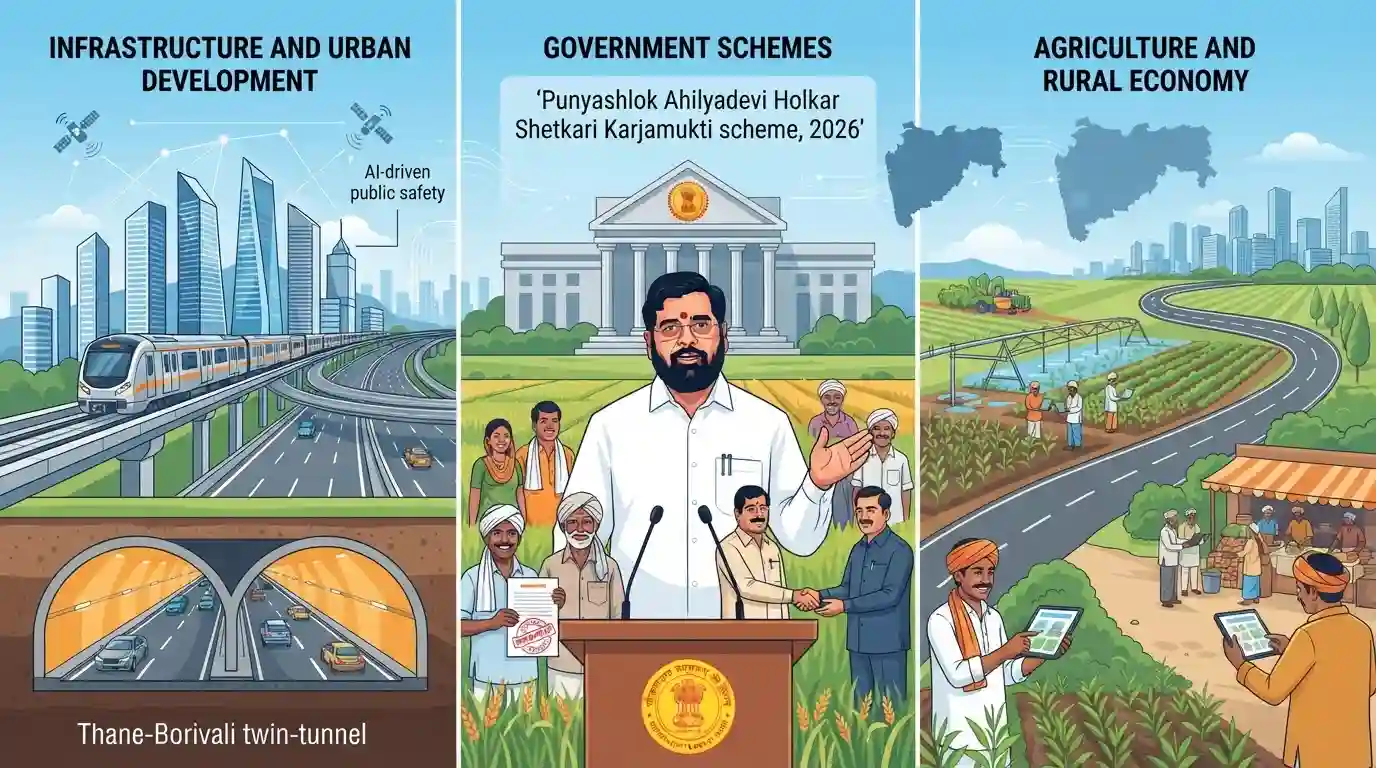
During his Independence Day address, Maharashtra Deputy Chief Minister Eknath Shinde outlined a vision of Maharashtra as the primary engine driving India toward global superpower status. He announced major infrastructure and urban development initiatives in the Mumbai Metropolitan Region, such as the Thane-Borivali twin-tunnel road and extensive Metro expansions, alongside a significant push for AI-driven public safety systems. Bridging urban technological growth with agricultural welfare, he also highlighted the newly launched 'Punyashlok Ahilyadevi Holkar Shetkari Karjamukti scheme, 2026', a comprehensive farmer loan waiver program aimed at providing critical financial relief to the state's agrarian sector.
Key Points
- Maharashtra Deputy CM Eknath Shinde positioned the state as the primary growth engine for India's ambition to become a global superpower.
- Major infrastructure projects were highlighted, including the Thane-Borivali twin-tunnel road and new Metro corridors to boost connectivity in the Mumbai Metropolitan Region.
- The state emphasized technology and public safety by installing 6,059 AI-enabled cameras across Thane.
- The government announced the 'Punyashlok Ahilyadevi Holkar Shetkari Karjamukti scheme, 2026', a comprehensive debt waiver initiative aimed at providing financial relief to farmers.
Important Terms
Punyashlok Ahilyadevi Holkar Shetkari Karjamukti scheme, 2026

A 2026 Maharashtra government farm loan waiver program providing complete relief on agricultural loans up to ₹2 lakh, intended to benefit approximately 56 lakh farmers.
UPSC context
Critical for MPSC GS Paper 2 (State Policies) and GS 3 (Agriculture). Tests knowledge of agrarian distress alleviation and rural welfare interventions.
Maharashtra State Road Development Corporation (MSRDC)
A state-owned corporation established in 1996 to plan, construct, and manage major road infrastructure, including expressways, flyovers, and twin-tunnel roads across Maharashtra.
UPSC context
Important for MPSC GS Paper 3 (Infrastructure). Tests knowledge of dedicated state agencies driving regional connectivity and economic development.
Mumbai Metropolitan Region Development Authority (MMRDA)
An apex state agency created in 1975 for urban planning and executing large-scale public transportation and infrastructure projects across the Mumbai Metropolitan Region.
UPSC context
Relevant for MPSC GS Paper 1 (Urbanization) and GS 3 (Infrastructure). Assesses understanding of metropolitan governance and sustainable urban expansion.
Prelims Trap
"The Ahilyadevi Holkar scheme provides a complete waiver on all outstanding crop loans."
Aspirants might assume a blanket waiver. It only provides a full waiver up to ₹2 lakh. Amounts above this get a One-Time Settlement, while regular repayers receive a ₹50,000 incentive.
Static Concepts Connected
What are the economic impacts and critiques of farm loan waivers?
- Fiscal Burden: Increases state fiscal deficit, severely limiting capital expenditure on long-term agricultural infrastructure like irrigation and storage.
- Moral Hazard: Disincentivizes honest borrowers from repaying future loans in anticipation of subsequent waivers, thereby damaging the credit culture.
- Short-term Relief: Provides immediate liquidity to distressed farmers but fails to address systemic issues like poor yield, climate shocks, or unremunerative prices.
What is the ecological and historical significance of Sanjay Gandhi National Park (SGNP)?
- Urban Location: Located entirely within the MMR, it is one of the few national parks globally situated within the limits of a major metropolis.
- Biodiversity & Hydrology: Known for its high density of leopards and acts as the crucial catchment area for Mumbai's Tulsi and Vihar lakes.
- Cultural Heritage: Houses the ancient rock-cut Kanheri Caves, a prominent Buddhist monastic site dating from the 1st century BCE to 10th century CE.
Cross-Topic Patterns
Infra expansion vs. Urban Ecology
Mega-projects like the SGNP twin-tunnel frequently test the balance between alleviating Mumbai Metropolitan Region's severe traffic congestion and protecting its fragile urban forest ecosystems.
AI in Urban Governance and Policing
Deploying over 6,000 AI cameras in Thane reflects a shift toward predictive policing and smart-city surveillance, linking directly to MPSC Mains topics on e-governance, data privacy, and state capacity.

Expect a multi-statement question testing the Ahilyadevi Holkar scheme's financial limits alongside the ecological geography of the SGNP.
Linked PYQs · 3
Linked PYQs · 3
- 2010MPSC_PRELIMSGS1
When did Government of Maharashtra declare the farmers debt waive scheme ?
- 2021MPSC_PRELIMSGS1
The Mumbai Metropolitan Region spread over 6,328 sq.km. consists of ________ Municipal Corporations.
- 2025MPSC_PRELIMSGS1
Identify the correct statements regarding Bhagwan Birsa Munda Road Linking Scheme. A. This scheme was started by Maharashtra Government. B. This scheme was only launched to connect the tribal villages. C. This scheme was made to connect tribal areas with primary health centres and Ashram schools through main roads. D. This scheme was discontinued by Govt. of Maharashtra in January 2025.
