Maharashtra Primary Education Language Policy Review Panel
Source:The Hindu ↗
Why It Matters
Highlights the persistent federal and cultural friction regarding the imposition of Hindi in non-Hindi speaking states. It demonstrates the intersection of education policy (like the three-language formula in NEP) and regional political mobilization.
Summary
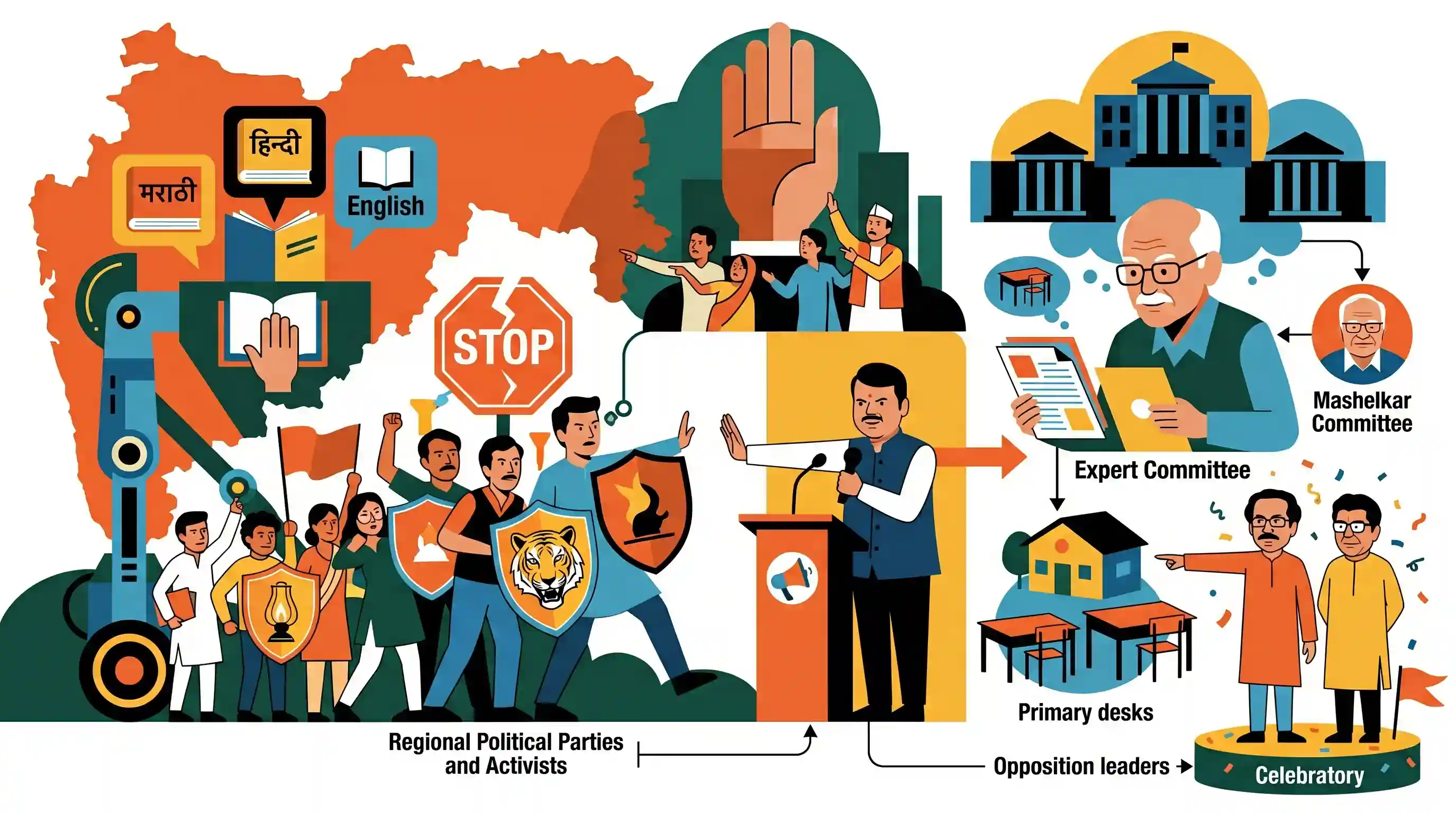
The Maharashtra government has suspended its controversial three-language policy for primary schools (Classes 1 to 5) after significant pushback from regional political parties and language activists. Chief Minister Devendra Fadnavis announced the formation of an expert committee led by Dr. Narendra Jadhav to reassess the policy and review recommendations from the Mashelkar Committee. Critics, including opposition leaders Uddhav and Raj Thackeray, celebrated the rollback but remained wary, alleging that the initial move was an attempt to impose a "Hindi, Hindu, Hindustan" agenda and questioning the relevance of Dr. Jadhav's higher education expertise in shaping primary school frameworks.
Key Points
- The Maharashtra government cancelled two recent orders that sought to implement a three-language policy, which included Hindi as a mandatory third language for Classes 1 to 5.
- An expert committee headed by economist Dr. Narendra Jadhav has been appointed to review the policy's implementation timeline and study the Mashelkar Committee recommendations.
- The initial policy faced severe backlash from opposition parties, activists, and academics who viewed it as a threat to Marathi identity and an imposition of a pro-Hindi agenda.
- Critics maintain skepticism over the newly formed committee, questioning Dr. Jadhav's expertise in primary education and demanding the permanent scrapping of the Hindi mandate.
Important Terms
Three-Language Formula

A 1968 educational framework requiring students to learn three languages: a regional language, Hindi, and English (with variations for Hindi-speaking states) to promote multilingualism.
UPSC context
GS Paper II (Governance/Education); GS Paper I (Diversity/Regionalism). Tests knowledge of federal language policy and national integration.
National Education Policy (NEP) 2020
A comprehensive framework for Indian education reform that emphasizes mother tongue-based instruction and flexibility in the three-language policy without mandatory language imposition.
UPSC context
GS Paper II (Social Justice/Education). Crucial for questions on current educational reforms and developmental goals.
Mashelkar Committee Report
A Maharashtra state panel report (2021) that recommended implementing the three-language formula (Marathi, Hindi, and English) from Classes 1 to 12.
UPSC context
GS Paper II (State Governance). Exemplifies how expert committees shape public policy and state-level implementation of national frameworks.
Dr. Narendra Jadhav Committee
An expert panel formed in 2025 to review Maharashtra's school language policy following protests against mandatory Hindi in primary education.
UPSC context
GS Paper II (Governance). Relevant for understanding administrative responses to civil society pushback and policy rollbacks.
Marathi Abhyas Kendra
An influential Marathi cultural and research organization that advocates for regional language preservation and mother-tongue primary education in Maharashtra.
UPSC context
GS Paper II (Civil Society). Tests the role of interest groups in influencing government policy and democratic discourse.
Linguistic Regionalism
Political or cultural loyalty to a specific region and its language, often leading to demands for autonomy or resistance to perceived external imposition.
UPSC context
GS Paper I (Regionalism). A core concept in Indian society relating to identity politics and internal security/stability.
Prelims Trap
"NEP 2020 mandates the compulsory inclusion of Hindi in primary schools for all non-Hindi speaking states."
NEP 2020 retains the three-language formula but emphasizes complete flexibility, explicitly stating that "no language will be imposed on any State."
Static Concepts Connected
What are the key Constitutional provisions regarding language instruction and promotion?
- Article 350A: Directs states and local authorities to endeavor to provide adequate facilities for instruction in the mother-tongue at the primary stage of education.
- Article 351: Directs the Union government to promote the spread and development of Hindi to serve as a medium of expression for India's composite culture.
- Article 30: Grants linguistic minorities the fundamental right to establish and administer educational institutions of their choice.
How did the Three-Language Formula evolve in India's education policy?
- Kothari Commission (1964-66): First recommended teaching the regional language, English, and a modern Indian language (preferably Hindi or a South Indian language).
- NPE 1968 & 1986: Formally adopted the formula to promote national integration, advocating Hindi in non-Hindi areas and another Indian language in Hindi areas.
- NEP 2020: Continues the formula but mandates that at least two of the three languages must be native to India, with strict non-imposition.
Cross-Topic Patterns
Concurrent List friction in Education
Transferred to the Concurrent List by the 42nd Amendment (1976), education consistently witnesses Centre-State tug-of-wars over national policy frameworks (like NEP 2020) versus state-level syllabus autonomy.
Linguistic identity and Regionalism
Rooted in the States Reorganisation Commission (1953), language remains a primary tool for regional political parties to assert sub-national identity and resist perceived cultural homogenization.

Expect a multi-statement Prelims question blending NEP 2020's language flexibility with Constitutional Articles 350A and 351.
Linked PYQs · 2
Linked PYQs · 2
- 2020MainsGS2
National Education Policy 2020 is in conformity with the Sustainable Development Goal-4 (2030). It intends to restructure and reorient education system in India. Critically examine the statement.
- 2022MainsGS2
“While the national political parties in India favour centralisation, the regional parties are in favour of State autonomy.” Comment.
