Maharashtra Government Rules Of Business Executive Powers
Source:indiatoday ↗
Why It Matters
Understanding the Rules of Business is crucial for MPSC aspirants as it illustrates the functional hierarchy and distribution of executive powers within the state government, directly correlating with constitutional provisions like Articles 163, 164, and 166.
Summary
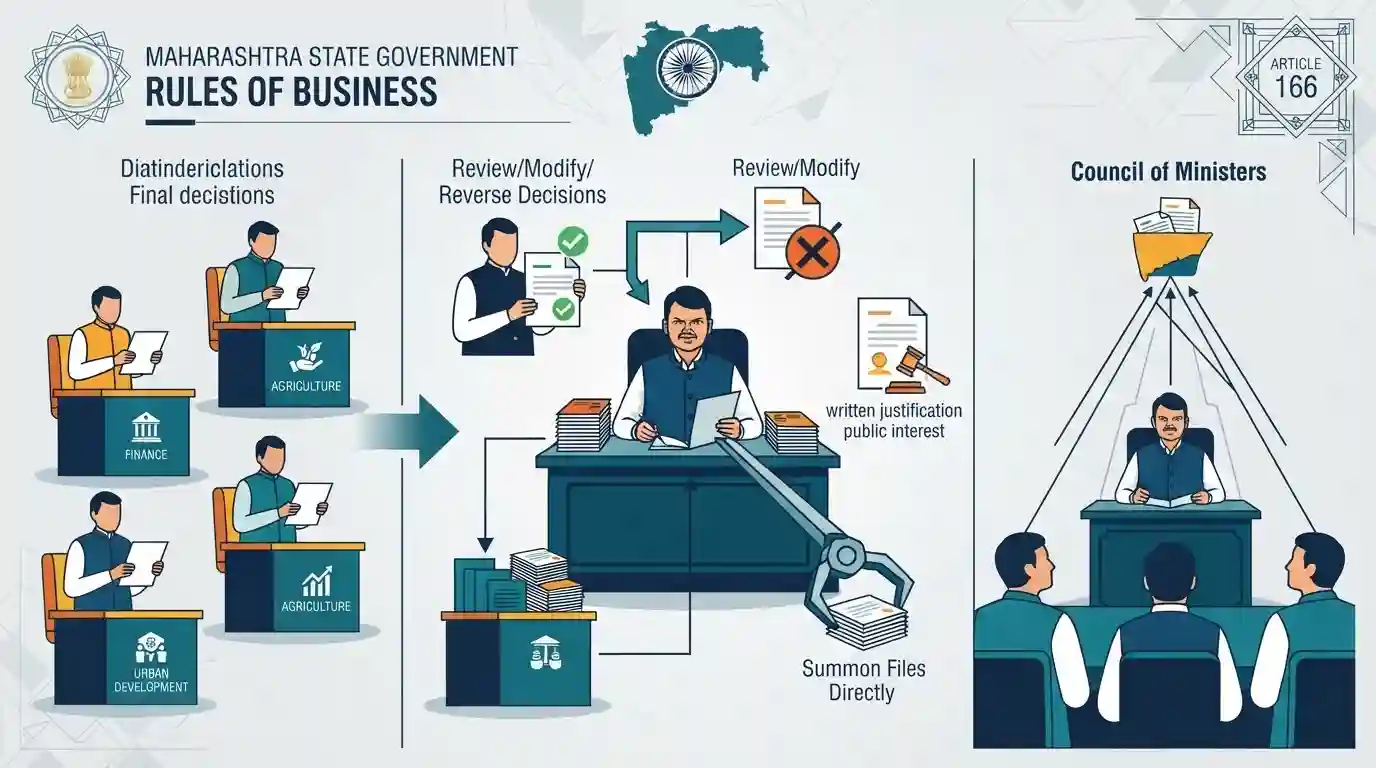
The Maharashtra Government has implemented the 'Maharashtra Government Rules of Business, 2026', granting Chief Minister Devendra Fadnavis significant overriding powers over his Cabinet colleagues. Under the new rules, the Chief Minister can review, modify, or reverse decisions made by individual ministers if deemed in the 'public interest', subject to providing written justification. Furthermore, the Chief Minister can directly summon files from any department. This marks a shift from past practices where ministers had final say in their departmental matters unless brought before the Cabinet. The development highlights the internal dynamics of the State Executive and relates to Article 166 of the Constitution, which deals with the conduct of business of a state government.
Key Points
- The new 'Maharashtra Government Rules of Business, 2026' explicitly authorize the Chief Minister to review, modify, or overturn decisions made by ministers.
- This override power can be exercised in the 'public interest', provided the Chief Minister issues written reasons for the intervention.
- The rules empower the Chief Minister to directly call for files and information from any department, enhancing centralized oversight.
- Previously, ministers enjoyed autonomy over decisions within their departments unless matters were voluntarily referred to the Cabinet.
- These rules are framed under the constitutional framework of Article 166, which empowers the Governor to make rules for the more convenient transaction of the state government's business.
Important Terms
Maharashtra Government Rules of Business, 2026

A set of administrative rules notified on August 14, 2026, replacing the 1975 framework, explicitly granting the Maharashtra Chief Minister overriding powers to review, modify, or revoke ministerial decisions in the public interest.
UPSC context
GS-II: State Legislature & Executive; tests current administrative reforms, coalition dynamics, and executive overrules in Maharashtra.
Article 166 of the Constitution
A constitutional provision governing the conduct of business of a state government, mandating executive actions be taken in the Governor's name, and empowering the Governor to frame rules for convenient government transaction.
UPSC context
GS-II: Indian Constitution; tests state executive powers, conduct of state business, and the Governor's rule-making authority.
Council of Ministers
A constitutional body headed by the Chief Minister (at the state level) that aids and advises the constitutional head of state and is collectively responsible to the Legislative Assembly.
UPSC context
GS-II: State Executive; tests ministerial accountability, collective responsibility, and the relationship between the CM and portfolio ministers.
State Executive
The branch of state government consisting of the Governor, Chief Minister, Council of Ministers, and Advocate General, responsible for implementing laws and administering the state as per Part VI.
UPSC context
GS-II: State Administration; tests the organizational structure, roles, and inter-relationships of state executive elements.
Prelims Trap
The Maharashtra Rules of Business are framed and enacted by the Chief Minister or State Legislature.
Under Article 166(3) of the Constitution, the Governor, not the Chief Minister or State Legislature, is the constitutional authority who makes these rules of business.
Static Concepts Connected
What does Article 166 of the Constitution mandate?
- Governor's Name: All executive actions of a state government are formally taken in the name of the Governor.
- Authentication of Orders: Orders executed in the Governor’s name must be authenticated as specified by rules made by the Governor.
- Rules of Business: The Governor makes rules for the more convenient transaction of state business and allocation of work among Ministers.
What is the constitutional relationship between the Governor and CM under Article 167?
- Information Sharing: The CM must communicate all decisions of the Council of Ministers to the Governor.
- Administrative Reporting: The CM is bound to furnish any administrative or legislative information that the Governor calls for.
- Collective Responsibility: The Governor can require the CM to submit a single minister's decision to the Cabinet for consideration.
Cross-Topic Patterns
Cabinet collegiality vs Presidential executive
The shift toward CM-centric file recall dilutes the traditional Westminster principle of cabinet collegiality, turning the CM into an overriding executive authority over individual departments.
Article 163 versus Article 166
Highlights the operational friction where executive power is held by the Governor under aid and advice (Article 163) but structured via Rules of Business (Article 166).

MPSC will likely test the Governor's rule-making authority under Art 166(3) vs the CM's executive supremacy under the new 2026 Rules.
Linked PYQs · 2
Linked PYQs · 2
- 2023MPSC_PRELIMSGS1
Which of the following statement is not included in Article 164 ?
- 2013MPSC_PRELIMSGS1
The Chief Minister of a state can be removed if : (a) a resolution is passed by 2/3rd members of the Legislative Council or the Rajya Sabha. (b) in the opinion of the Governor, there is a breakdown of the constitutional machinery in the state. (c) a no - confidence motion is passed by the Legislative Assembly. (d) a no - confidence motion is passed by both the houses of State Legislature. Codes :
