Coaching Regulation: Draft Act Limits Daily Classes To Five Hours
Source:dailypioneer ↗
Why It Matters
This proposed legislation represents a major regulatory shift in curbing the commercialization of education, addressing safety hazards in coaching hubs, and mitigating mental health issues among students preparing for highly competitive exams.
Summary
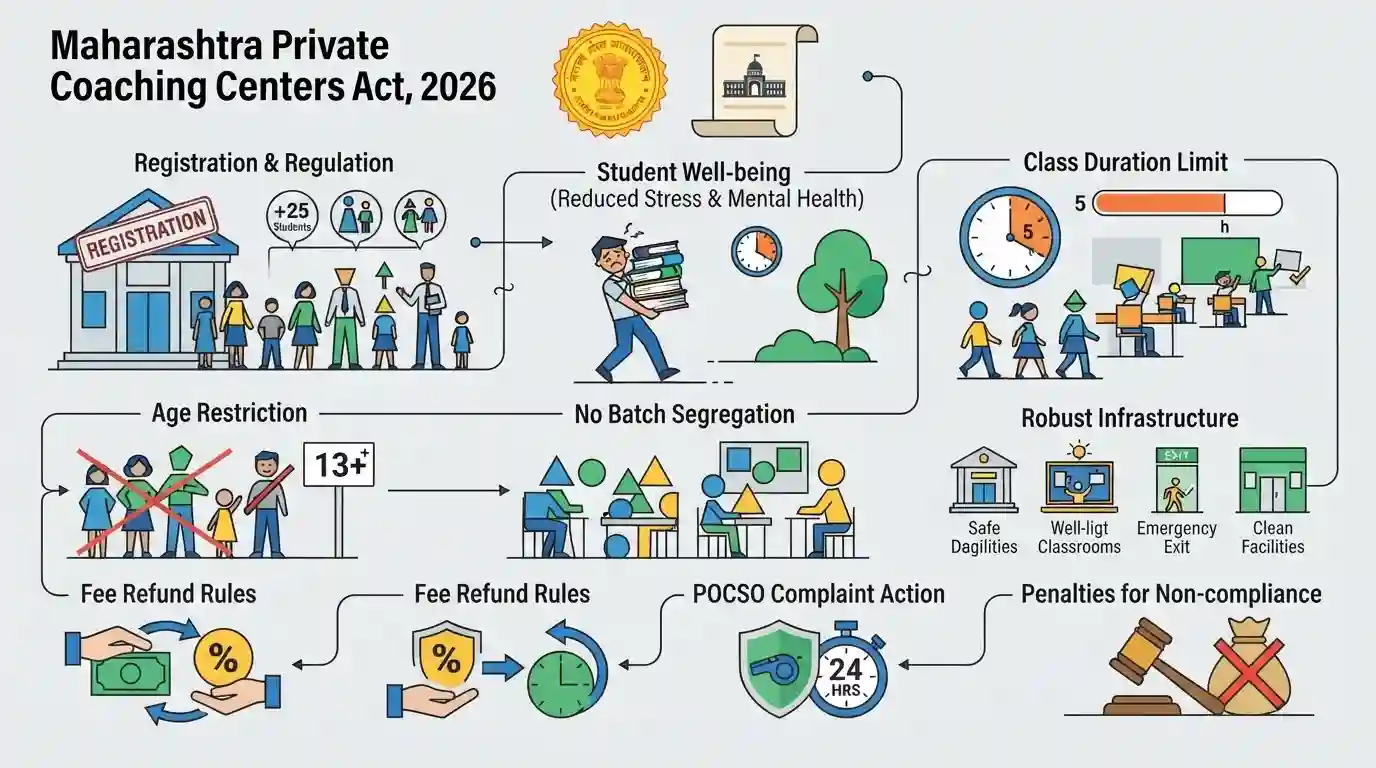
The Maharashtra government has proposed the 'Maharashtra Private Coaching Centers (Registration and Regulation) Act, 2026' to bring private coaching institutions under strict state regulation. Designed to reduce academic stress, protect students' mental health, and ensure safety, the draft bill mandates registration for centers with over 25 students, limits class duration to 5 hours daily, bars the enrollment of children below 13, and prohibits academic-performance-based batch segregation. It also outlines robust infrastructure requirements, fee refund rules, a 24-hour action mandate for POCSO-related complaints, and steep penalties for non-compliance.
Key Points
- The Maharashtra School Education and Sports Department has released the draft 'Maharashtra Private Coaching Centers (Registration and Regulation) Act, 2026' to regulate private coaching centers with more than 25 students.
- Mandatory registration is proposed for all centers, valid for three years, with a six-month window provided for existing centers to comply. Each branch requires separate registration.
- The legislation bans enrolling children under 13 years of age, prohibits batch segregation based on academic performance to protect mental health, and caps daily classes at five hours.
- Coaching centers are barred from making misleading promises or guarantees regarding ranks/marks and are forbidden from operating on recognized school/junior college premises or employing their teachers.
- Physical infrastructure norms require a minimum of 1 square meter of space per student, fire safety certification, CCTV coverage with 30-day backup, and a strict ban on operating in basements.
- Fees cannot be increased mid-course, and pro-rata refunds for tuition, hostel, and mess fees must be processed within 10 days if a student leaves midway.
- A formal grievance redressal mechanism is established, requiring immediate action (within 24 hours) for any POCSO or workplace sexual harassment complaints, and reporting suspected BNS offences to the local police.
- Violations will attract heavy penalties, ranging from Rs 1 lakh to Rs 5 lakh for minor offences, and Rs 10 lakh to Rs 50 lakh for major violations, alongside potential registration cancellation.
Important Terms
Maharashtra Private Coaching Centers (Registration and Regulation) Act, 2026

A proposed state law mandating registration and regulating operations, safety, and working conditions for private coaching centres with over 25 students, barring enrollment of children below 13.
UPSC context
Relevant for GS Paper 2 (Government Policies, Education Sector in Maharashtra) testing state-level regulatory interventions.
Right of Children to Free and Compulsory Education Act, 2009
An Act operationalising Article 21A, ensuring free and compulsory education for children aged 6 to 14, establishing basic school norms, and mandating private school seat reservations.
UPSC context
Essential for GS Paper 2 (Education, Fundamental Rights) to evaluate knowledge of constitutional mandates and educational inclusion.
Protection of Children from Sexual Offences (POCSO) Act, 2012
A gender-neutral legislation aimed at protecting children under 18 from sexual abuse, exploitation, and harassment, establishing special courts and child-friendly trial procedures.
UPSC context
Crucial for GS Paper 2 (Social Justice, Vulnerable Sections) testing legal frameworks for child protection and welfare.
Bharatiya Nyaya Sanhita (BNS)
The new criminal code of India effective July 2024, which replaces the colonial-era Indian Penal Code (IPC) to modernise the nation's criminal justice system.
UPSC context
Vital for GS Paper 2 (Governance, Legal Framework) as it represents a fundamental overhaul of India's statutory criminal laws.
Prelims Trap
The Maharashtra Act aligns with Union guidelines by banning coaching enrollment for students below 16 years.
The Maharashtra draft permits enrollment of children above 13 years, which is notably lower than the Union Ministry of Education's 2024 guidelines that recommend a minimum age of 16.
Static Concepts Connected
How is 'Education' distributed in the 7th Schedule?
- Pre-1976 Status: Education was originally in the State List, giving states exclusive control.
- Concurrent List: The 42nd Amendment Act (1976) moved Education to the Concurrent List, allowing both Parliament and State Legislatures to enact laws.
- Repugnancy Rule: Under Article 254, if a state law conflicts with a central law on a concurrent subject, the central law prevails unless the state law receives Presidential assent.
What are the mandatory reporting obligations under the POCSO Act?
- Definition of Child: The Act defines a child as any person below 18 years and is entirely gender-neutral.
- Mandatory Reporting: Section 19 mandates that any person who apprehends that a child has been abused must report it to the Special Juvenile Police Unit or local police.
- Penalty for Omission: Failure to report a suspected POCSO offense (Section 21) is a criminal offense punishable by imprisonment, which this coaching bill reinforces with a 24-hour action mandate.
Cross-Topic Patterns
Dummy Schools & RTE Act 2009
The ban on 'integrated coaching' protects the RTE mandate of holistic education, preventing schools from acting merely as proxy enrollment centers for competitive exams.
Student Suicides and NCRB Data
The ban on performance-based batch segregation targets the mental health crisis, addressing issues highlighted by NCRB data on rising student suicide rates in coaching hubs.

Expect a multi-statement question contrasting this draft's 13-year age threshold with the Union Ministry's 16-year guideline.
Linked PYQs · 3
Linked PYQs · 3
- 2025MPSC_PRELIMSGS1
The 'Protection of Children from Sexual Offences' (POCSO) Act was enacted in India in which year ?
- 2015MPSC_PRELIMSGS1
What is the main purpose of Right to Education Act, 2009 ?
- 2024MPSC_PRELIMSGS1
What were the main principles of the National Education Policy of 1968 based on the recommendations of the Kothari Commission ? (a) Compulsory and free education till the age of 14 years. (b) Higher position and improved pay for teachers. (c) At least 10% of gross national income spent on education.
