Maharashtra drafts new regulation act for private coaching classes
Source:opindia ↗
Why It Matters
This draft legislation represents a major state-level intervention to regulate the largely unchecked private coaching industry, addressing student mental health, safety standards, and structural malpractices like the dummy school model, making it crucial for governance and educational policy questions in MPSC examinations.
Summary
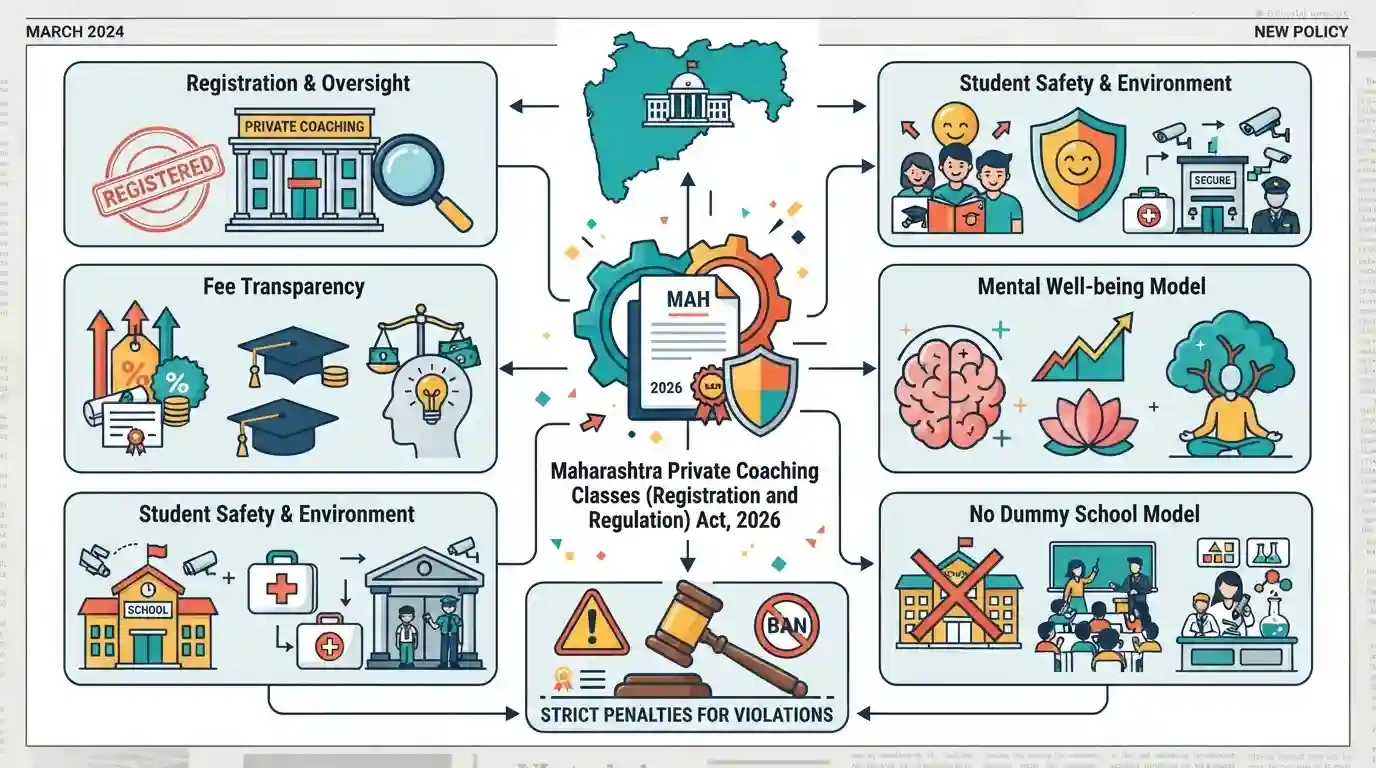
The Maharashtra government introduced the draft Maharashtra Private Coaching Classes (Registration and Regulation) Act, 2026, aimed at bringing the sprawling private coaching and tuition industry under a legal framework. The bill addresses student safety, mental well-being, fee transparency, qualifications of tutors, and bans the dummy school model while imposing strict penalties for violations.
Key Points
- The Maharashtra government released the draft Maharashtra Private Coaching Classes (Registration and Regulation) Act, 2026 to regulate private coaching centers and protect student welfare.
- Key provisions include minimum qualification of graduation for teachers, prohibition of enrolling students under 13 years of age, and a ban on coaching classes operating from basements.
- The bill explicitly prohibits the 'dummy school model' and dual employment of school teachers in private coaching centers.
- Violations are categorized as major and minor, carrying heavy penalties ranging from ₹1 lakh to ₹50 lakh and cancellation of registration.
Important Terms
Maharashtra Private Coaching Classes (Registration and Regulation) Act 2026

A proposed state legislation to regulate private coaching institutes having over 25 students. It mandates registration, bans basement operations and dummy schools, caps study hours, and penalizes misleading ads.
UPSC context
MPSC Polity & Governance: Tests knowledge of state-level legislative interventions, education policy, and regulation of commercial coaching hubs.
POCSO Act
The Protection of Children from Sexual Offences Act, 2012, designed to protect children under 18 from sexual assault, harassment, and pornography with strict legal procedures.
UPSC context
MPSC Social Welfare & Governance: Tests legal frameworks for child protection, student safety, and institutional compliance in educational settings.
POSH Act
The Sexual Harassment of Women at Workplace (Prevention, Prohibition and Redressal) Act, 2013, which mandates safe working and studying environments and internal complaints mechanisms.
UPSC context
MPSC Social Justice: Tests gender rights, workplace safety mandates, and regulatory accountability in public and private institutions.
School Education Department Maharashtra
The principal administrative body of the Maharashtra government responsible for formulating, implementing, and supervising school education policies, curriculum frameworks, and state educational institutions.
UPSC context
MPSC Public Administration: Tests state administrative machinery, bureaucratic structure, and governance of school education in Maharashtra.
Static Concepts Connected
What are the constitutional provisions and legislative competence regarding education in India?
- Concurrent List: Education was moved from the State List to the Concurrent List (Entry 25) by the 42nd Constitutional Amendment Act, 1976.
- Legislative Competence: State legislatures retain competence to enact specific complementary laws like private coaching regulation to protect child rights and public health.
Cross-Topic Patterns
Coaching Regulation vs. Consumer Protection Frameworks
The crackdown on dummy schools connects state educational legislation with national NEET/JEE competitive exam reforms and consumer protection frameworks.

Maharashtra Coaching Act + NEP 2020 regulatory guidelines will likely feature as a statement-based question in MPSC mains/prelims.
Linked PYQs · 1
Linked PYQs · 1
- 2024MPSC_PRELIMSGS1
Match the following pairs : | List-I | List-II | |---|---| | (a) Dr. Nitin Karmalkar Committee | (i) For implementation of National Education Policy - 2020 in Maharashtra | | (b) Nitin Karir Committee | (ii) To enquire the incident which happened during the distribution of Maharashtra Bhushan Award | | (c) Sunil Pawar Committee | (iii) To study why the rates of onion collapse. | | (d) Dr. K. Kasturirangan Committee | (iv) To make the syllabus for pre-primary to degree according to National Education Policy - 2020 | Code: (a) (b) (c) (d)
