Vertical Industrial Development Policy in Maharashtra
Source:Indian Express ↗
Why It Matters
Important for MPSC aspirants tracking Maharashtra's industrial policies, economic initiatives, and urban-industrial planning strategies to address land scarcity.
Summary
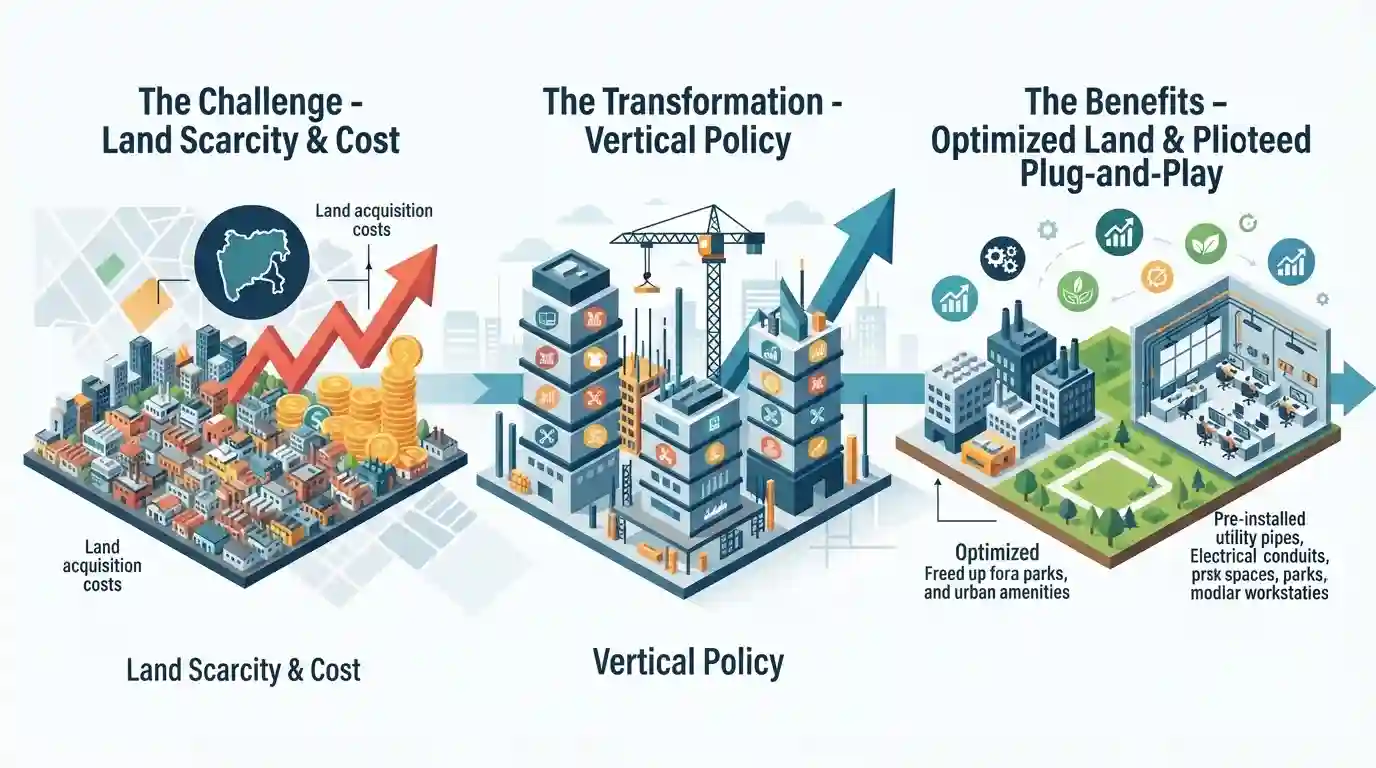
The Maharashtra government is formulating a Vertical Industrial Development Policy to tackle acute land scarcity and soaring land acquisition costs. By promoting multi-storeyed factories and vertical industrial clusters, the state aims to optimize land use, encourage plug-and-play infrastructure, and sustain industrial growth.
Key Points
- Maharashtra is planning a new Vertical Industrial Development Policy to address land crunch and rising acquisition costs for industrial expansion.
- The policy aims to encourage multi-storeyed industrial buildings, plug-and-play infrastructure, and vertical factories, particularly in urban and semi-urban industrial clusters.
- This shift moves away from traditional horizontal land-intensive industrial expansion toward optimal space utilization and higher employment generation per unit of land.
Important Terms
Vertical Industrial Development Policy

A state policy initiative designed to promote multi-storeyed factories and vertical industrial clusters to combat acute land scarcity and soaring land acquisition costs.
UPSC context
MPSC Economy & Governance: Tests knowledge of state-level industrial growth strategies, urban infrastructure planning, and policy response to land scarcity.
Maharashtra Industrial Development Corporation (MIDC)
The premier industrial infrastructure development agency of the Maharashtra government responsible for promoting industrial growth, land allocation, and investment facilitation across the state.
UPSC context
MPSC Economy & Maharashtra Geography: Tests understanding of institutional mechanisms for industrialization, special economic zones, and infrastructure development.
Maharashtra Government
The executive organ responsible for governance, formulating economic policies, and administering industrial and welfare schemes within the state of Maharashtra.
UPSC context
MPSC Polity & Governance: Tests knowledge of state executive functioning, administrative decision-making, and state-level policy formulation.
Prelims Trap
MIDC operates primarily as a central public sector undertaking under the Ministry of Commerce and Industry.
Aspirants often assume MIDC functions solely under central industrial acts, whereas it is a state-level statutory body created under a specific Maharashtra state legislature act of 1962.
Static Concepts Connected
What are the primary functions and powers of the Maharashtra Industrial Development Corporation (MIDC)?
- Statutory Origin: Established in 1962 under the Maharashtra Industrial Development Act to promote and secure orderly industrial growth across the state.
- Core Mandate: Acts as the premier industrial infrastructure arm, undertaking land acquisition, development of industrial areas, and provision of basic amenities.
- Land Powers: Empowered to acquire land under the MID Act, develop infrastructural facilities like roads, water supply, and drainage, and lease or sell plots to entrepreneurs.
Cross-Topic Patterns
Urban Land Economics vs. Regional Disparities
As Maharashtra pivots to vertical industrialization to conserve land, regional imbalances are addressed through the Eastern Vidarbha Industrial Corridor, balancing urban land constraints with rural development in Nagpur and Gadchiroli.
MIDC Land Reforms and Municipal Infrastructure
Transitioning from horizontal land acquisition (MIDC) to vertical multi-storey clusters mirrors urban FSI policy shifts, directly impacting municipal finances, fire safety norms, and decentralized industrial employment.

Maharashtra's industrial policies (MIDC, vertical clusters, Vidarbha corridor) are perennial MPSC favorites for matching lists.
Linked PYQs · 1
Linked PYQs · 1
- 2026MPSC_PRELIMSGS1
Observe the following statements. (a) As per the State Mineral Policy 1999, iron, sulphur, gold, copper and lead mineral production was opened to the private sector. (b) Konkan region has the highest mineral availability after Nagpur region. (c) Maharashtra State Mining Corporation was established in 1973.
