Four-Year Undergraduate Reform in Maharashtra Higher Education
Why It Matters
Important for MPSC aspirants tracking state-level implementation of national educational frameworks and structural reforms in Maharashtra's higher education system.
Summary
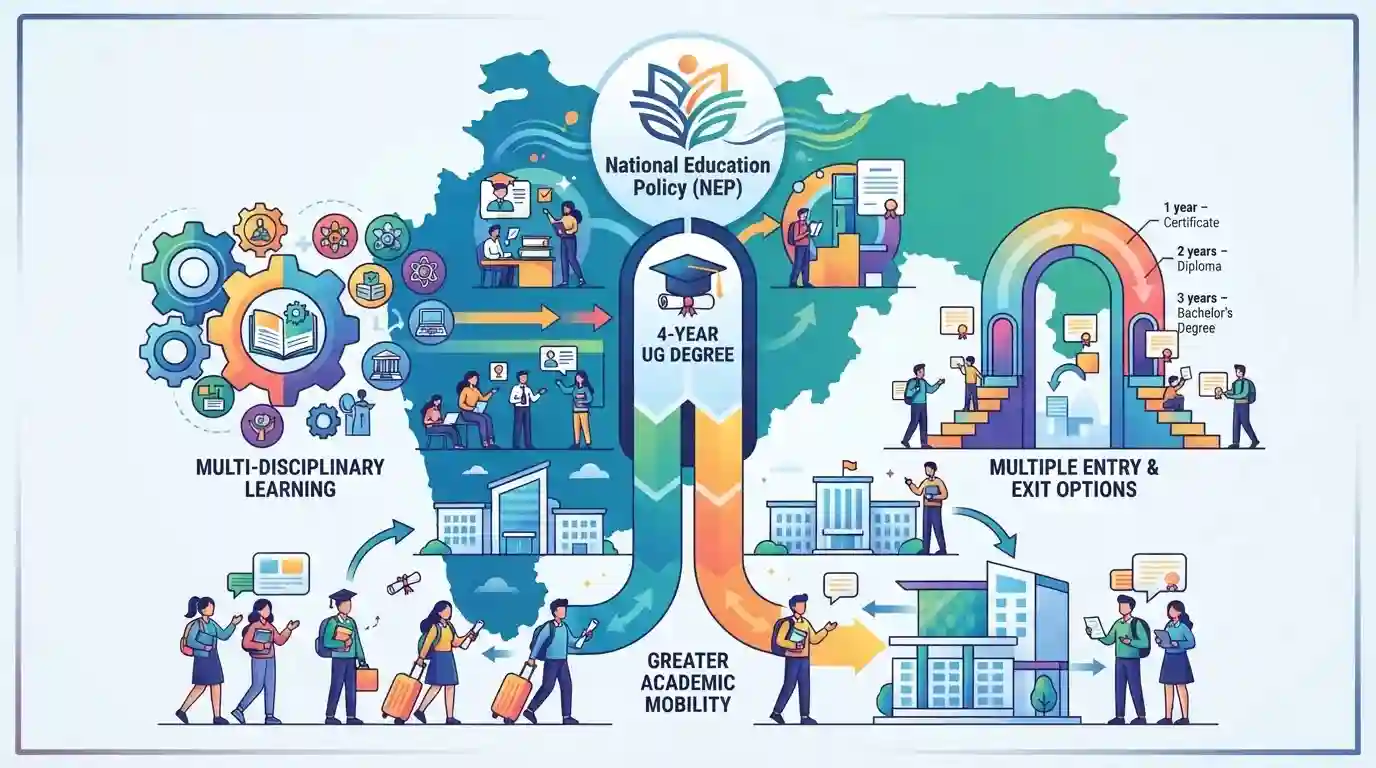
Maharashtra is implementing Harvard-style educational flexibility in higher education institutions via a 4-year Undergraduate (UG) reform under the National Education Policy (NEP), as announced by Higher and Technical Education Minister Chandrakant Patil. The move focuses on multi-disciplinary learning, multiple entry and exit options, and greater academic mobility for students across colleges in the state.
Key Points
- Maharashtra is rolling out Harvard-style educational flexibility across its colleges through a 4-year Undergraduate (UG) program reform.
- Announced by Higher and Technical Education Minister Chandrakant Patil, the initiative aligns with the National Education Policy (NEP) framework.
- The reform aims to provide students with multi-disciplinary learning options, multiple entry and exit points, and customizable academic pathways.
Important Terms
National Education Policy (NEP) 2020

A comprehensive policy framework approved by the Union Cabinet in 2020 to overhaul India's education system from school to higher education, emphasizing foundational literacy, multidisciplinary learning, critical thinking, and flexible curricula.
UPSC context
MPSC / MPSC Rajyaseva Mains GS Paper II: Tests knowledge of educational reforms, governance policies, and human resource development in India.
Academic Bank of Credits (ABC)
A digital credit repository established under NEP 2020 that functions like a bank account for academic credits, enabling students to accumulate, transfer, and redeem credits across multiple recognized institutions.
UPSC context
MPSC Rajyaseva Mains GS Paper II (Governance and Social Sector): Tests understanding of digital governance and higher education flexibility reforms.
Prelims Trap
Making 4-year undergraduate degree mandatory for all students without any intermediate exit options.
Aspirants often confuse the 4-year undergraduate reform with compulsory 4-year study; however, NEP 2020 and its state implementations provide multiple exit options (e.g., certificate after 1 year, diploma after 2 years, degree after 3 years).
Static Concepts Connected
What are the key structural features of the National Education Policy (NEP) 2020 for Higher Education?
- 4-Year UG Program: Introduction of a 4-year multidisciplinary bachelor's degree with multiple entry and exit options.
- Academic Credits: Establishment of an Academic Bank of Credits (ABC) to digitally store and transfer academic credits earned.
- Regulatory Body: Creation of the Higher Education Commission of India (HECI) as a single overarching umbrella body.
Cross-Topic Patterns
NEP 2020 implementation and federal UGC guidelines
Maharashtra's implementation of 4-year UG reforms under NEP 2020 directly intersects with federal UGC guidelines on academic bank of credits and inter-university student mobility.

NEP 2020 structural reforms, multi-entry/exit features, and state-level adoption (Maharashtra) frequently appear in multi-statement prelims.
Linked PYQs · 3
Linked PYQs · 3
- 2026MPSC_PRELIMSGS1
Which of the following statement/s given is/are correct ? (a) The National Institutional Ranking Framework provides a methodology to rank educational institutions across the country. (b) The National Institutional Ranking Framework (NIRF) was launched in 2020. (c) The ranking is based on five parameters. (d) Indian Institute of Technology Madras tops in the Sustainable Development Goals (SDGs) category.
- 2024MPSC_PRELIMSGS1
What were the main principles of the National Education Policy of 1968 based on the recommendations of the Kothari Commission ? (a) Compulsory and free education till the age of 14 years. (b) Higher position and improved pay for teachers. (c) At least 10% of gross national income spent on education.
- 2018MPSC_PRELIMSGS1
Out of the following statements about the regulatory body in the field of higher education, which is not correct ?
