Maharashtra Undergraduate Curriculum Reforms in Higher Education
Why It Matters
Important for understanding state-level implementation of national education reforms and structural changes in higher education governance in Maharashtra.
Summary
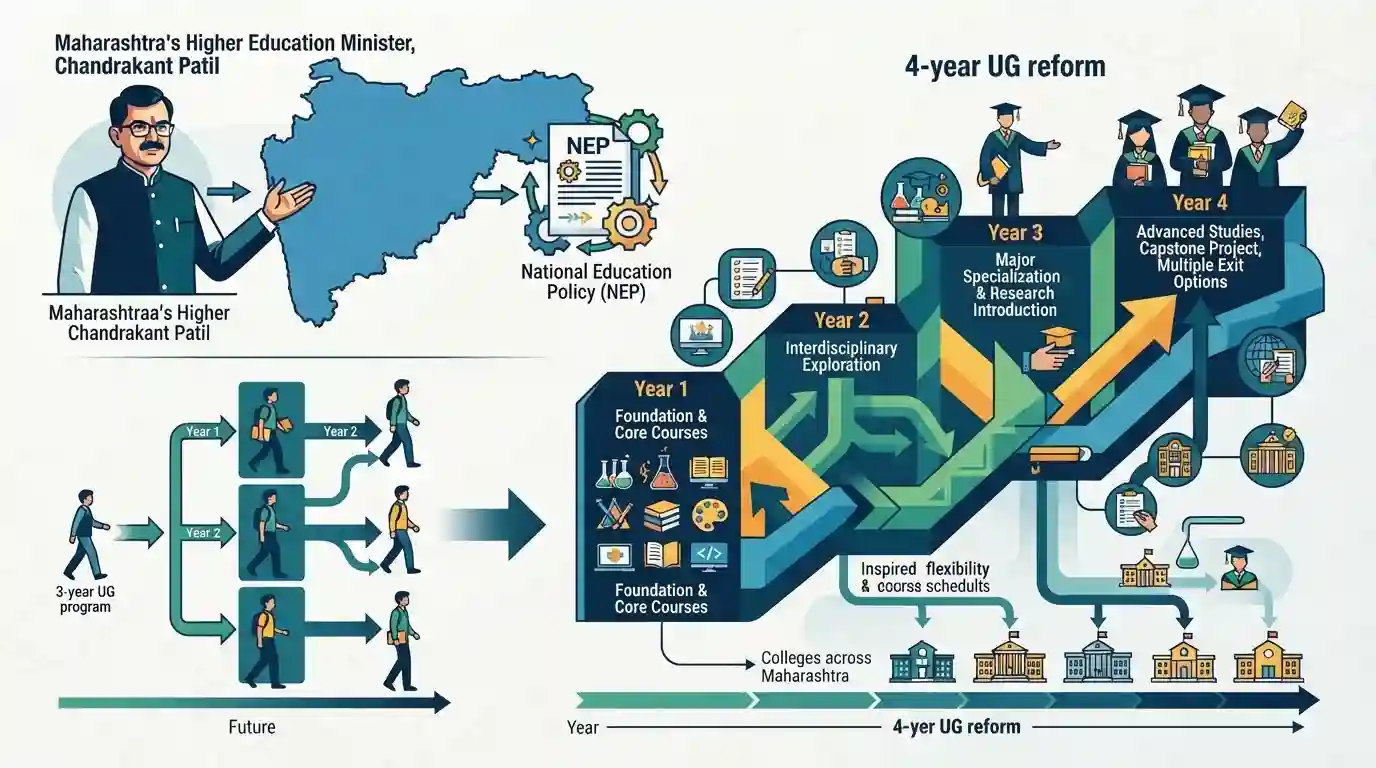
Maharashtra Higher Education Minister Chandrakant Patil announced plans to introduce Harvard-style academic flexibility across colleges in the state through a 4-year undergraduate (UG) reform under the National Education Policy (NEP).
Key Points
- Maharashtra is planning to implement Harvard-style academic flexibility in colleges through a 4-year undergraduate (UG) degree reform.
- State Higher Education Minister Chandrakant Patil announced the initiative to overhaul the higher education framework in alignment with modern global standards and multidisciplinary approaches.
- The 4-year undergraduate program will offer multiple entry and exit options, major and minor subject combinations, and enhanced research components.
Important Terms
National Education Policy (NEP) 2020

India's overarching educational roadmap replacing the 1986 policy, promoting multi-disciplinary higher education, flexible 4-year undergraduate programs, multiple entry-exit options, and research orientation.
UPSC context
Crucial for MPSC General Studies Papers (Education, Governance, and Social Sector Policies); tests policy formulation and higher education restructuring.
Government of Maharashtra
The sub-national administrative body of Maharashtra executing policy decisions, state budget allocations, and statutory reforms across universities and colleges via the Higher Education Department.
UPSC context
Vital for MPSC State Polity and Governance; tests state-level administrative machinery, ministerial portfolios, and policy implementation.
Prelims Trap
Multiple entry-exit options mean students can secure an equivalent master's degree within the 4-year UG duration.
Aspirants might confuse the 4-year UG structure's exit awards with standard post-graduate degrees, whereas a 2-year exit gives a diploma and a 3-year exit gives a bachelor's degree.
Static Concepts Connected
What are the key structural pillars and exit options under the National Education Policy (NEP) 2020 undergraduate reforms?
- Exit Options: The 4-year undergraduate program offers multiple entry and exit options, granting a UG Certificate after 1 year, UG Diploma after 2 years, Bachelor's Degree after 3 years, and Bachelor's (Honours/Research) after 4 years.
- Credit Mobility: The Academic Bank of Credits (ABC) digital platform facilitates students to store, transfer, and redeem academic credits across recognized Higher Education Institutions seamlessly.
- Multidisciplinary Focus: The curriculum promotes a multidisciplinary approach combining arts, science, and vocational education with a core emphasis on critical thinking and skill development.
Cross-Topic Patterns
NEP 2020 Implementation + State Fiscal Federalism
The implementation of NEP 2020 structures connects state-level administrative autonomy with federal higher education financing under SSA and Rashtriya Uchchatar Shiksha Abhiyan (RUSA).

NEP 2020 four-year undergraduate framework, Academic Bank of Credits (ABC), and state-level structural reforms will feature in MPSC Mains Paper II.
Linked PYQs · 2
Linked PYQs · 2
- 2026MPSC_PRELIMSGS1
Which of the following statement/s given is/are correct ? (a) The National Institutional Ranking Framework provides a methodology to rank educational institutions across the country. (b) The National Institutional Ranking Framework (NIRF) was launched in 2020. (c) The ranking is based on five parameters. (d) Indian Institute of Technology Madras tops in the Sustainable Development Goals (SDGs) category.
- 2024MPSC_PRELIMSGS1
What were the main principles of the National Education Policy of 1968 based on the recommendations of the Kothari Commission ? (a) Compulsory and free education till the age of 14 years. (b) Higher position and improved pay for teachers. (c) At least 10% of gross national income spent on education.
