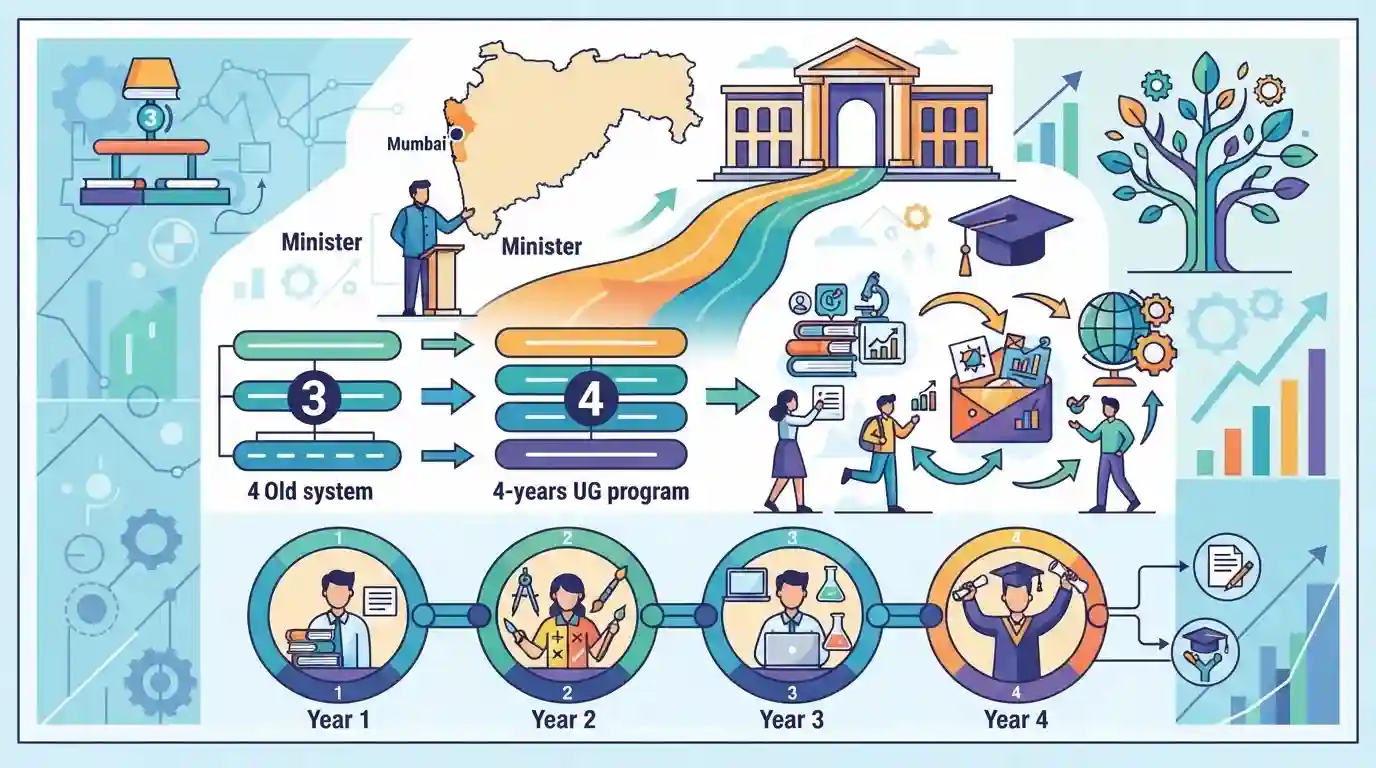
Maharashtra Higher Education Four Year Undergraduate Reform
Why It Matters
Important for understanding state-level implementation of national educational frameworks like NEP 2020 and structural reforms in higher education in Maharashtra.
Summary
Maharashtra Higher and Technical Education Minister Chandrakant Patil announced plans to introduce Harvard-style academic flexibility in state colleges through the implementation of the 4-year undergraduate (UG) education reforms aligned with the National Education Policy (NEP).
Key Points
- Maharashtra is planning Harvard-style flexibility in colleges through the implementation of the 4-year undergraduate (UG) reform under the National Education Policy (NEP).
- State Higher and Technical Education Minister Chandrakant Patil highlighted that the reform aims to offer flexible learning pathways, multiple entry and exit options, and multidisciplinary education for students.
- The initiative intends to modernize higher education infrastructure and curriculum alignment in Maharashtra colleges.
Important Terms
National Education Policy (NEP) 2020

Comprehensive policy framework replacing the 1986 policy, aiming to overhaul India's education system from school to higher education by introducing multidisciplinary learning, flexible entry-exit options, and skill development.
UPSC context
Crucial for MPSC Paper II (Governance and Social Sector) and Paper III (Human Resource Development), testing knowledge of educational reforms and structural changes in governance.
4-Year Undergraduate Programme (FYUP)
An undergraduate degree structure aligned with the NEP offering multiple exit and entry points, multidisciplinary choices, and specialized tracks including Honours and Honours with Research.
UPSC context
Important for MPSC educational schemes, higher education restructuring, and employment/skill development policies under GS Paper II and III.
Government of Maharashtra
The executive branch of the state government of Maharashtra, responsible for formulating state-level policies, legislation, and implementing central directives like the NEP across regional universities and colleges.
UPSC context
Relevant for MPSC Paper I (Maharashtra Polity and Administration), testing administrative frameworks, executive actions, and implementation of state policies.
Static Concepts Connected
What are the key structural features of the National Education Policy (NEP) 2020 for higher education?
- FYUP Structure: Introduction of a 4-year multidisciplinary undergraduate degree with multiple entry and exit options.
- Credit Bank: Establishment of an Academic Bank of Credits (ABC) to digitally store academic credits earned from recognized HEIs.
- Single Regulator: Creation of the Higher Education Commission of India (HECI) as a single overarching umbrella body.
Cross-Topic Patterns
NEP 2020 & Academic Bank of Credits (ABC)
The NEP 2020 framework is deeply linked to the Academic Bank of Credits (ABC) platform, connecting state higher education reforms with national digital public infrastructure.
Federalism & State Higher Education Committees
State-level implementation committees like the Nitin Karmalkar Committee reflect how center-state cooperative federalism shapes higher education policy execution.

NEP 2020 4-year UG structure & multiple entry/exit options will likely feature in MPSC polity/governance objective questions.
Linked PYQs · 2
Linked PYQs · 2
- 2024MPSC_PRELIMSGS1
Match the following pairs : | List-I | List-II | |---|---| | (a) Dr. Nitin Karmalkar Committee | (i) For implementation of National Education Policy - 2020 in Maharashtra | | (b) Nitin Karir Committee | (ii) To enquire the incident which happened during the distribution of Maharashtra Bhushan Award | | (c) Sunil Pawar Committee | (iii) To study why the rates of onion collapse. | | (d) Dr. K. Kasturirangan Committee | (iv) To make the syllabus for pre-primary to degree according to National Education Policy - 2020 | Code: (a) (b) (c) (d)
- 2026MPSC_PRELIMSGS1
Which of the following statement/s given is/are correct ? (a) The National Institutional Ranking Framework provides a methodology to rank educational institutions across the country. (b) The National Institutional Ranking Framework (NIRF) was launched in 2020. (c) The ranking is based on five parameters. (d) Indian Institute of Technology Madras tops in the Sustainable Development Goals (SDGs) category.
