Essential Commodities Act: Sugar Stock Limits And Inspection Drives
Source:chinimandi ↗
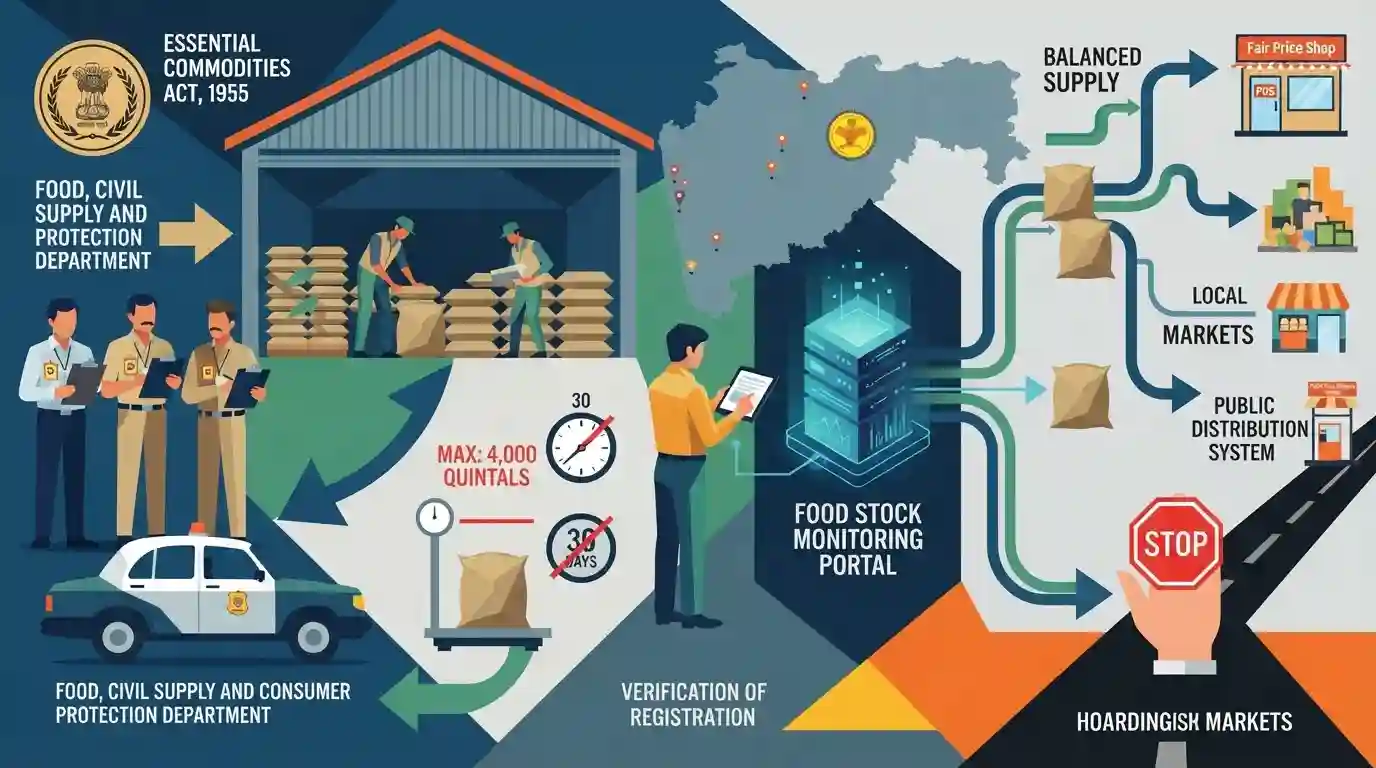
Why It Matters
Government regulation of agricultural commodities under the Essential Commodities Act is a fundamental tool for controlling supply-side inflation and ensuring food security. The sugar industry holds vast political and economic weight in Maharashtra, making its regulation a crucial area of state governance.
Summary
The Maharashtra government's Food, Civil Supply and Consumer Protection Department has initiated a statewide inspection drive to enforce sugar stock limits set by the Central government. By invoking the Essential Commodities Act, 1955, authorities aim to prevent hoarding and black marketing. District-level squads will inspect stocks, ensuring compliance with the maximum limit of 4,000 quintals and 30-day storage caps, while also verifying registration on the Food Stock Monitoring Portal.
Key Points
- The Maharashtra government ordered a joint inspection drive to enforce central limits on sugar stocks held by sellers, wholesalers, and distributors.
- Under the Essential Commodities Act, 1955, the Central government has restricted sugar stock limits to a maximum of 4,000 quintals (400 MT) and a 30-day time limit.
- District-level verification squads led by the District Supply Officer and Deputy Registrar of Cooperative Societies will inspect godowns for hoarding or black marketing.
- Violators of the stock limits or those failing to register on the Food Stock Monitoring Portal will face penal action under the Essential Commodities Act.
Important Terms
Essential Commodities Act, 1955

A central law regulating the production, supply, and distribution of essential goods. It empowers authorities to impose stock limits to prevent hoarding, black marketing, and supply-side inflation.
UPSC context
Highly relevant for GS-3 (Economy), testing knowledge of government interventions to control food inflation and ensure market stability.
Food Stock Monitoring Portal
A digital platform mandated by the Central Government where sugar sellers, distributors, and bulk consumers must register and update their physical inventory weekly to verify compliance with stock limits.
UPSC context
Tests GS-2 (E-Governance) and GS-3 (Food Security), illustrating how digital tools monitor supply chains and curb hoarding.
Food, Civil Supply and Consumer Protection Department
The Maharashtra government body executing central directives on food security. It conducts state-wide joint inspections to enforce stock limits, oversee the Public Distribution System, and curb artificial supply bottlenecks.
UPSC context
Covers GS-2 (State Governance) and GS-3 (PDS), testing understanding of the state-level administrative machinery regulating essential commodities.
Directorate of Sugar (Commissionerate of Sugar)
The regulatory and developmental body for Maharashtra's sugar industry. Elevated to Commissionerate status in 1992, it oversees cooperative factories, grants crushing licenses, and regulates sugar stock management.
UPSC context
Crucial for MPSC GS-1 (Agro-based industries) and GS-3 (Cooperative Sector), highlighting the socio-economic backbone of rural Maharashtra.
Prelims Trap
"The Essential Commodities Act, 1955 explicitly outlines the economic and nutritional criteria for a commodity to be declared 'essential'."
The ECA contains no statutory definition or specific criteria for 'essential commodities'. It simply applies to any item the Central Government chooses to list in the Act's Schedule.
Static Concepts Connected
What are the milestones of the cooperative sugar movement in Maharashtra?
- Key Pioneers: Padmashree Vithalrao Vikhe Patil and economist Dhananjayrao Gadgil pioneered the cooperative model for sugar in the state.
- First Factory: Pravara Sahakari Sakhar Karkhana (Ahmednagar) was commissioned in 1950-51, becoming Asia's first successful cooperative sugar factory.
- Current Dominance: Driven by this cooperative model, Maharashtra frequently ranks as India's top sugar producer, with regions like Kolhapur leading output.
How does the Essential Commodities Act, 1955 function to control prices?
- Schedule Mechanism: The Centre can add or remove items from the Schedule (e.g., drugs, fertilizers, pulses, sugar) to regulate their production, supply, and distribution.
- Centre-State Enforcement: The Central government imposes stock limits to prevent hoarding, while State governments enforce these limits through district-level inspections and penal actions.
- Digital Tracking: The Food Stock Monitoring Portal is used to track real-time inventory of wholesale and retail distributors to prevent artificial scarcity.
Cross-Topic Patterns
Sugar cooperatives and regional political economy
The origin of the cooperative sugar movement in Western Maharashtra (Ahmednagar, Kolhapur) is fundamentally linked to the region's current political economy, irrigation infrastructure, and agricultural dominance in the state.
ECA as an inflation management tool
Invoking the ECA to curb hoarding is a classic administrative intervention used to manage supply-side food inflation, complementing the RBI's monetary policy during price spikes.

Expect a multi-statement question combining the history of Maharashtra's sugar cooperatives with the statutory provisions of the ECA 1955.
Linked PYQs · 3
Linked PYQs · 3
- 2007MPSC_PRELIMSGS1
In which district of Maharashtra the first co-operative sugar factory was established ?
- 2022MPSC_PRELIMSGS1
Given the importance of supply side factors in determination of inflation in India, following long-term policies are likely to help. (a) Changing production patterns (b) Calibrated import policy (c) Focus on transportation (d) Storage infrastructure for perishable commodities
- 2026MPSC_PRELIMSGS1
Consider the following statements regarding the Public Distribution System (PDS) in Maharashtra. (a) By December 2025, there were 270.48 lakh ration card holders in the state. (b) As of 31 October 2025, 51,636 Fair price shops were functioning in the state. (c) By October 2025, about 1.55 crore families received food grains through Aadhaar - based biometric authentication. Which of the statements given above is/are correct ?
