Maharashtra Onion Farmers Crisis and Export Policy Impact
Source:Indian Express ↗
Why It Matters
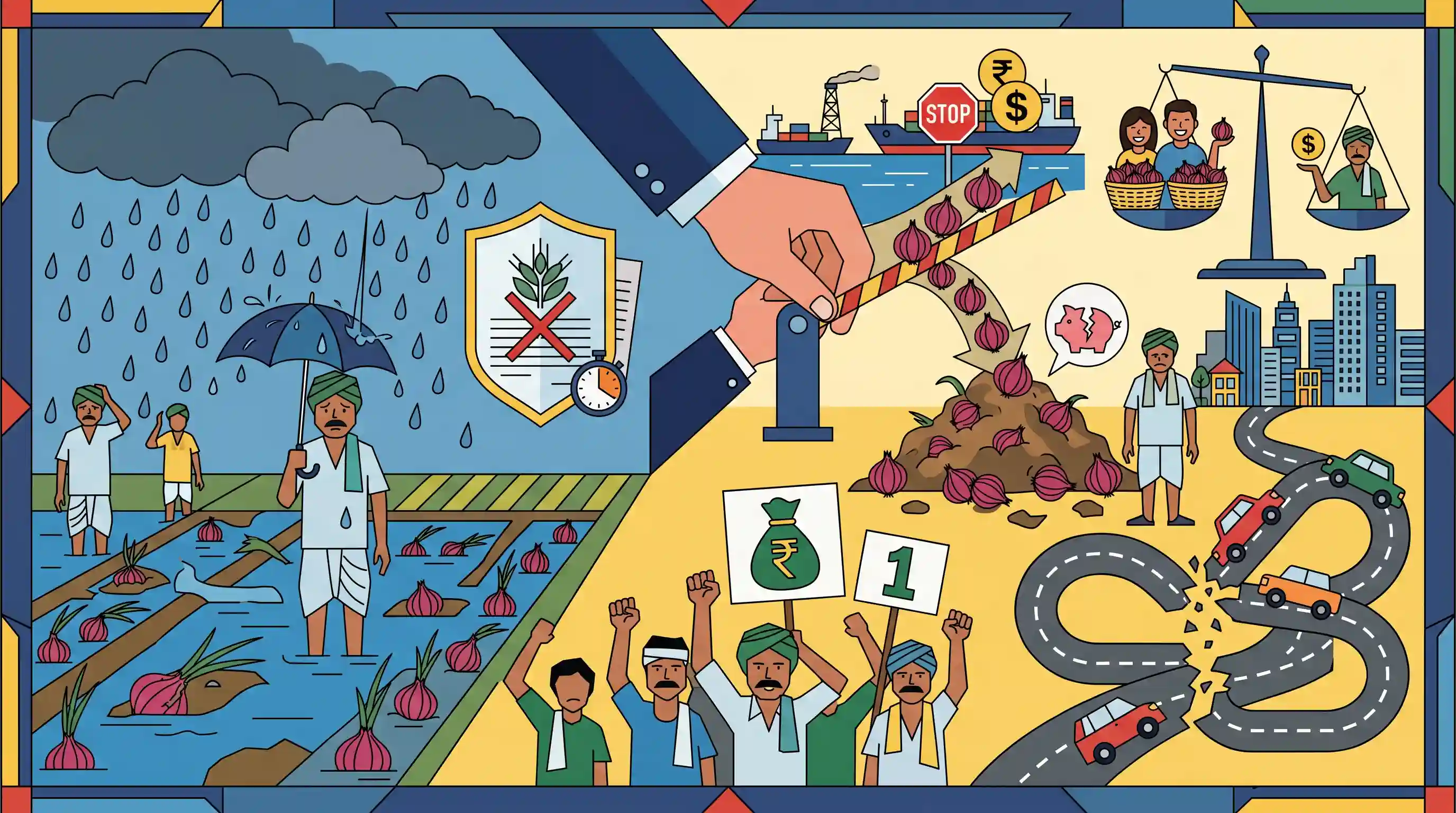
This issue encapsulates the core GS3 dilemma of balancing inflation control with doubling farmers' income. It provides a real-world case study on the adverse impacts of abrupt export policies (Essential Commodities Act interventions) and climate vulnerability on Indian agriculture.
Summary
Onion farmers in Maharashtra are protesting and demanding Rs 1 lakh per acre in compensation to recover from massive financial losses. Their distress stems from a combination of severe weather anomalies, such as unseasonal rains that damage crops, and restrictive government interventions in agricultural trade. To curb domestic inflation, the Union government frequently bans onion exports or imposes a high Minimum Export Price (MEP). While these measures protect urban consumers from price shocks, they lead to a sudden collapse in domestic wholesale prices, devastating farmers' incomes. This recurring issue underscores systemic bottlenecks in agricultural marketing, the urban consumer bias in trade policies, and the limitations of existing crop insurance frameworks like PMFBY in providing timely relief.
Key Points
- Maharashtra onion farmers are demanding a compensation of Rs 1 lakh per acre due to severe financial distress caused by recurring crop losses and price crashes.
- The agrarian distress is often triggered by erratic weather events, such as unseasonal rains and hailstorms, which destroy both standing and harvested crops.
- Restrictive government trade policies—specifically sudden export bans or the imposition of a high Minimum Export Price (MEP) aimed at controlling domestic inflation—lead to a domestic supply glut, drastically reducing wholesale prices at mandis.
- The crisis highlights the structural tension in Indian agricultural policy: balancing urban consumer inflation control against the need for remunerative farm incomes.
- The demand for ad-hoc compensation exposes gaps in the coverage, claim settlement, and overall effectiveness of formalized crop insurance schemes like PMFBY.
Important Terms
Minimum Export Price (MEP)

A government-set floor price below which a commodity cannot be exported. It is used to restrict exports, ensure domestic availability, and curb internal inflation.
UPSC context
GS Paper 3: Agricultural trade policy; tests understanding of trade-offs between export earnings and domestic food security.
Pradhan Mantri Fasal Bima Yojana (PMFBY)
India's flagship crop insurance scheme providing financial support to farmers against losses from natural calamities, pests, and diseases, with premiums subsidized by Central and State governments.
UPSC context
GS Paper 2 & 3: Welfare schemes and agricultural risk management; critical for evaluation of farmer safety nets.
Agricultural Produce Market Committee (APMC)
State-mandated marketing boards that operate 'mandis' to regulate the sale of agricultural produce, aiming to eliminate exploitation by intermediaries and ensure fair price discovery through auctions.
UPSC context
GS Paper 3: Agricultural marketing reforms; essential for understanding domestic trade bottlenecks and farmer income issues.
Essential Commodities Act (ECA)
A 1955 legislation empowering the Union government to regulate the production, supply, and distribution of specific commodities to prevent hoarding and ensure affordability for consumers.
UPSC context
GS Paper 3: Food security and inflation management; focuses on legal frameworks for state intervention in markets.
NAFED and NCCF
Central agencies responsible for procuring and selling agricultural commodities like onions to build buffer stocks and stabilize domestic prices under government directives.
UPSC context
GS Paper 3: Public procurement and price stabilization; relevant for the role of state-led market interventions.
Prelims Trap
The government announces a Minimum Support Price (MSP) for onions to protect farmers from price crashes.
Onions are not part of the 22 mandated MSP crops. Their price volatility is managed via the Price Stabilization Fund and Market Intervention Scheme.
Static Concepts Connected
How does the Minimum Export Price (MEP) function in agricultural trade?
- Definition: A floor price below which exports of a specific commodity are legally prohibited.
- Primary Objective: To restrict the outflow of essential domestic commodities (like onions and rice) and contain domestic inflation.
- Impact on Farmers: It often creates a domestic supply glut, crashing local wholesale prices and denying farmers remunerative international rates.
What mechanisms manage price volatility for non-MSP horticultural crops?
- Price Stabilization Fund: Maintains a strategic buffer stock of essential commodities (like pulses and onions) to cool down market prices during shortages.
- Operation Greens: Expanded from TOP (Tomato, Onion, Potato) to TOTAL crops; aims to integrate value chains and reduce post-harvest losses.
- Market Intervention Scheme: An ad-hoc scheme for procuring perishables when market prices fall below the cost of production, sharing losses between Centre and States.
Cross-Topic Patterns
Macro Inflation Targeting vs. Farm Incomes
RBI's inflation targeting mandates frequent government intervention in food prices (export bans, MEP), directly pitting macroeconomic monetary stability against remunerative farmer incomes.
ECA Stock Limits and Agri-Infrastructure
Frequent invocation of the Essential Commodities Act to impose stock limits deters private sector investment in cold storage, undermining long-term supply chain resilience.

A multi-statement Prelims question contrasting MSP with MEP, and linking export bans to the Essential Commodities Act, is highly probable.
Linked PYQs · 4
Linked PYQs · 4
- 2020MainsGS3
What are the main constraints in transport and marketing of agricultural produce in India?
- 2022MainsGS3
What are the main bottlenecks in upstream and downstream process of marketing of agricultural products in India?
- 2016MainsGS3
Given the vulnerability of Indian agriculture to vagaries of nature, discuss the need for crop insurance and bring out the salient features of the Pradhan Mantri Fasal Bima Yojana (PMFBY).
- 2015PrelimsGS1
In India, markets in agricultural products are regulated under the
