Maharashtra Local Self Government Nominated Expert Members
Source:Indian Express ↗
Why It Matters
The capacity deficit of Panchayati Raj Institutions (PRIs) is a frequent UPSC theme. Introducing non-voting subject matter experts addresses the lack of technical expertise in local administration ('Functionality') while upholding the democratic structure created by the 73rd Constitutional Amendment.
Summary
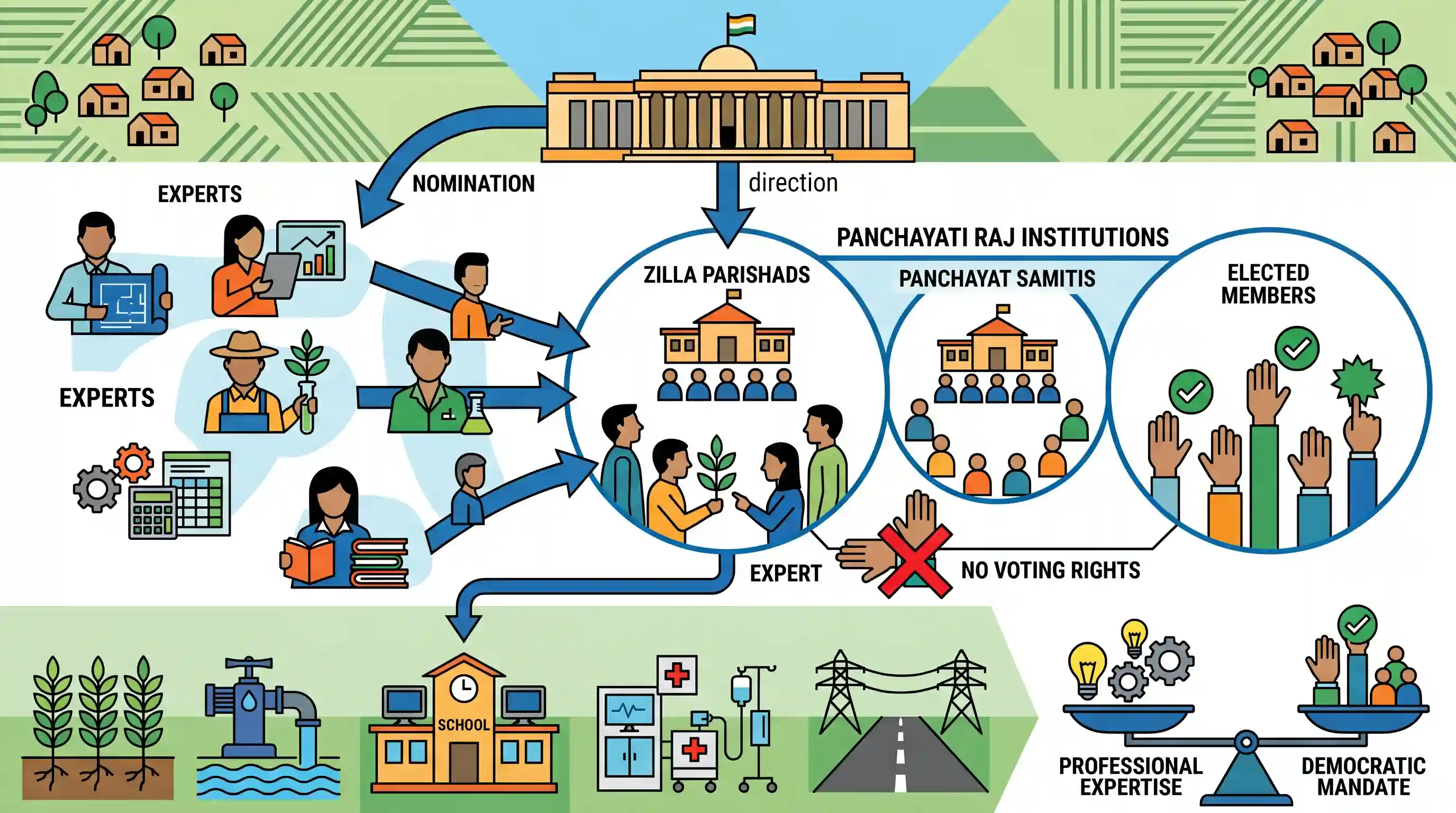
The Maharashtra government is set to introduce a significant rural policy shift by allowing the nomination of 'experts' to Zilla Parishads and Panchayat Samitis. While the move is designed to inject professional expertise into rural governance and address functional deficits in local bodies, the nominated members are expected to be denied voting rights to ensure the democratic balance and electoral mandate of the institutions are not disrupted.
Key Points
- The Maharashtra government is planning to induct nominated 'experts' into rural local bodies, namely Zilla Parishads and Panchayat Samitis.
- The objective is to utilize specialized professional knowledge to improve rural development planning, governance, and policy implementation at the grassroots level.
- To preserve the democratic mandate of the local bodies, these nominated experts will reportedly not be granted voting rights.
- This reform highlights an effort to transition Panchayati Raj Institutions from being purely political entities into more functionally effective and capable administrative units.
Important Terms
Zilla Parishad

The district-level (apex) tier of the Panchayati Raj system, responsible for coordinating administration and implementing development programs across the rural areas of a district.
UPSC context
GS II: Governance/Polity; essential for understanding the three-tier structure and devolution of powers under the 73rd Amendment.
Panchayat Samiti
The intermediate tier of rural local government at the block or taluka level, acting as a link between Gram Panchayats and the Zilla Parishad.
UPSC context
GS II: Polity; tests knowledge of administrative hierarchy and functional coordination in local self-governance.
73rd Constitutional Amendment Act
The 1992 legislation that granted constitutional status to Panchayati Raj Institutions (PRIs), mandating a three-tier system, regular elections, and reservations for marginalized groups.
UPSC context
GS II: Constitution; a fundamental topic regarding grassroots democracy and socio-political representation in rural India.
Maharashtra Zilla Parishads and Panchayat Samitis Act, 1961
The primary state-specific legislation governing the formation, powers, and administrative functions of district and block-level rural local bodies in Maharashtra.
UPSC context
GS II: Local Government; relevant for studying how states exercise legislative authority over Panchayati Raj Institutions.
Nominated Members
Individuals appointed to a local body by the state government for their expertise or social work, typically without the right to vote in meetings.
UPSC context
GS II: Local Self-Government; tests understanding of institutional composition and the balance between expertise and democratic mandates.
Democratic Decentralization
The process of devolving functions, funds, and decision-making powers from central or state governments to locally elected bodies to enhance public participation.
UPSC context
GS II: Governance; central to discussions on public service delivery, local empowerment, and grassroots development.
Prelims Trap
The Constitution explicitly empowers State legislatures to nominate experts to Panchayats under Article 243C.
Article 243R explicitly allows expert nominations for Municipalities, but Article 243C lacks this parallel for Panchayats, only allowing ex-officio representation of MPs/MLAs.
Static Concepts Connected
How do expert nomination provisions differ between Panchayats and Municipalities?
- Article 243R (ULBs): Expressly empowers State Legislatures to nominate individuals with special knowledge in municipal administration, explicitly denying them voting rights.
- Article 243C (PRIs): Requires direct election for all seats. It allows ex-officio representation of MPs/MLAs but contains no explicit constitutional clause for nominating unelected experts.
What is the functional developmental mandate of Panchayats under Article 243G?
- Self-Government: States must endow Panchayats with the necessary powers and authority to function effectively as true institutions of self-government.
- Core Mandate: Their primary constitutional mandate is the preparation and implementation of plans for economic development and social justice.
- Eleventh Schedule: Involves the devolution of responsibilities and powers across 29 designated subjects, ranging from agriculture to rural electrification.
Cross-Topic Patterns
State List discretion in Local Bodies
Maharashtra’s move reflects Entry 5 of the State List. Similar discretionary powers are seen in states imposing educational qualifications or two-child norms for Panchayat elections.
Governance: Parastatals vs Elected PRIs
Nominating experts highlights a persistent capacity deficit in PRIs. It attempts to bridge the gap between pure political representation and the technical expertise required for rural development.

Expect a tricky 2026 prelims statement swapping Art 243C (Panchayats) and Art 243R (Municipalities) rules on expert nominations.
Linked PYQs · 3
Linked PYQs · 3
- 2015MainsGS2
In absence of a well-educated and organized local level government system, 'Panchayats' and 'Samitis' have remained mainly political institutions and not effective instruments of governance. Critically discuss.
- 2020MainsGS2
The strength and sustenance of local institutions in India has shifted from their formative phase of 'Functions, Functionaries and Funds' to the contemporary stage of 'Functionality'. Highlight the critical challenges faced by local institutions in terms of their functionality in recent times.
- 2017PrelimsGS1
Right to vote and to be elected in India is a
