New Primary School Curriculum Approved Under NEP Guidelines
Source:educationworld ↗
Why It Matters
Crucial for understanding state-level policy execution under the National Education Policy (NEP) 2020, focusing on primary education reforms in Maharashtra.
Summary
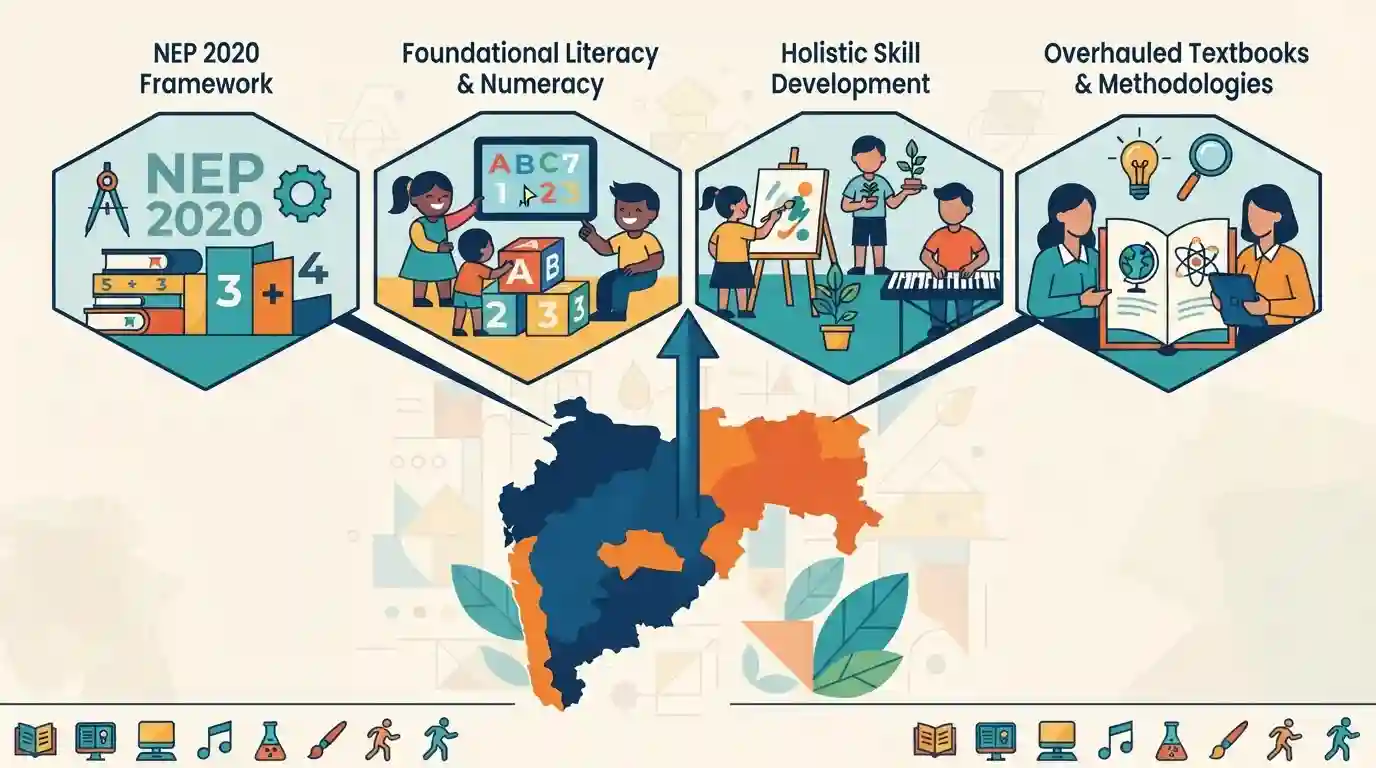
The Maharashtra state government has approved a new curriculum for primary classes, conforming to the guidelines and structural framework of the National Education Policy (NEP) 2020. The rollout emphasizes foundational literacy, numeracy, and holistic skill development through overhauled textbooks and instructional methodologies designed by state educational authorities.
Key Points
- Maharashtra has approved a new curriculum framework for primary classes aligned with the National Education Policy (NEP) 2020.
- The updated school curriculum aims to revamp foundational learning, textbooks, and pedagogical approaches across primary education in the state.
- The implementation is spearheaded by state educational bodies like SCERT Maharashtra and Balbharati.
Important Terms
National Education Policy (NEP) 2020

A comprehensive national policy framework introduced in 2020 to overhaul India's education system, replacing the 10+2 structure with a 5+3+3+4 design focusing on foundational literacy, numeracy, and holistic skill development.
UPSC context
MPSC Paper II (Governance, Social Sector - Education): Tests knowledge of major educational policy reforms, pedagogical structures, and implementation timelines.
SCERT Maharashtra
The state-level apex body in Maharashtra responsible for designing school curricula, teacher training guidelines, and foundational frameworks in alignment with NEP 2020.
UPSC context
MPSC Paper II (Educational Governance & Maharashtra Administration): Evaluates the administrative machinery responsible for executing state-level educational policy and curricular updates.
Balbharati
The Maharashtra State Bureau of Textbook Production and Curriculum Research, responsible for publishing state-board school textbooks and learning materials in compliance with the updated NEP curriculum.
UPSC context
MPSC Paper II / Maharashtra Governance: Tests understanding of state autonomous bodies and statutory institutions involved in executing educational policies and textbook distribution.
Prelims Trap
NCERT directly implements and distributes primary school textbooks across all districts in Maharashtra under the new NEP curriculum.
NCERT does not mandate state textbooks; autonomous state bodies like Balbharati and SCERT Maharashtra design and implement the state-specific curriculum under NEP 2020 guidelines.
Static Concepts Connected
What are the key structural changes introduced under the NEP 2020 school education framework?
- 5+3+3+4 Design: Replaces the old 10+2 system with a 5+3+3+4 design covering ages 3 to 18.
- Four Stages: Divides schooling into Foundational (5), Preparatory (3), Middle (3), and Secondary (4) stages.
- Early Childhood: Focuses heavily on early childhood care and education (ECCE) starting from age 3.
Cross-Topic Patterns
NEP 2020 & State Autonomy in Education
NEP 2020 decentralization allows states like Maharashtra to adapt primary curricula through SCERT and Balbharati while maintaining federal guidelines.
Foundational Literacy & Sustainable Development Goals
Transition to 5+3+3+4 schooling shifts focus from rote memorization to foundational literacy and numeracy as mandated by SDG 4.

Expect multi-statement questions on the 5+3+3+4 schooling structure and the roles of SCERT versus NCERT under NEP 2020.
Linked PYQs · 2
Linked PYQs · 2
- 2024MPSC_PRELIMSGS1
Match the following pairs : | List-I | List-II | |---|---| | (a) Dr. Nitin Karmalkar Committee | (i) For implementation of National Education Policy - 2020 in Maharashtra | | (b) Nitin Karir Committee | (ii) To enquire the incident which happened during the distribution of Maharashtra Bhushan Award | | (c) Sunil Pawar Committee | (iii) To study why the rates of onion collapse. | | (d) Dr. K. Kasturirangan Committee | (iv) To make the syllabus for pre-primary to degree according to National Education Policy - 2020 | Code: (a) (b) (c) (d)
- 2024MPSC_PRELIMSGS1
What were the main principles of the National Education Policy of 1968 based on the recommendations of the Kothari Commission ? (a) Compulsory and free education till the age of 14 years. (b) Higher position and improved pay for teachers. (c) At least 10% of gross national income spent on education.
